
Resource Recycling
  • The Latest
  • Analysis
    • All
    • Certification Scorecard
    • Industry Announcements
    • Opinion

    Certification Scorecard – Week of March 16, 2026

    Groups identify recovered plastics users in the Northeast

    Bale pricing for recycled plastics diverges

    Why global ITAD is stranded in the Gulf

    Why global ITAD is stranded in the Gulf

    Certification scorecard for the week of March 9, 2026

    Diversion Dynamics: Secondhand exports slow down fast fashion

    Certification scorecard for the week of March 2, 2026

    Industry announcements for January 2026

    Industry Announcements for March 2026

    HP receives ocean plastics certification

    HP Inc. earnings point to memory inflation challenge

    Certification scorecard for the week of Feb. 23, 2026

  • Conferences
  • Publications

    Other Topics

    Textiles
    Organics
    Packaging
    Glass
    Brand Owners

    Metals
    Technology
    Research
    Markets
    Grant Watch

    All Topics

Subscribe
No Result
View All Result
Resource Recycling
  • The Latest
  • Analysis
    • All
    • Certification Scorecard
    • Industry Announcements
    • Opinion

    Certification Scorecard – Week of March 16, 2026

    Groups identify recovered plastics users in the Northeast

    Bale pricing for recycled plastics diverges

    Why global ITAD is stranded in the Gulf

    Why global ITAD is stranded in the Gulf

    Certification scorecard for the week of March 9, 2026

    Diversion Dynamics: Secondhand exports slow down fast fashion

    Certification scorecard for the week of March 2, 2026

    Industry announcements for January 2026

    Industry Announcements for March 2026

    HP receives ocean plastics certification

    HP Inc. earnings point to memory inflation challenge

    Certification scorecard for the week of Feb. 23, 2026

  • Conferences
  • Publications

    Other Topics

    Textiles
    Organics
    Packaging
    Glass
    Brand Owners

    Metals
    Technology
    Research
    Markets
    Grant Watch

    All Topics

Subscribe
No Result
View All Result
Resource Recycling
No Result
View All Result
Home Analysis Opinion

In My Opinion: Have you checked for mercury in your workplace?

byPaul Abernathy
August 10, 2017
in Opinion
In My Opinion: Have you checked for mercury in your workplace?

Processing electronics and processing fluorescent lights are distinct sectors, but they share one important trait: Each carries a risk of exposing your facility and workers to mercury.

Despite that fact, the two sectors are regulated differently. Processors of lighting are regulated as “destination facilities” and are subjected to myriad Resource Conservation and Recovery Act (RCRA) compliance requirements for storage, testing and monitoring, worker health evaluations, inspections, downstream product uses and more. Electronics processors are generally not subject to the same levels of stringency and are not defined as hazardous waste processors.

Mercury is what makes energy-efficient lighting toxic and, therefore, regulated under RCRA and the Universal Waste Rule. Lighting is considered “characteristically hazardous” because levels of mercury found in lights typically fail the toxicity characteristic leaching procedure (TCLP) test, a common method of determining through chemical analysis whether a material is hazardous.

But electronics may not fail this test, even if the entire device could be ground up into beakers and tubes and subjected to the leaching reagents — something very impractical, if even possible. That means e-scrap processors may be unwittingly exposing their facilities to mercury and should test accordingly.

Mercury in devices

For several years, I went to e-scrap conferences and would often ask vendors and processors about mercury. Mostly I got blank stares or denials that any mercury was present in the materials they were disassembling or shredding.

Many people don’t realize that any device with a screen, backlighting or any type of visual display contain small amounts of mercury (it makes them light up). CRTs, cell phones, LCD and other flat panels, laptops, certain printers and medical imaging equipment all contain mercury, as do some batteries, switches, thermostats, instruments and so on.

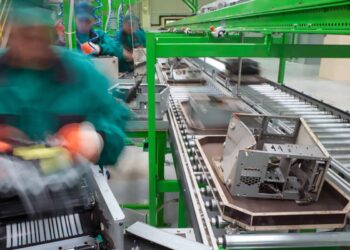
When these devices are breached by physical or mechanical separation, typically from hammer mills, shredders, magnetic separators or even eddy current sorting, they break and the mercury contained inside is released into the workplace. Although the mercury from one device is minute, collectively enough mercury can be released to be detected on equipment, walls and floors, in HVAC ducting and elsewhere. The emitted mercury vapor is almost impossible to find unless you look for it.

This phenomenon could present a risk to workers that would go unnoticed unless they are sent to toxicologists for urine and blood testing. Additionally, mercury vapor, which is invisible, odorless, colorless and tasteless, can be detected by government inspectors or industrial hygienists.

Simple steps to know where you stand

Aaron Blum, co-founder and chief operating officer at ERI, one of the e-scrap industry leaders, describes the steps ERI takes to ensure mercury does not become a problem in the workplace. ERI handles mercury-containing devices such as LCD televisions/monitors, as well as all-in-one scanners and copiers.

“We do in-depth training on the proper way to hand-dismantle these items in order to prevent breakage of the mercury tubes,” Blum said. “We also have procedures around the cleanliness of our facilities on a daily basis. The mercury tubes are very fragile and our team expertly handles the devices to properly remove and safely package the tubes. We ensure proper handling procedures that prevent breakage and mercury releases into the environment. ERI also has a third-party Certified Industrial Hygienist come in at least once a year to do a full Industrial Hygiene monitoring on all positions. ERI prides itself on the ongoing safety of its employees and its facilities.”

All members of the Association of Lighting and Mercury Recyclers (ALMR) routinely test for mercury. Checking to see if mercury is present is easy and inexpensive. There are several brands of handheld mercury vapor analyzers that can be used by anyone with minimal training. They can even be rented by the day. Manufacturers include Jerome (Arizona Instruments), Ohio Lumex, Mercury Instruments, Nippon Instruments, Genesis Laboratory Systems and Bacharach. While I have not used all these brands, the ones I am familiar with are easy to learn and very easy to use. They provide instant quantification of mercury vapor in the workplace air or worker breathing zone.

We think testing for mercury is a necessary activity in your workplace to ensure you are not being impacted. We recommend periodic checks anywhere electronics are processed, and any industrial hygienist can provide guidance.

Knowing where you stand is good for your business. It could also put your mind at ease.

Paul Abernathy is the executive director of the Association of Lighting and Mercury Recyclers, which represents leading lamp recyclers in the U.S. Its membership also includes electronic recyclers and recycling equipment manufacturers.

This In My Opinion is a follow-up to a recent E-Scrap News piece exploring the importance of testing for lead in e-scrap processing facilities.

The views and opinions expressed are those of the author and do not imply endorsement by Resource Recycling, Inc. If you have a subject you wish to cover in an op-ed, please send a short proposal to [email protected] for consideration.


Tags: Processors
TweetShare
Paul Abernathy

Paul Abernathy

Related Posts

Greenway now takes e-scrap from Midwest businesses

Greenway now takes e-scrap from Midwest businesses

byScott Snowden
March 11, 2026

Chicago-based Greenway Metal Recycling ties the move to rising volumes of retired electronics and increasing compliance demands.

What the NAND flash crunch means for remarketing, refurbishment and residual values

What the NAND flash crunch means for remarketing, refurbishment and residual values

byDavid Daoud
February 26, 2026

AI infrastructure demand is consuming the world's flash memory supply. The secondary market and ITAD industry will feel the consequences.

PET bales stacked for recycling.

Evergreen closing RPET plants in Ohio, New York

byAntoinette Smith
February 24, 2026

The Ohio-based company attributed the closure to the unexpected actions of a lender even as Evergreen was in talks with...

WM opens new $90m MRF in south Florida 

WM opens new $90m MRF in south Florida 

byAntoinette Smith
February 23, 2026

The new facility is expected to process the most volume of recyclables in the hauler's MRF network.

Focus on recycling film, flexibles takes shape in two reports

byAntoinette Smith
February 13, 2026

The US Plastics Pact and the Alliance to End Plastic Waste released reports outlining necessary steps to improving recycling outcomes...

Certification scorecard for the week of Feb. 9, 2026

byEditorial Staff
February 11, 2026

The following facilities achieved, renewed or otherwise regained certifications recently.

Load More
Next Post

QRS and Canusa Hershman will idle Maryland PRF

More Posts

Chinese processing group details goals for US visit

AMP lays out vision of next-generation, AI-driven MRFs

July 24, 2024
Groups identify recovered plastics users in the Northeast

Bale pricing for recycled plastics diverges

March 17, 2026
War-driven fuel costs compound recycling woes

War-driven fuel costs compound recycling woes

March 16, 2026
ERI sues Revivn alleging raid on staff and trade secrets

ERI sues Revivn alleging raid on staff and trade secrets

March 10, 2026
ExxonMobil files suit against California AG for defamation

Legal issues continue for canceled Pennsylvania project 

March 13, 2026
Celebrate Global Recycling Day 2026

Celebrate Global Recycling Day 2026

March 18, 2026
Landfill

Oregon DEQ issues $3.1 million fine to Republic Services subsidiary

March 12, 2026
Oregon state capitol building with state flag and blue sky.

Oregon opens comment on updated REM plan

March 16, 2026
Apple accused of hampering battery replacement

Apple’s MacBook Neo: iFixit’s best MacBook score in 14 years, but the residual value ceiling is real

March 17, 2026
E-scrap export pause urged to keep rare earth scrap in US

E-scrap export pause urged to keep rare earth scrap in US

March 11, 2026
Load More

About & Publications

About Us

Staff

Archive

Magazine

Work With Us

Advertise
Jobs
Contact
Terms and Privacy

Newsletter

Get the latest recycling news and analysis delivered to your inbox every week. Stay ahead on industry trends, policy updates, and insights from programs, processors, and innovators.

Subscribe

Welcome Back!

Login to your account below

Forgotten Password?

Retrieve your password

Please enter your username or email address to reset your password.

Log In

Add New Playlist

No Result
View All Result
  • The Latest
  • Analysis
  • Recycling
  • E-Scrap
  • Plastics
  • Policy Now
  • Conferences
    • E-Scrap Conference
    • Plastics Recycling Conference
    • Resource Recycling Conference
    • Textiles Recovery Summit
  • Magazine
  • About Us
  • Advertise
  • Archive
  • Jobs
  • Staff
Subscribe
This website uses cookies. By continuing to use this website you are giving consent to cookies being used. Visit our Privacy and Cookie Policy.