






While geopolitical tensions and skyrocketing demand have made nearshoring a top priority for critical minerals, recovery of e-plastics is developing more gradually and with much less fanfare.
With their focus on packaging materials, batteries and recovery of critical minerals, emerging US product stewardship policies typically do not address e-plastics. Even so, the e-plastics industry has built slowly over about eight years, Ken Thomas, president of Universal Recycling Technologies (URT), told E-Scrap News.
But recently the pace has picked up amid US policy pushing domestic supply chains, even as Basel Convention compliance has been a hurdle for American plastic recyclers. Although the US is not a party to the Basel Convention – an international treaty on cross-border waste shipments that requires importing countries’ consent for most mixed plastic scrap – American exporters still must meet its rules when shipping to countries that are.
“As more manufacturing moves to North America, as well as requirements for raw materials to come from North America, we’re seeing the industry bend in the right direction,” Thomas said. “But it’s only a bend at the moment – it’s not a turn.”
That “bend” includes Fukutomi Recycling, which now operates recycling facilities in Montezuma, Georgia, and Benicia, California. In addition to his role as Fukutomi CEO, Steve Wong has attended numerous meetings hosted by the United Nations Environment Programme (UNEP) regarding the Basel Convention.
In an interview, Wong told E-Scrap News that issues exporting e-scrap to Asia pushed the company to establish processing operations in the US.
That way, the company can mechanically recycle high-impact polystyrene (HIPS) and acrylonitrile-butadiene-styrene (ABS) resin – two common engineering plastics used in electronics – for shipment to compounders concentrated in Southeast Asia. The compounders then mix in additives and virgin resin to achieve certain properties, in custom “recipes” for use in customers’ products.
Wong previously had a plant in Hong Kong but closed it due to the high labor cost and difficulty obtaining high-quality feedstock. He said the Georgia site will run the same process as in Hong Kong, and the company may eventually move all production to the US.
And while the reputation of higher costs in the US may discourage investment, “the numbers aren’t as terrible as most people think,” Wong said.
It’s true that American labor is more expensive than in other regions, but a plant does not need many workers. “What we need is only a couple skilled workers to start with training the team.” The more difficult issue is obtaining a work visa for the skilled workers to come to the US, Wong said.
In any case, domestic resin recycling is very predictable compared to exporting e-scrap, he said. There’s no real risk of a container being returned, or paying exorbitant fees for scrap material to enter another country.
With its economic involution policy – an aggressive push to create overcapacity, depress prices and gain global market share – China has built up vast virgin resin production capacity, which is now competing with recycled pellet, Wong said. Production costs in another country or region may be lower but often are offset by import costs including deep-sea freight, he added.
Quality – and compliance – matter
Fukutomi can sell recycled resins to major electronics brands Samsung and Sony because it complies with the EU’s RoHS (Restriction of Hazardous Substances) and REACH (Registration, Evaluation, Authorization and Restriction of Chemicals) limits on certain brominated flame retardants used in electronics.
Providing high-quality recycled resin is what gets a company’s material into brand supply chains, Wong said. “So we are able to survive a little bit better than other people” during downcycles, he said.
And with e-plastics, that quality – and compliance with the Basel Convention – comes down to separation methods, Wong and Thomas both said.
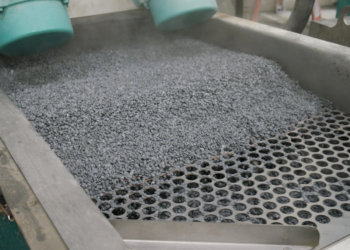
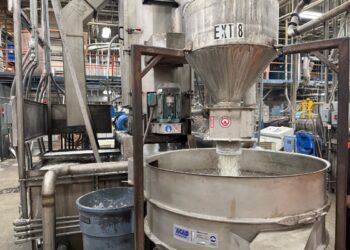
First, shredded plastics are put in a sink-float tank filled with water. The lighter densities float and can be separated, after which salt is added to raise the water’s density and separate other plastic fractions, Wong said. And while optical sorters can separate plastic items by polymer, they do not work well on black items – common to electronics.
However, electrostatic separation can separate fractions including ABS and PS. Wong estimates that this equipment can achieve up to 99% purity, with workers providing quality checks along the way.
By definition, “mixed plastic” hasn’t gone through electrostatic separation, Thomas said, and shipping it overseas requires the Basel prior informed consent process.
URT performs sink-float sortation in house, having invested several million dollars in systems for its sites in Wisconsin, Texas and Oregon. Partner Hanil Eco Solutions conducts electrostatic separation – the step that actually produces clean, sellable resin, Thomas said.
With Hanil, compounder Shinil and injection molder BH Tech, URT created the Nexloop Polymers Alliance, to return plastics to electronics. The alliance pairs “a Basel-compliant core” with downstream partner capabilities, to produce electronics-derived PCR plastic that can integrate into existing supply chains, Thomas said.
‘Getting all the right people in the same room’
Wong noted that the time he has spent observing UNEP meetings has proved the value of cross-sector collaboration and engagement. At first he was often the only recycler in a room full of government officials, diplomats, attorneys, scientists and environmental experts.
“A representative from the recycling and waste-trading sector was not automatically viewed as part of the solution from the outset,” he wrote in a recent blog post. But over time he overcame the skepticism, his counterparts began to ask about the realities of the recycling industry and Wong developed a deeper understanding of the regulatory process.
“We do not always see eye to eye, but we now recognise one another, exchange greetings and hold candid conversations — a stark contrast to my early days here,” he wrote. “The recycling industry needs regulation, and governments equally need to understand the practical realities of recycling operations.”
Wong added that “without a solid grasp of industry regulations, it is nearly impossible to fully understand this business.” He noted that attending the meetings has helped him anticipate policy trajectory early on, as revisions to e-scrap, plastics and battery regulations are “debated for years before they fully impact the market.”
Meanwhile, URT also has learned a lesson or two along the way. “We’ve had several hard knocks,” Thomas said, “and I anticipate we’ll have more.”
One crucial takeaway: Talk to the end user before investing in equipment. URT invested in processing equipment but then discovered that the output was “useless to the manufacturer,” and had to return to the drawing board. That experience showed URT the importance of connecting the entire supply chain, from the recycler to the compounder, to the injection molder and the device manufacturer.
“Getting all the right people in the same room having these discussions – that’s the challenge,” Thomas said.
‘Not a penny-per-pound business’
URT started as a certified recycler, and over the past six to seven years has expanded its capabilities. “We’re really focusing on being able to satisfy all aspects of the electronics life cycle,” Thomas said.
“The worst thing we can do is throw something into a shredder. That means we’ve exhausted the ability to get this material back into the consumer market.”
URT offers certified whole-life solutions, “and that is not a penny-per-pound business. People are starting to understand the actual value of our capital investments,” Thomas said, adding that the overhead costs are “way bigger than any other company I’ve ever run, because we’re following the certifications, and that requires overhead. We can’t go to the cheapest downstream because the cheapest downstream oftentimes is not doing stuff that we want our name associated with.”
While investing millions in creating an entire supply chain carries its own risks, the effort pays off even if it takes time and some hard lessons. For example, a major buyer opted to source recycled engineering plastics from a broker based on price, Thomas said, and that broker later appeared on the Basel Action Network’s “Brokers of Shame” watchdog report in October 2025.
“I think those BAN reports have an impact,” Thomas said. “Now we’re starting to get phone calls saying, ‘I guess you were right.’ People are starting to take it seriously.”