






Resource Recycling
  • The Latest
  • Analysis
    • All
    • Certification Scorecard
    • Industry Announcements
    • Opinion

    Who should pay for lithium-ion battery fire damage?

    America’s critical-materials buildout has a feedstock problem

    Certification scorecard – week of Sept. 14

    Canada Plastics Pact reports 2024 progress

    Trade tensions shift global mineral partnerships 

    Spin-off lets Linca focus on battery mineral recovery

    Critical mineral policy shift creates opportunity

    CommanderAI launches searchable hauler database

    Inside the Circle: Put AI to work for the people who do the work

  • Conferences
    • Resource Recycling Conference
    • Plastics Recycling Conference
    • E-Scrap: The Longevity Conference
    • Textiles Recovery Summit
  • Publications
    • E-Scrap News
    • Plastics Recycling Update
    • Policy Now
    • Resource Recycling
    • Other Topics
      • All Topics
      • Brand Owners
      • Critical Minerals
      • Glass
      • Grant Watch / RFPs
      • Markets
      • Organics
      • Packaging
      • Research
      • Technology
      • Textiles
Subscribe
No Result
View All Result
Resource Recycling
  • The Latest
  • Analysis
    • All
    • Certification Scorecard
    • Industry Announcements
    • Opinion

    Who should pay for lithium-ion battery fire damage?

    America’s critical-materials buildout has a feedstock problem

    Certification scorecard – week of Sept. 14

    Canada Plastics Pact reports 2024 progress

    Trade tensions shift global mineral partnerships 

    Spin-off lets Linca focus on battery mineral recovery

    Critical mineral policy shift creates opportunity

    CommanderAI launches searchable hauler database

    Inside the Circle: Put AI to work for the people who do the work

  • Conferences
    • Resource Recycling Conference
    • Plastics Recycling Conference
    • E-Scrap: The Longevity Conference
    • Textiles Recovery Summit
  • Publications
    • E-Scrap News
    • Plastics Recycling Update
    • Policy Now
    • Resource Recycling
    • Other Topics
      • All Topics
      • Brand Owners
      • Critical Minerals
      • Glass
      • Grant Watch / RFPs
      • Markets
      • Organics
      • Packaging
      • Research
      • Technology
      • Textiles
Subscribe
No Result
View All Result
Resource Recycling
No Result
View All Result
Home E-Scrap

Who should pay for lithium-ion battery fire damage?

byDavid Daoud
September 21, 2026
in Analysis, E-Scrap

JLStock / Shutterstock

Editor’s note: Fire safety and electronics recycling will be featured in sessions at the 2026 E-Scrap: The Longevity Conference in New Orleans October 26-28.

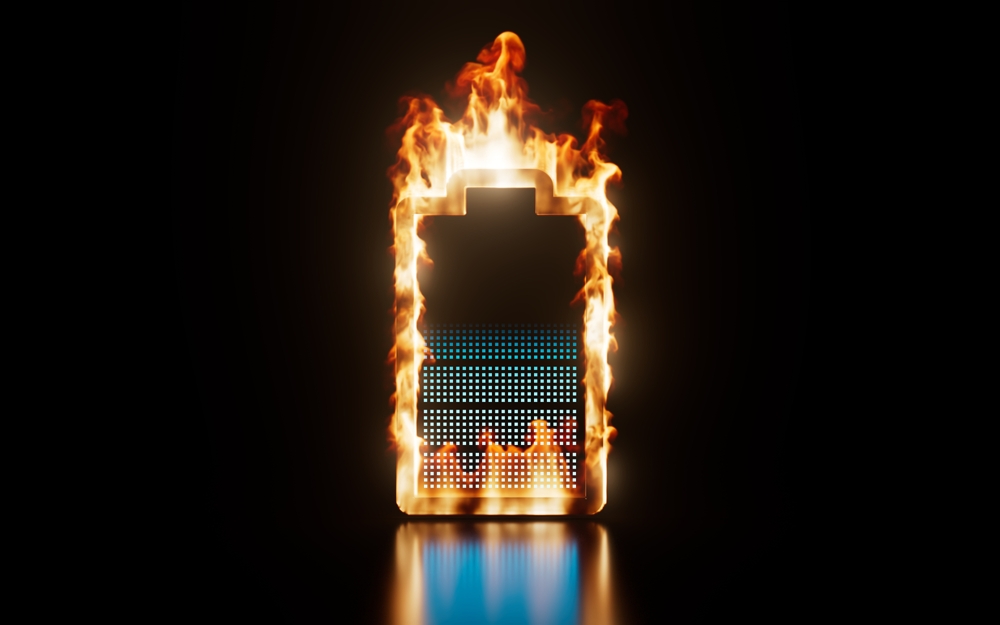
A lithium-ion battery tossed into the wrong bin can travel unnoticed until a compactor, shredder or sorting machine punctures it. By then, the person who discarded the battery is gone, the manufacturer is far removed and the recycling operator is left fighting the fire.

The scale of the problem is alarming. The US Environmental Protection Agency identified 245 fires at 64 waste-management facilities between 2013 and 2020 that were caused or likely caused by lithium metal or lithium-ion batteries. The incidents occurred at a number of sites, which include material recovery facilities, landfills, electronics recyclers, scrap yards, waste-to-energy facilities and during transportation. EPA cautioned that its research did not represent a complete accounting. Interviews and other evidence collected by the agency indicated that lithium-ion battery fires were substantially underreported.

European recyclers report similarly serious consequences. Research cited by the European Recycling Industries’ Confederation found that 36% of surveyed waste electrical and electronic equipment recyclers experienced a severe fire between 2016 and 2019. EuRIC reported that severe thermal events could take one to six hours to extinguish and estimated the average cost of more severe incidents at approximately €1.3 million ($1.5 million). The organization warned that such losses can be particularly difficult for a recycling industry composed largely of small and medium-sized companies.

When a fire occurs, the receiving facility faces the immediate operational consequences. Those can include damaged equipment, emergency response, cleanup, interrupted service and lost production. Regardless of how insurance, contracts or subsequent legal claims ultimately distribute the financial loss, the facility must first contend with the fire and the disruption it causes.

The industry has responded by strengthening prevention and emergency procedures. In December 2025, the Solid Waste Association of North America, National Waste & Recycling Association and Recycled Materials Association announced joint guidance covering battery identification, employee training, storage, handling and emergency planning at material recovery facilities. SWANA CEO Amy Lestition Burke called lithium-ion battery fires “one of the most urgent safety issues” facing the waste and recycling sector.

Prevention, however, carries its own costs. Lithium batteries are regulated as hazardous materials during transportation under Parts 171 through 180 of Title 49 of the Code of Federal Regulations. Damaged or defective batteries can require specialized packaging and handling, with additional requirements depending on their condition and how they are transported. Building a collection system capable of identifying, separating, storing and safely moving these batteries therefore requires more than simply placing another collection bin in front of consumers.

States are beginning to move more of these front-end responsibilities upstream. Illinois’ Portable and Medium-Format Battery Stewardship Act requires producers selling covered batteries in the state, beginning January 1, 2026, to participate in an approved stewardship plan providing for collection and end-of-life management. The programs are overseen by the Illinois Environmental Protection Agency. The Environmental Council of the States described the legislation when it was enacted as the country’s 16th battery extended-producer-responsibility law.

Minnesota lawmakers considered another approach after a lithium battery apparently ignited inside a recycling collection truck. House File 3566 proposed a recycling fee equal to 3.2% of the retail price of most covered electronics, with the revenue intended to support a system for collection and recycling of covered electronic devices. The legislation would have allowed retailers to collect the fee from purchasers. Representative Athena Hollins, discussing the truck fire and the broader battery problem, warned that the incident could not be dismissed as a “one-off.”

Illinois’ law and proposals such as Minnesota’s illustrate efforts to move more of the cost and responsibility for collection upstream. Convenient collection systems can give consumers alternatives to throwing batteries and battery-containing products into household recycling or trash, while stewardship programs can make producers participate financially in managing products at the end of their useful lives.

But collection responsibility and catastrophic-loss responsibility are not the same thing. When a battery still reaches the wrong facility and starts a fire, the operator initially confronts the suppression effort, cleanup, damaged equipment and downtime. Existing stewardship programs can shift collection and recycling costs upstream without necessarily assigning responsibility for catastrophic losses caused by improperly discarded batteries.

That distinction has important implications. Producer-funded collection can reduce the likelihood that batteries enter conventional waste and recycling streams, but it does not by itself answer what happens when prevention fails. A manufacturer, retailer, stewardship organization, consumer, municipality, insurer and recycling facility can each occupy a different position in the chain, while the fire occurs at only one of them.

The emerging policy question is therefore broader than who should pay to collect and recycle batteries. It is whether responsibility for preventing battery fires and responsibility for the losses that result from them should continue to be treated separately.

For now, policy is moving more of the prevention cost upstream. The much harder question of how catastrophic fire losses should ultimately be allocated remains largely unresolved.


Tags: BatteriesElectronicsSafety
TweetShare
David Daoud

David Daoud

David Daoud is a contributor to Resource Recycling and E-Scrap News, covering IT asset disposition, electronics recycling, and circular IT governance. He is the founder of and current Principal Analyst at Compliance Standards LLC, where he conducts independent research and advisory work on ITAD markets, sustainability and ESG compliance, data security, and lifecycle risk management. Daoud has analyzed enterprise IT trends since the late 1990s and was among the first analysts to examine ITAD as a distinct market segment during his time at IDC. He advises operators, OEMs, and investment teams on regulatory, technology, and market developments affecting the electronics lifecycle.

Related Posts

America’s critical-materials buildout has a feedstock problem

byDavid Daoud
September 18, 2026

As the US invests in critical-minerals capacity will facilities have enough material to process?

Google Pixel 6 phone

Google makes repairability part of design ethos

byBrian Clark Howard
September 16, 2026

The tech titan supports the right-to-repair movement in several key ways.

Spin-off lets Linca focus on battery mineral recovery

Critical mineral policy shift creates opportunity

byPaul Lane
September 14, 2026

Government leaders are calling for minerals to stay onshore, but industry leaders say more public investment would maximize the ability...

Battery fire risk isn’t going away. Insurance is responding

Vape ban awaits California governor’s signature

byStefanie Valentic
September 10, 2026

California's vape ban was written to close the exact loophole that let disposable devices survive a ban in the UK.

Hawaii's state capitol building.

Funding lapse leaves Hawaii e-scrap collectors seeking answers

byPaul Lane
September 10, 2026

Reimbursements for e-scrap collection have run out for the year — without warning, collectors say.

iFixit launches 2-week circuit board training course

Printed circuit board (PCB) recycling explained

byJavier Castilloand2 others
September 9, 2026

Recycling PCBs presents significant technical challenges because these waste streams combine metallic, non-metallic and electronic fractions with different characteristics and...

Load More

2026 Buyers’ Guide

Equipment, services and technology suppliers serving the recycling industry.

Browse the Guide

More Posts

New Jersey pushes back PCR mandate to 2030

New Jersey pushes back PCR mandate to 2030

September 10, 2026

SB 54 plan for cartons, film draws warning

September 15, 2026
Alpek closing Pennsylvania RPET plant

Alpek seizing on war-related opportunity 

July 27, 2026
Canada tariffs latest in new normal for RPET

Canada tariffs latest in new normal for RPET

September 11, 2026
Bale pricing mostly flat for September

Bale pricing mostly flat for September

September 9, 2026
Spin-off lets Linca focus on battery mineral recovery

Critical mineral policy shift creates opportunity

September 14, 2026
Study assesses environmental cost of excess data storage

BAN paper says AI e-scrap estimates are low

September 17, 2026
Additive cuts acetaldehyde migration in RPET bottles

PET roadmap pairs demand, CO2 footprint

September 15, 2026
California Governor Gavin Newsom speaking at podium.

What’s on Newsom’s desk after the CA session end

September 14, 2026
US packaging is evolving. The recycling system isn’t ready

US packaging is evolving. The recycling system isn’t ready

September 16, 2026
Load More

About & Publications

About Us

Staff

Archive

Magazines

Work With Us

Advertise
Jobs
Contact
Terms and Privacy

Newsletters

Get the latest recycling news and analysis delivered to your inbox every week. Stay ahead on industry trends, policy updates, and insights from programs, processors, and innovators.

Subscribe

Welcome Back!

Login to your account below

Forgotten Password?

Retrieve your password

Please enter your username or email address to reset your password.

Log In

Add New Playlist

No Result
View All Result
  • The Latest
  • Analysis
  • Recycling
  • E-Scrap
  • Plastics
  • Policy Now
  • Conferences
    • E-Scrap Conference
    • Plastics Recycling Conference
    • Resource Recycling Conference
    • Textiles Recovery Summit
  • Magazines
  • About Us
  • Advertise
  • Archive
  • Jobs
  • Staff
Subscribe
This website uses cookies. By continuing to use this website you are giving consent to cookies being used. Visit our Privacy and Cookie Policy.