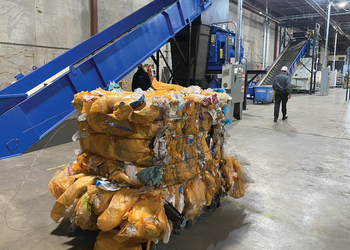







Flexible plastics, including food packaging, are among the largest and fastest-growing types of plastic waste, yet less than 5% are currently recycled, according to Delterra and Eunomia. The environmental nonprofit and global sustainability consultancy, respectively, are releasing a new report Wednesday that seeks to bolster that recycling rate.
The report found that companies could readily create demand for up to 800,000 tons of recycled household flexible plastics annually across eight applications. The team found that three uses in particular — industrial liners, impermeable construction membranes and dark-colored trash bags — could account for approximately 600,000 tons per year, or 75% of the total potential of the eight products.
Titled “Building Markets for Recycled Household Flexible Plastics: Identifying the End Uses Needed to Meet EPR Goals,” the report was funded by Amcor and Kraft Heinz.
Shannon Bouton, president and CEO of Delterra and one of the report’s authors, said, “You have to have demand for that material in order to create the incentive for all the rest of it to happen — the collection, the sortation, and so on.”
Bouton said the rapid rise of extended producer responsibility (EPR) around the world presents an opportunity and a challenge for flexible plastics. EPR can provide funding to help offset the costs of recycling. But it can also end up with a lot more material collected — material that needs some place to go.
In the case of California, Senate Bill 54 sets out a 65% recycling rate target by 2032 for single-use plastics, yet less than 5% of flexible plastics in the state are recycled today. “Closing this gap over the coming five years will require not only expanded collection and sorting, but also robust demand to use the recycled material in new applications,” the report authors wrote.
Bouton explained that flexibles have been particularly challenging to recycle because they are often contaminated with food or have paints or dyes on them. Flexibles can be made up of different resins and are often mixed with other materials like metals or fiber. Many recyclers have long said films and other flexibles can gum up their machinery. In part because of the challenges, Delterra and Eunomia found that there are fewer than 30 North American reclaimers that can mechanically recycle PE film.
“There’s no reason for those recyclers to exist because there just hasn’t been a lot of that material flowing through the system, and there hasn’t been a lot of demand for it,” said Bouton. “That is going to be a significant bottleneck when you start to see EPR come into play in places like California and other states.”
In order to assess the potential demand, Bouton and colleagues interviewed recyclers in Europe and other countries. They evaluated more than 40 potential applications for recycled household polyethylene film, from flower pots to car parts, from shrink film to buckets. They looked for technical feasibility and uses that aren’t already robust in the market (omitting plastic lumber, asphalt additives and roof coverboard).
They found these eight uses to be the most promising:
-Horticulture liners, trays and plastic pots
-Rigid consumables (e.g. housewares)
-Transit packaging pallets
-Rotational-molded items (e.g. consumer goods, large containers, trash bins)
-Industrial liners (e.g. pond liners, landfill liners)
-Impermeable construction membranes
-Agricultural heavy-duty covers
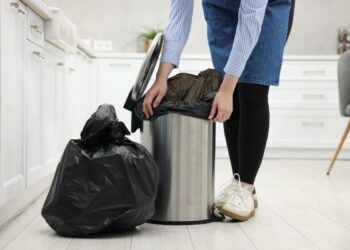
-Dark-colored trash bags
These eight identified uses share some similarities: they are generally not food-contact-sensitive, they can tolerate color variation and imperfections, and they are more forgiving of variability in resin composition. They include a mix of injection-molded rigid products and thicker-gauge, mixed-color film applications.
Bouton said the next step is to test how these recycled products perform in the real world, and in particular, in North America, where there might be subtle differences with Europe or other markets.
She added that one misconception she often encounters is that the recycled product needs to have price parity with virgin material. “Actually it needs to be significantly cheaper than virgin in order to generate that demand for it,” she said.
“The hardest part of building markets for recycled materials isn’t ambition – it’s honestly assessing what’s technically and economically feasible and being willing to follow the evidence where it leads,” said Sarah Edwards, North America director and private lead for Eunomia, in a statement.
“Recycling only happens really in truth if the material makes it back into a new product,” said Bouton.