




Resource Recycling
  • The Latest
  • Analysis
    • All
    • Certification Scorecard
    • Industry Announcements
    • Opinion
    SK Tes on track to meet 2030 ITAD goal

    SK tes’ sustainability report offers window into ITAD

    Our top stories from February 2023

    ADS flexes new recycling capacity against resin spikes

    SCS launches chem recycling standard

    Certification scorecard — week of Sept. 28

    NJ’s PCR delay risks making its own excuse permanently true

    NJ’s PCR delay risks making its own excuse permanently true

    E-scrap magnet recycling company scales up

    Why only some rare-earth sources are economically viable

    e-Stewards to develop an ITAD-specific standard

    Certification scorecard — week of Sept. 21

  • Conferences
    • Resource Recycling Conference
    • Plastics Recycling Conference
    • E-Scrap: The Longevity Conference
    • Textiles Recovery Summit
  • Publications
    • E-Scrap News
    • Plastics Recycling Update
    • Policy Now
    • Resource Recycling
    • Other Topics
      • All Topics
      • Brand Owners
      • Critical Minerals
      • Glass
      • Grant Watch / RFPs
      • Markets
      • Organics
      • Packaging
      • Research
      • Technology
      • Textiles
Subscribe
No Result
View All Result
Resource Recycling
  • The Latest
  • Analysis
    • All
    • Certification Scorecard
    • Industry Announcements
    • Opinion
    SK Tes on track to meet 2030 ITAD goal

    SK tes’ sustainability report offers window into ITAD

    Our top stories from February 2023

    ADS flexes new recycling capacity against resin spikes

    SCS launches chem recycling standard

    Certification scorecard — week of Sept. 28

    NJ’s PCR delay risks making its own excuse permanently true

    NJ’s PCR delay risks making its own excuse permanently true

    E-scrap magnet recycling company scales up

    Why only some rare-earth sources are economically viable

    e-Stewards to develop an ITAD-specific standard

    Certification scorecard — week of Sept. 21

  • Conferences
    • Resource Recycling Conference
    • Plastics Recycling Conference
    • E-Scrap: The Longevity Conference
    • Textiles Recovery Summit
  • Publications
    • E-Scrap News
    • Plastics Recycling Update
    • Policy Now
    • Resource Recycling
    • Other Topics
      • All Topics
      • Brand Owners
      • Critical Minerals
      • Glass
      • Grant Watch / RFPs
      • Markets
      • Organics
      • Packaging
      • Research
      • Technology
      • Textiles
Subscribe
No Result
View All Result
Resource Recycling
No Result
View All Result
Home Recycling

Safety in focus: Reducing injury rates with technology

byPaul Lane
March 18, 2026
in Recycling
SWANA reports increase in fatalities in 2022

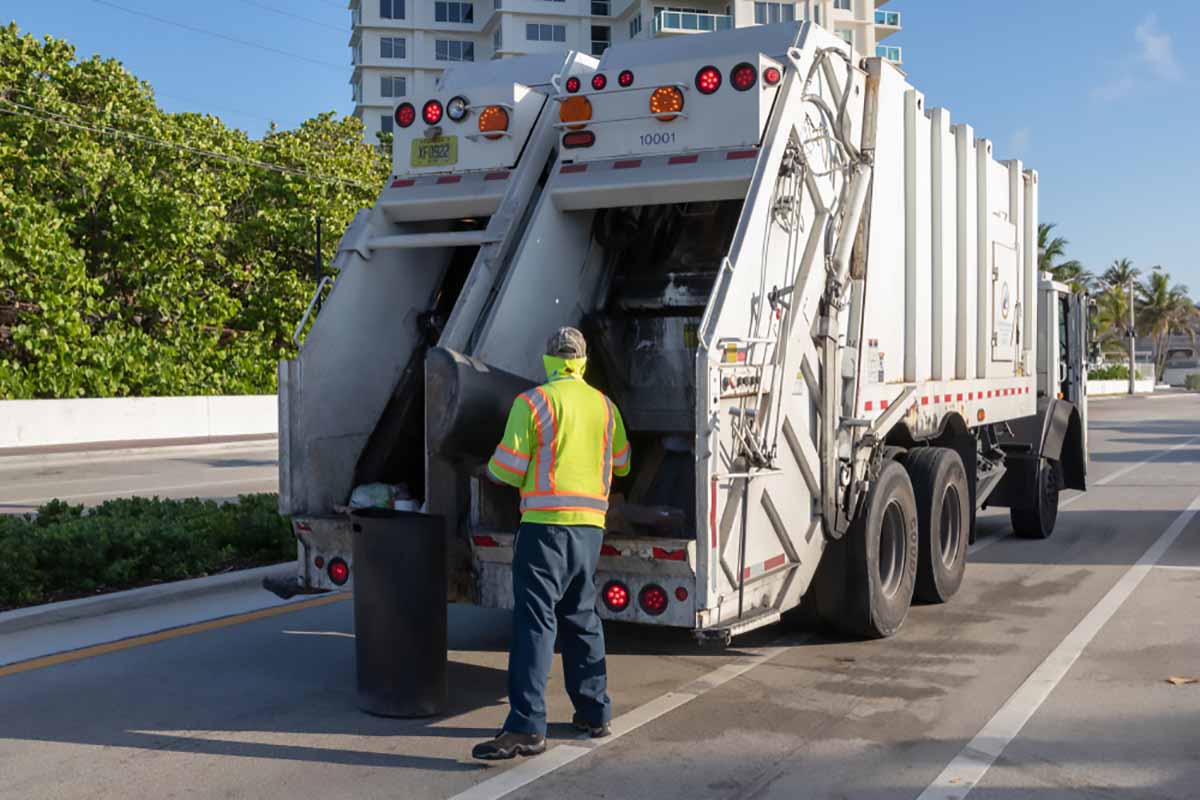
Waste industry workers get hurt at more than twice the rate of the average private-sector employee, and the industry is now pushing to change that. | YES Market Media/shutterstock

Editor’s note: This article is the second installment in a three-part series on evolving safety threats facing waste and recycling industry workers. Read part one here.

Waste and recycling industry workers get hurt at more than twice the rate of the average private-sector employee. This is not to say waste-collection companies have neglected safety.

A market.us report found in 2025 that just more than half of the global garbage truck fleet featured automatic arms.

This helps reduce safety incidents due to workers handling fewer receptacles and avoiding traffic, said Kristyn Oldendorf, senior director of public policy and communications for the Solid Waste Association of North America (SWANA), an industry professional association.

Some companies are taking additional steps toward a safer work environment. 

Republic Services lowered injury incidents about 9% from the year prior. Aiding in that was the installation of a collision avoidance system that recognizes unfocused driving behavior and potential environmental risk. It gives the driver real-time, in-cab audio alerts. The technology was in more than 13,000 Republic trucks as of 2024, according to the company’s 2024 Sustainability Report.

WM, meanwhile, reduced its overall worker injury rate by 6% from 2023 to 2024, according to the company’s 2025 Sustainability Report. Company leaders enhanced its onboarding safety training to reduce injuries while monitoring compliance and assessing risk potential. The company has also launched a serious injury and fatality pilot program to help employees identify and address potential hazards before they lead to serious injuries.

WM also became a corporate partner with SWANA in February 2026. WM will take part in SWANA events and help the organization in its safety efforts.

“WM provides essential services to communities across North America, and with SWANA we are able to provide additional industry insight and support to our municipal customers,” said Susan Moulton, WM’s senior director, public sector solutions. “We look forward to working with SWANA to help solve important issues that affect recycling, landfills, collections and other aspects of our industry.”

Tech lends a hand

Industry leaders say artificial intelligence is showing promise for enhancing safety. Robotic recycling and waste containers that come to the vehicle, thus not requiring a worker to leave the vehicle, are showing promise to help avoid struck-by incidents and slip-and-fall accidents, said Mike Marino, safety director at the Recycled Materials Association (ReMA).

Telematics and sensor systems are increasingly common on trucks, said Michael E. Hoffman, president and CEO of the National Waste and Recycling Association (NWRA). AI can also be used for equipment and automated quality control.

“AI-supported technologies can reduce worker exposure to risks by identifying issues earlier and supporting more automated and predictable operations,” Oldendorf said.

AI can assist in bringing to reality the steps Hoffman wants waste management companies to make to improve worker safety. Others include:

●  Data-driven prevention to record indicators such as near-misses and prompt corrective action

●  Traffic controls such as improved routing, backing reduction and in-cab/360 cameras

●  Serious injury and fatality prevention frameworks that promote organizational responsibility for machine guarding, lockout discipline and other industry hazards

“Risk factors on the route are on the rise: more traffic density, distracted drivers, e-mobility in blind spots,” he said. “The composition of the waste stream is adding more risk as e-commerce packaging increases, more single-use packing leads to contamination.”

AI’s reach is growing in the recycling sector. Companies are employing AI-enhanced sorting and infrastructure improvement, and machines are learning how to self-diagnose and maintain – functions that could keep humans out of harm’s way.

AI can also keep humans away from sorting hazards such as lithium-ion batteries. But machines work best in conjunction with enhanced education. Marino said his organization co-hosted a safety poster/video contest with JASON Learning about battery recycling, showing children nationwide how to properly recycle them. 

Hoffman said the NWRA is launching a “Safety First” webinar series with Waste Today GIE Media Group and launching the “Skip the Bin! Turn Your Batteries In” PSA campaign. And in addition to SWANA’s work with Griffith, that organization hosted a safety workshop in March 2026 in Washington, DC to give safety leaders a plan and support network.

“Progress is being made, but it is uneven,” Oldendorf said. “Advances in vehicle technology, automation and training have improved safety outcomes in many of our industry’s operations. At the same time, workforce shortages, aging infrastructure and evolving waste streams continue to introduce new risks. Safety improvements require sustained investment, consistent training and leadership focus, which can be challenging in a rapidly changing operating environment.”


Tags: Safety
TweetShare
Paul Lane

Paul Lane

Paul Lane is an award-winning journalist who joined Resource Recycling in June 2026 after working for several years in corporate communications and at various local news outlets. He can be reached at paul.lane@resource-recycling.com.

Related Posts

Facility fires remain high across US, Canada in August

byPaul Lane
September 23, 2026

Despite high August numbers, the latest Fire Rover report indicated there may be overall progress in slowing the number of...

Who should pay for lithium-ion battery fire damage?

byDavid Daoud
September 21, 2026

Fires continue to be a major threat to the recycling industry, even as states explore new policy solutions.

Study quantifies lithium battery threat to infrastructure

Fire incidents remain on the upswing in summer

byPaul Lane
August 24, 2026

July proved to be a dangerous month for waste handling facilities in North America, with an above-average number of fire...

Propane and steel recycling unit

Pennsylvania pilot tackles propane cylinder recycling challenges

byIsabella Burke
August 24, 2026

A Pennsylvania pilot project is testing a new way to safely recover propane and steel from disposable propane cylinders, a...

Copper prices fall to lowest point since spring

EMR recycling plant to reopen in NJ after fire, legal battle

byBrian Clark Howard
July 21, 2026

A major fire May 29 at the metal recycling facility in Camden prompted a legal exchange with the city.

batteries

WM adds batteries to recycling watch list

byPaul Lane
June 16, 2026

Putting batteries on its “Recycle Right” list could help WM mitigate fires they cause at collection facilities, according to company...

Load More
Next Post
Celebrate Global Recycling Day 2026

Celebrate Global Recycling Day 2026

2026 Buyers’ Guide

Equipment, services and technology suppliers serving the recycling industry.

Browse the Guide

More Posts

Newsom nixes recycled content claims bill

Newsom nixes recycled content claims bill

September 28, 2026
Analysis: Undersupply of PCR is ‘stifling’ brand goals

US lawmakers urge protection of domestic RPET

September 25, 2026
trash bags

Sorted: Should we use recycled trash bags?

September 28, 2026
Oregon state capitol building with state flag and blue sky.

NAW appeals Oregon EPR ruling

September 25, 2026
Recyclers reeling from NJ PCR extension

Recyclers reeling from NJ PCR extension

September 23, 2026
Domestic e-plastics recovery picks up pace 

Domestic e-plastics recovery picks up pace 

September 30, 2026
Diversion Dynamics: Policy needed to reach full charge for vape recycling

Disposable vapes banned in California

September 28, 2026
USFFI signs first film offtake deals

USFFI signs first film offtake deals

September 29, 2026
NJ’s PCR delay risks making its own excuse permanently true

NJ’s PCR delay risks making its own excuse permanently true

September 28, 2026
Cyclic launches commercial test of rare earth recycling tech

ERI investment to help fund Cyclic Materials expansion

September 29, 2026
Load More

About & Publications

About Us

Staff

Archive

Magazines

Work With Us

Advertise
Jobs
Contact
Terms and Privacy

Newsletters

Get the latest recycling news and analysis delivered to your inbox every week. Stay ahead on industry trends, policy updates, and insights from programs, processors, and innovators.

Subscribe

Welcome Back!

Login to your account below

Forgotten Password?

Retrieve your password

Please enter your username or email address to reset your password.

Log In

Add New Playlist

No Result
View All Result
  • The Latest
  • Analysis
  • Recycling
  • E-Scrap
  • Plastics
  • Policy Now
  • Conferences
    • E-Scrap Conference
    • Plastics Recycling Conference
    • Resource Recycling Conference
    • Textiles Recovery Summit
  • Magazines
  • About Us
  • Advertise
  • Archive
  • Jobs
  • Staff
Subscribe
This website uses cookies. By continuing to use this website you are giving consent to cookies being used. Visit our Privacy and Cookie Policy.