



Resource Recycling
  • The Latest
  • Analysis
    • All
    • Certification Scorecard
    • Industry Announcements
    • Opinion

    From CES to the shredder: What 2026 PCs mean for ITAD

    Certification scorecard for week of Jan. 12, 2026

    Industry announcements for January 2026

    Certification scorecard for Dec. 18-30, 2025

    Certification scorecard for Dec. 18, 2025

    Industry announcements for the week of Dec. 15

    Certification scorecard for December 10, 2025

    Industry Announcements for Week of December 8

    Certification Scorecard for December 3, 2025

  • Conferences
  • Publications

    Other Topics

    Textiles
    Organics
    Packaging
    Glass
    Brand Owners

    Metals
    Technology
    Research
    Markets
    Grant Watch

    All Topics

Subscribe
No Result
View All Result
Resource Recycling
  • The Latest
  • Analysis
    • All
    • Certification Scorecard
    • Industry Announcements
    • Opinion

    From CES to the shredder: What 2026 PCs mean for ITAD

    Certification scorecard for week of Jan. 12, 2026

    Industry announcements for January 2026

    Certification scorecard for Dec. 18-30, 2025

    Certification scorecard for Dec. 18, 2025

    Industry announcements for the week of Dec. 15

    Certification scorecard for December 10, 2025

    Industry Announcements for Week of December 8

    Certification Scorecard for December 3, 2025

  • Conferences
  • Publications

    Other Topics

    Textiles
    Organics
    Packaging
    Glass
    Brand Owners

    Metals
    Technology
    Research
    Markets
    Grant Watch

    All Topics

Subscribe
No Result
View All Result
Resource Recycling
No Result
View All Result
Home Plastics

WEF tackles plastic pollution in developing nations

Antoinette SmithbyAntoinette Smith
August 27, 2025
in Plastics
WEF tackles plastic pollution in developing nations
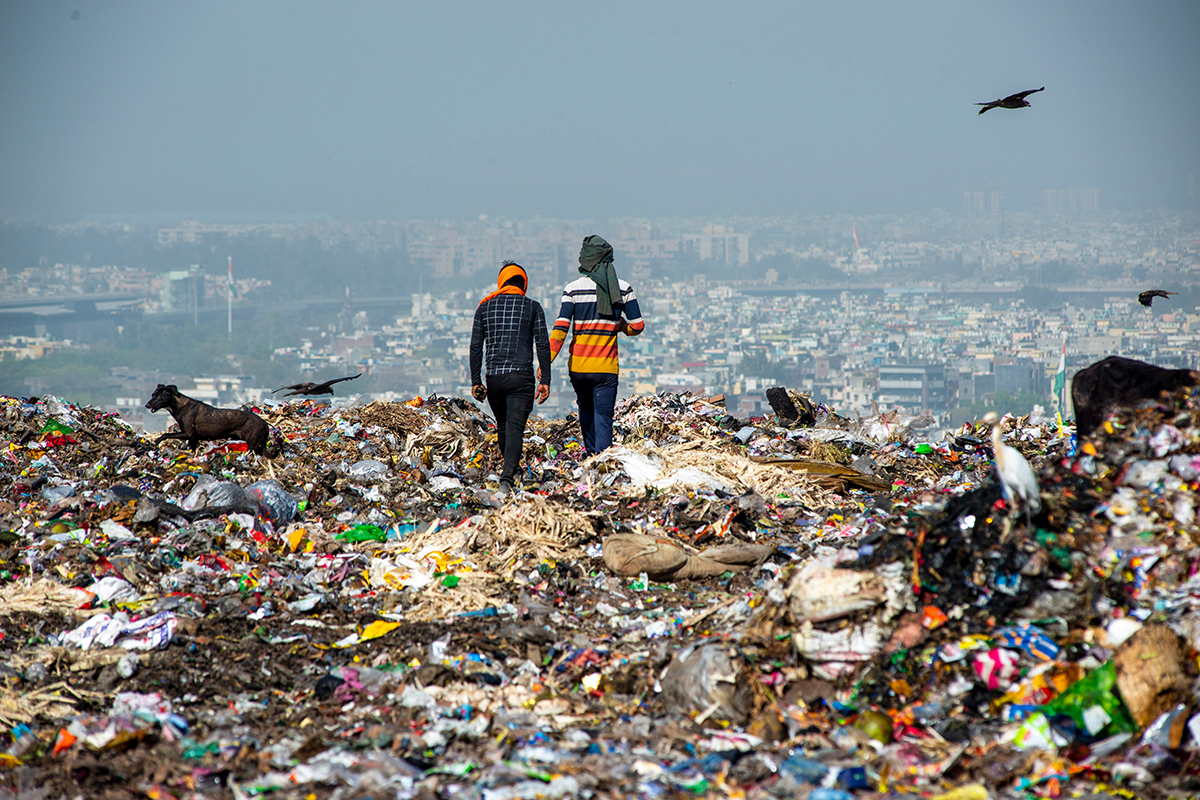
Among the areas of concern for the Global Plastic Action Partnership is improving conditions for workers in the informal recycling sectors common to developing countries. | Pradeep Gaurs/Shutterstock

Since its founding in 2018, the Global Plastic Action Partnership, part of the World Economic Forum, has worked to address plastic pollution in developing countries, creating a network of partnerships across Latin America, Asia and Africa.

About one in five people now lives in a country that has a national plastic action partnership, said Clemence Schmid, director of GPAP, during an interview with Plastics Recycling Update. As a public-private platform, GPAP aims to convene stakeholders throughout the plastics value chain in partnerships to reduce plastic pollution as well as to create jobs, she said. 

The recently collapsed plastic treaty talks serve as an example of the limited understanding of the complexities of addressing plastic pollution, Schmid said, adding that GPAP has attempted to bridge that knowledge gap. 

 “Transparently, we’re struggling to engage either companies or experts, because there are not so many, and they tend to be busy on the ground,” which is why their perspective would be extremely valuable at such discussions, she noted.

“It’s eye opening when you’re able to show and you’re able to bring people that are actually doing the job to really explain how it works and what makes something collectible, solvable, recyclable. It changes the conversation,” Schmid added.

Of GPAP’s 25 partnerships so far, eight are in Asia and South Asia, including Indonesia, Vietnam, Cambodia, Laos and Bangladesh. GPAP has eight more partnerships in Africa, including Ghana, Senegal, Nigeria, Kenya and Tanzania. And in Latin America, the nine partnerships include Mexico City, Colombia, Peru, Ecuador and Paraguay, among others.

The group starts each partnership by creating a baseline assessment of the country’s plastics life cycle, using anonymized data in analytical models and involving all stakeholders in the process. 

“What’s very important is to do this in a consultative process,” Schmid said. “This is not something that we just collect the data and then bring it back, but we discuss it with all the stakeholders to make sure that we align as much as possible on the best possible pictures.”

GPAP holds at least three or four meetings with a metrics advisory group, to align on data. 

“That baseline is not just a baseline for the sake of data collection, but enables us afterwards to model different types of scenarios based on the level of ambition of plastic pollution reduction in the country, and be able afterwards to put a road map together that gives the country and the stakeholder at the national level some guidance,” she said. 

The group also makes recommendations in meeting the country’s goals, including providing guidance on policy, innovation, behavioral change and financing. 

Measuring success

Each partnership consists of three pillars, Schmid said, starting with ensuring that the national platform’s ownership lies within its own country.

“It is not a traditional infrastructure building project, where you finance a piece of infrastructure,” she said. “Our objective is really to give the tools to the countries and the stakeholder in the country to really be on track to have and own their own decision when it comes to infrastructure building.” 

For example, the most mature GPAP partnership involves 200 to 300 organizations in its network, and the group intends to continue its growth, Schmid said. 

“It’s a very fragmented industry, sometimes very locally defined, not even at the national but at the subnational level,” she continued. “So, it’s a continuous work on the ground to increase the number of people that are aware and that can participate, into the platform, and afterwards, are aligned to take the action following the roadmap.”

Another pillar of each partnership is impartiality, basing its findings and actions on data and evidence, rather than politics or opinion, she said. 

Schmid explained.that by involving participants from informal waste and recycling networks, which are common in developing countries, from the very beginning of the partnership process, GPAP facilitates a just transition.

Informal recycling networks

Recycling networks in many developing countries are informal, consisting of “pickers” who sift manually through landfills for recyclable commodities, performing dangerous and low-paid work. 

This dynamic raises the question of how to bring these workers closer together, Schmid said. “There is data in the field that shows that when you organize as a cooperative, you might still remain informal, you might still not be formalized, but at least as a cooperative, you’re stronger, because then your quantities are stronger, and instead of each individual going to a certain aggregator or to a different part of the value chain, then you’re able to go together and have bigger volume, and that gives you a bit more of security.” 

Financing pathways

“In the recycling world, more than others, we all know that it has to make economic sense in order to make it a business-building idea, but that’s obviously hard to do in the early stage,” Schmid said. Instead, the group looks at how to best leverage different types of public and private funding to help bring projects to scale. 

For more than two years, GPAP has worked with the WEF’s Financing Coordination Group to explore innovative financing mechanisms to help address such issues as plastic pollution as well as provide opportunities. 

And although the financing group works on a global level, including during the recent plastic treaty talks in Geneva, Switzerland, it also digs into the local level to produce a dedicated financing assessment that helps show how a roadmap would be implemented. 

GPAP itself is funded by such partners as the UK and Canadian governments, multinational companies including Coca-Cola and Nestle and other NGOs.
Tags: AsiaEPREurope
TweetShare
Antoinette Smith

Antoinette Smith

Antoinette Smith has been at Resource Recycling Inc., since June 2024, after several years of covering commodity plastics and supply chains, with a special focus on economic impacts. She can be contacted at [email protected].

Related Posts

Aduro reports losses, will pick site for demo plant by end Jan

byAntoinette Smith
January 16, 2026

Canada-based Aduro Clean Technologies plans to finalize site selection, with options including a Dutch site, amid higher quarterly revenue but...

EU contributes €6 million toward textile DRS pilot

byAntoinette Smith
January 16, 2026

The TexMat pilot project will test a deposit return system featuring automated textile collection bins to accompany the rollout of...

#PRC2026 Speaker Spotlight: Scott Saunders

byScott Snowden
January 7, 2026

Scott Saunders grew up in the Southeast and has spent most of his life in Alabama, building a career in...

Analysis: Dire EU landscape hints at US future

EU Commission fast-tracks support for plastics recyclers

byAntoinette Smith
January 6, 2026

The European Commission acknowledged the urgency for EU-wide measures to protect trade from cheap imports and to provide regulatory certainty...

#PRC2026 Speaker Spotlight: Christine Yeager

#PRC2026 Speaker Spotlight: Christine Yeager

byScott Snowden
December 29, 2025

Christine Yeager blends CPG leadership with advocacy, bringing energy to EPR and recycling debates. A former Coca-Cola sustainability director, she...

Panel tracks shifts in e-scrap as policy, AI reshape

Panel tracks shifts in e-scrap as policy, AI reshape

byScott Snowden
December 22, 2025

Executives across the electronics recycling and ITAD sector said shifting device design, battery risk, regulatory pressure and rapid data center...

Load More
Next Post
Circularix starts Florida RPET plant, expands Pennsylvania site

Circularix starts Florida RPET plant, expands Pennsylvania site

More Posts

mobile phone fix

Repair movement reshapes reuse as laws reshape ITAD

December 17, 2025
Austria’s DRS on track for 80% collection in first year

Austria’s DRS on track for 80% collection in first year

December 17, 2025
Deposit schemes garner support, despite ‘awareness gap’

Deposit schemes garner support, despite ‘awareness gap’

December 18, 2025
paint cans recycling

PaintCare brings stewardship to Illinois, Maryland on deck

December 19, 2025
WM Facility

Modern recycling meets AI 

December 18, 2025
small format coalition

Small format packing collaboration

December 18, 2025
Carbios delays French PET recycling plant to secure funds

Carbios delays French PET recycling plant to secure funds

December 19, 2025
Mitsubishi Materials buys into Elemental e-scrap pact in US

Mitsubishi Materials buys into Elemental e-scrap pact in US

December 19, 2025
#PRC2026 Speaker Spotlight: Joel Morales

#PRC2026 Speaker Spotlight: Joel Morales

December 22, 2025
Panel tracks shifts in e-scrap as policy, AI reshape

Panel tracks shifts in e-scrap as policy, AI reshape

December 22, 2025
Load More

About & Publications

About Us

Staff

Archive

Magazine

Work With Us

Advertise
Jobs
Contact
Terms and Privacy

Newsletter

Get the latest recycling news and analysis delivered to your inbox every week. Stay ahead on industry trends, policy updates, and insights from programs, processors, and innovators.

Subscribe

Welcome Back!

Login to your account below

Forgotten Password?

Retrieve your password

Please enter your username or email address to reset your password.

Log In

Add New Playlist

No Result
View All Result
  • The Latest
  • Analysis
  • Recycling
  • E-Scrap
  • Plastics
  • Policy Now
  • Conferences
    • E-Scrap Conference
    • Plastics Recycling Conference
    • Resource Recycling Conference
    • Textiles Recovery Summit
  • Magazine
  • About Us
  • Advertise
  • Archive
  • Jobs
  • Staff
Subscribe
This website uses cookies. By continuing to use this website you are giving consent to cookies being used. Visit our Privacy and Cookie Policy.