



Resource Recycling
  • The Latest
  • Analysis
    • All
    • Certification Scorecard
    • Industry Announcements
    • Opinion
    Colorado regulators suggest mid-range EPR scenario

    Why collaboration on plastic waste still matters

    Battery processors lay out latest moves

    Battery recycler Ascend Elements files for bankruptcy

    EPR fees are a market signal. Here’s what they’re telling you.

    EPR fees are a market signal. Here’s what they’re telling you.

    Wolframite ore, the primary ore of tungsten from Altai, Russia

    Tungsten scrap export controls draw industry attention

    Certification Scorecard — Week of April 6, 2026

    Closed Loop Partners acquires Sutter Metals, connecting electronics disposition to metals recovery

    Certification Scorecard — Week of March 30, 2026

    Industry announcements for January 2026

    Industry announcements for April 2026

    Certification scorecard – Week of March 23, 2026

  • Conferences
  • Publications

    Other Topics

    Textiles
    Organics
    Packaging
    Glass
    Brand Owners

    Metals
    Technology
    Research
    Markets
    Grant Watch

    All Topics

Subscribe
No Result
View All Result
Resource Recycling
  • The Latest
  • Analysis
    • All
    • Certification Scorecard
    • Industry Announcements
    • Opinion
    Colorado regulators suggest mid-range EPR scenario

    Why collaboration on plastic waste still matters

    Battery processors lay out latest moves

    Battery recycler Ascend Elements files for bankruptcy

    EPR fees are a market signal. Here’s what they’re telling you.

    EPR fees are a market signal. Here’s what they’re telling you.

    Wolframite ore, the primary ore of tungsten from Altai, Russia

    Tungsten scrap export controls draw industry attention

    Certification Scorecard — Week of April 6, 2026

    Closed Loop Partners acquires Sutter Metals, connecting electronics disposition to metals recovery

    Certification Scorecard — Week of March 30, 2026

    Industry announcements for January 2026

    Industry announcements for April 2026

    Certification scorecard – Week of March 23, 2026

  • Conferences
  • Publications

    Other Topics

    Textiles
    Organics
    Packaging
    Glass
    Brand Owners

    Metals
    Technology
    Research
    Markets
    Grant Watch

    All Topics

Subscribe
No Result
View All Result
Resource Recycling
No Result
View All Result
Home Plastics

How a company is turning PET into durable asphalt

byJared Paben
August 19, 2020
in Plastics
How a company is turning PET into durable asphalt
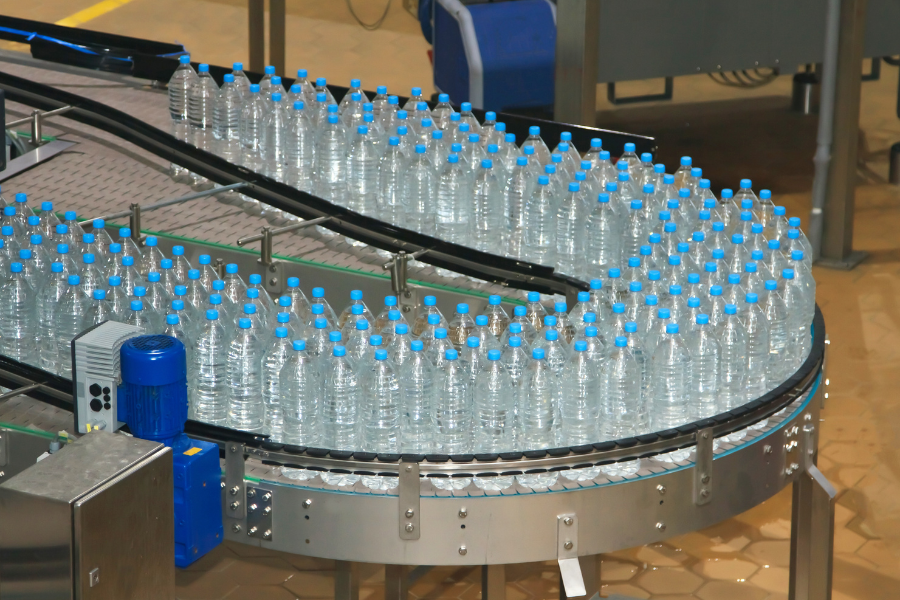
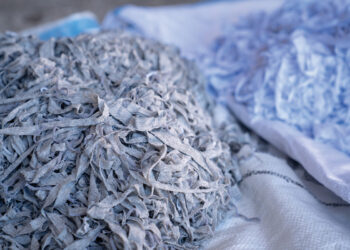
TechniSoil Industrial can process post-consumer or post-industrial PET for it’s asphalt binder product. | Courtesy of Technisoil.

A California company is using glycolysis to depolymerize PET scrap for use in an asphalt binder. The pavement it produces is stronger than traditional hot-mix asphalt.

TechniSoil Industrial has recently garnered widespread media attention because the California Department of Transportation (Caltrans) used the company’s asphalt binder to repave a segment of highway last month. Asphalt binder is essentially the cement that holds aggregate together in pavement.

Sean Weaver, CEO and founder of TechniSoil Industrial and inventor of the recycled-content asphalt binder, recently provided more details to Plastics Recycling Update about his company’s technology and its potential widespread use.

“It’s a pretty big deal to introduce a new type of pavement to a large agency like Caltrans, but I think the want is there from a sustainability standpoint and a performance standpoint,” Weaver said.

The road to recycled plastic

Eight years ago, Weaver began looking at polymer chemistry to produce an asphalt binder for golf cart paths (he has a sister company that produces landscaping-related products). Lab and field tests showed that using virgin urethane in an asphalt binder produced strong pavement, he said.

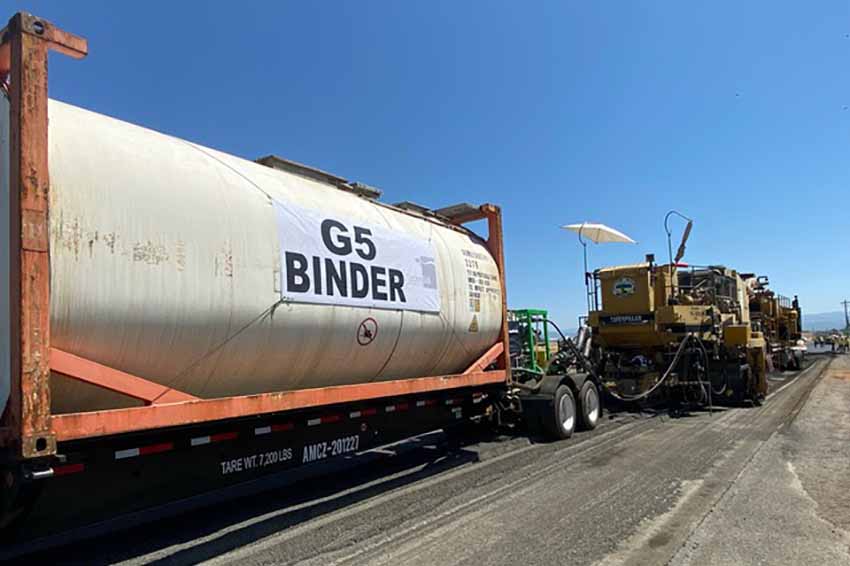
Based in Redding, Calif., TechniSoil Industrial’s asphalt binder with urethane is called G5. In 2017, Weaver began experimenting with using recycled polyester in G5 formulations, he said, calling that binder G5P. The city of Los Angeles has tested asphalt with different G5 and G5P formulations.

TechniSoil Industrial can process post-consumer or post-industrial PET, Weaver said. It uses glycolysis to depolymerize the PET into polyester polyols, which are then mixed with urethane to produce the binder (polyester polyols are also a feedstock for producing polyurethanes).

Weaver said that, with some testing, TechniSoil Industrial can use 20-25% recycled polyester polyol in the asphalt binder, but the company plans to start with 3-5% chemically recycled plastic.

When asked why his company uses recycled PET, for which there are established markets, instead of a lower-value scrap plastic, Weaver said TechniSoil Industrial started looking at PET because it was the feedstock available when it began its research into using recycled plastics. But, he added, the company is looking at using other recycled polymers, including PE.

Still, he argued the benefits of recycling PET into asphalt.

“Utilizing plastic from single-use applications into applications that last multiple decades, in my opinion, is the greatest use of a recycled material,” Weaver said.

The $3.2 million Caltrans repaving project covered three lanes for about 1,000 feet along Highway 162 in Oroville, which is a town north of Sacramento. The asphalt there has a range of recycled polyester polyol loadings, Weaver said. For the entire project, G5 makes up about 4.2% of the weight of material used. Of that G5 weight, specifically, the recycled polyol ranges from 4% to 20%, Weaver said.

If the G5P is made with 20% recycled polyester polyol, then one mile of asphalt uses nearly 4,000 pounds of recycled PET.
Courtesy of Caltrans.
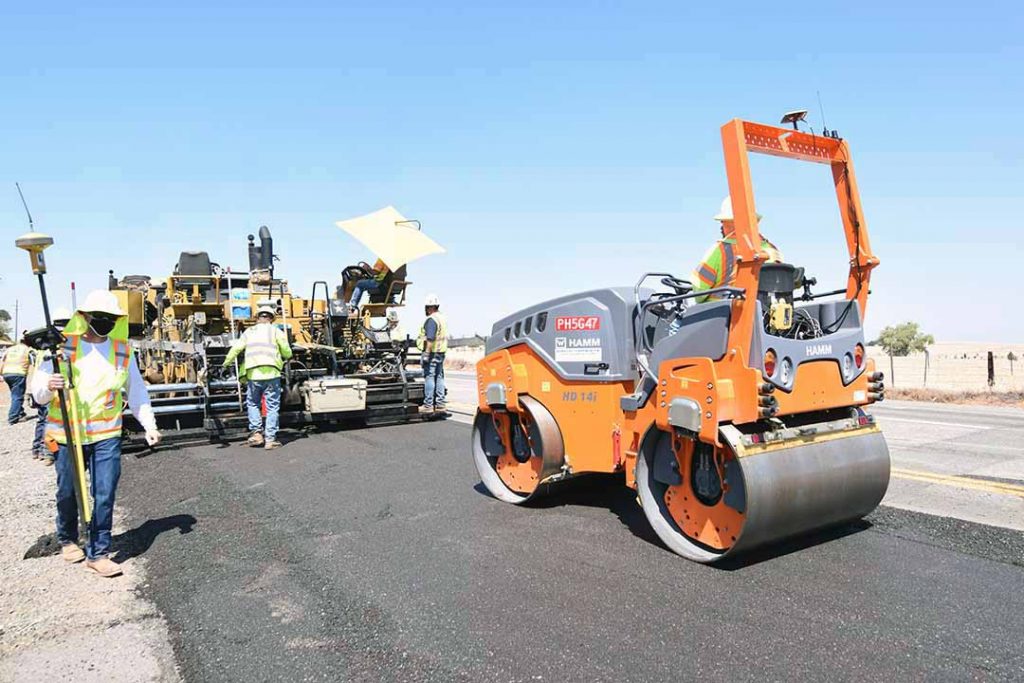
According to Caltrans, previous tests have found G5-containing asphalt lasts two to three times longer than traditional hot-mixed asphalt pavement. | Courtesy of Caltrans.

Benefits to road repaving

A significant amount of research has recently examined using recycled plastic in asphalt. The Plastics Industry Association is working with partners to test the recycling of recovered LDPE film into asphalt binders. A couple of years ago, global chemical company Dow began testing the use of scrap plastic in a roadway in Indonesia, research that has since moved to Texas. Separately, the Texas Department of Transportation has begun funding research into the topic.

Weaver emphasized his technology is different from Dow’s approach of melting PE chips into virgin hot mix asphalt. G5 completely replaces the use of bitumen as a binder, he said.

G5 can be used to recycle a road in place, which represents “just a huge step change,” Weaver said. Normally, for every lane mile of road, 42 truckloads will be used to remove the waste pavement and another 42 truckloads are needed to bring in new asphalt, he said.

The Caltrans project used what’s called “cold, in-place recycling,” which involves using a train of vehicles to grind and resize the top three inches of pavement, mix the material with the G5 binder, and then place and steamroll the new asphalt. It reuses 100% of the old asphalt.

Caltrans already uses the cold in-place process, mixing ground-up asphalt with a foamed binding agent made of bitumen. But the resulting pavement is only durable enough to be used as a road base, and hot-mix asphalt must still be trucked in to place the top layer, according to a Caltrans press release.

According to Caltrans, previous tests have found G5-containing asphalt lasts two to three times longer than traditional hot-mixed asphalt pavement.

“To be able to recycle 100% of the road into a road that’s stronger than the original road has always been a holy grail of road construction,” Weaver said, “and we have achieved that.”

In terms of upfront costs, asphalt with G5 costs about the same or less than installing traditional asphalt, he said.
 

Tags: PETTechnology
TweetShare
Jared Paben

Jared Paben

Related Posts

Amazon, DOE partner on critical materials recovery

byScott Snowden
April 13, 2026

DOE and Amazon will study recovery of graphite from textiles and gallium from IT hardware, aiming to strengthen US supply...

End markets, policy key to RPET viability

End markets, policy key to RPET viability

byAntoinette Smith
April 8, 2026

Longer-term actions support domestic RPET markets and can help prevent the loss of public trust in recycling systems, industry experts...

With RPET in crisis, focus turns to solutions

With RPET in crisis, focus turns to solutions

byAntoinette Smith
April 2, 2026

Stakeholders from across the RPET value chain share concrete solutions for the short term to help prevent further loss of...

Packaging sector sees shift from AI pilots to wider use

byScott Snowden
April 1, 2026

AI adoption is expanding across packaging operations as costs fall and use cases widen, though concerns around accountability, ROI and...

ReElement, Mitsubishi partner on rare earth supply chains

byScott Snowden
March 31, 2026

ReElement and Mitsubishi Materials form a US-Japan partnership to expand rare earth refining, targeting supply chain gaps with recycling, feedstock...

Circularity push meets internal behavior hurdles

byScott Snowden
March 30, 2026

At PRC, former Jabil executive Cassie Gruber argued circular economy efforts often stall on internal habits and culture, as she...

Load More
Next Post

Certification Scorecard: Aug. 20, 2020

More Posts

EPR fees are a market signal. Here’s what they’re telling you.

EPR fees are a market signal. Here’s what they’re telling you.

April 10, 2026
End markets, policy key to RPET viability

End markets, policy key to RPET viability

April 8, 2026

Trafigura signs $1.1b deal for recycled battery metals

April 8, 2026
Wineries help create model for film recycling

Wineries help create model for film recycling

April 7, 2026
With RPET in crisis, focus turns to solutions

With RPET in crisis, focus turns to solutions

April 2, 2026
Wolframite ore, the primary ore of tungsten from Altai, Russia

Tungsten scrap export controls draw industry attention

April 9, 2026

WM opens new $60m MRF in Indy

April 10, 2026
Plastics Recyclers Have the Capacity to Recycle More. Now Let’s Use It.

Study finds most recycling occurs within 30 miles of access

April 8, 2026

GFL acquires SECURE Waste for $6.4bn

April 13, 2026
Solarcycle starts up Georgia recycling plant

S3399 signals a shift in how states are tackling solar panel waste

April 6, 2026
Load More

About & Publications

About Us

Staff

Archive

Magazine

Work With Us

Advertise
Jobs
Contact
Terms and Privacy

Newsletter

Get the latest recycling news and analysis delivered to your inbox every week. Stay ahead on industry trends, policy updates, and insights from programs, processors, and innovators.

Subscribe

Welcome Back!

Login to your account below

Forgotten Password?

Retrieve your password

Please enter your username or email address to reset your password.

Log In

Add New Playlist

No Result
View All Result
  • The Latest
  • Analysis
  • Recycling
  • E-Scrap
  • Plastics
  • Policy Now
  • Conferences
    • E-Scrap Conference
    • Plastics Recycling Conference
    • Resource Recycling Conference
    • Textiles Recovery Summit
  • Magazine
  • About Us
  • Advertise
  • Archive
  • Jobs
  • Staff
Subscribe
This website uses cookies. By continuing to use this website you are giving consent to cookies being used. Visit our Privacy and Cookie Policy.