


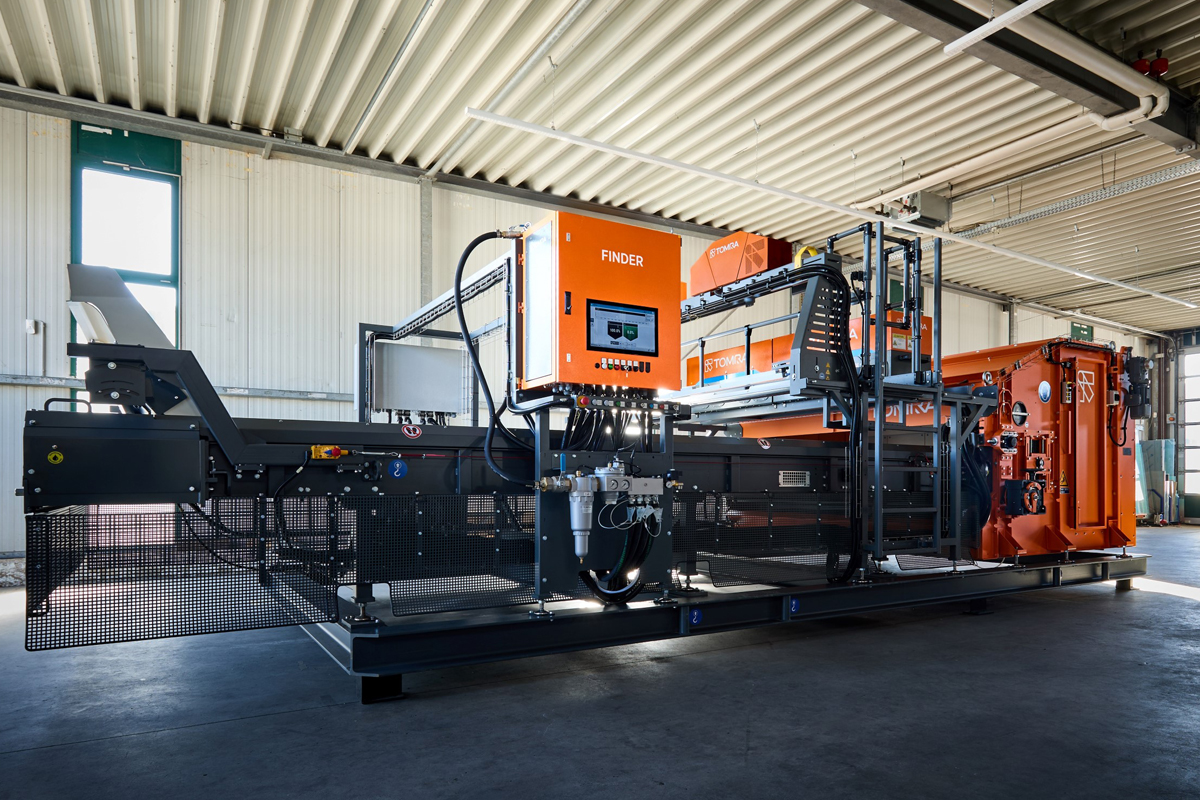
TOMRA Recycling has introduced an updated version of its FINDER metal sorting system, a long-established platform used to separate metals from mixed material streams and concentrate valuable fractions for further processing.
The Norwegian company said the redesigned system builds on more than two decades of use in metal recovery, where it is typically deployed as an early-stage unit to separate metals from non-metal material before downstream sorting.
“The Finder is the best machine you can find in the market,” Giuseppe Granara, head of metal recycling Americas for TOMRA Recycling, told E-Scrap News at the ReMa conference in Las Vegas. He described the system as a core technology that has been in use for more than 25 years and serves as the first step in concentrating metals.
TOMRA said the latest version introduces a modular, multi-sensor architecture that allows operators to configure the system based on the materials being processed and expand capabilities over time. The company said the design also supports faster installation and improved access for maintenance.
At the core of the system is an electromagnetic sensor used to distinguish metals from non-metals. The update also includes changes to air valve control and mechanical protection components, which the company said improve ejection precision, reduce air consumption and limit wear on internal parts.
The system can be equipped with additional sensors, including near-infrared units for identifying plastics or printed circuit boards in electronics streams. TOMRA said this enables more targeted separations, such as isolating insulated wire or cleaning stainless steel fractions.
A central feature of the update is the integration of artificial intelligence tools, including an optional laser-based system known as DEEP LAISER. The technology uses line scanning to create a digital representation of objects moving through the sorter, enabling three-dimensional recognition and classification.
Granara said the system is designed to improve performance when materials overlap or appear as a single item. “It allows the system to treat the object as two separate objects,” he said, noting that this can improve sorting accuracy in mixed streams.
The platform can also be paired with TOMRA’s GAINnext software, which uses trained neural networks to support more complex sorting tasks. The company said this allows operators to address materials that have been difficult to separate using conventional sensor systems.
Digital monitoring tools are integrated into the system, allowing operators to track machine performance and material flow across a facility from a single interface. TOMRA said the platform provides real-time updates on machine status and supports adjustments based on changing input material or product targets.
Granara said the updated system is designed to handle increasingly varied input streams while maintaining its role as a front-end sorting tool. “It’s a very flexible machine,” he said, adding that it allows operators to produce cleaner fractions of materials such as stainless steel and insulated copper wire.
The rollout of the updated FINDER began this week, according to Granara, with broader commercial availability expected later this year. “The technology will be available for booking starting this summer,” he said.
TOMRA said the system will be available in North America through its metals partner, WENDT Corp, which operates a testing facility where processors can evaluate material performance before deployment.