






Resource Recycling
  • The Latest
  • Analysis
    • All
    • Certification Scorecard
    • Industry Announcements
    • Opinion
    ESG

    Foreign equity is moving into North America’s e-scrap origination

    From claims to custody: PCR procurement grows up

    Certification Scorecard — Week of August 17, 2026

    Sorted: Country roads, take my recycling

    State program revamp proposal advances in Oregon

    Oregon EPR ruling looms: what legal experts think

    Triple-digit revenue gains propel ABTC’s expansion

    LFP batteries gain acceptance. Can they be recycled?

    May pricing bullish for most bales

    August pricing bearish for plastic bales

  • Conferences
    • Resource Recycling Conference
    • Plastics Recycling Conference
    • E-Scrap: The Longevity Conference
    • Textiles Recovery Summit
  • Publications
    • E-Scrap News
    • Plastics Recycling Update
    • Policy Now
    • Resource Recycling
    • Other Topics
      • All Topics
      • Brand Owners
      • Critical Minerals
      • Glass
      • Grant Watch / RFPs
      • Markets
      • Organics
      • Packaging
      • Research
      • Technology
      • Textiles
Subscribe
No Result
View All Result
Resource Recycling
  • The Latest
  • Analysis
    • All
    • Certification Scorecard
    • Industry Announcements
    • Opinion
    ESG

    Foreign equity is moving into North America’s e-scrap origination

    From claims to custody: PCR procurement grows up

    Certification Scorecard — Week of August 17, 2026

    Sorted: Country roads, take my recycling

    State program revamp proposal advances in Oregon

    Oregon EPR ruling looms: what legal experts think

    Triple-digit revenue gains propel ABTC’s expansion

    LFP batteries gain acceptance. Can they be recycled?

    May pricing bullish for most bales

    August pricing bearish for plastic bales

  • Conferences
    • Resource Recycling Conference
    • Plastics Recycling Conference
    • E-Scrap: The Longevity Conference
    • Textiles Recovery Summit
  • Publications
    • E-Scrap News
    • Plastics Recycling Update
    • Policy Now
    • Resource Recycling
    • Other Topics
      • All Topics
      • Brand Owners
      • Critical Minerals
      • Glass
      • Grant Watch / RFPs
      • Markets
      • Organics
      • Packaging
      • Research
      • Technology
      • Textiles
Subscribe
No Result
View All Result
Resource Recycling
No Result
View All Result
Home Recycling

Oregon offers first test as EPR rules take shape

byScott Snowden
October 21, 2025
in Recycling
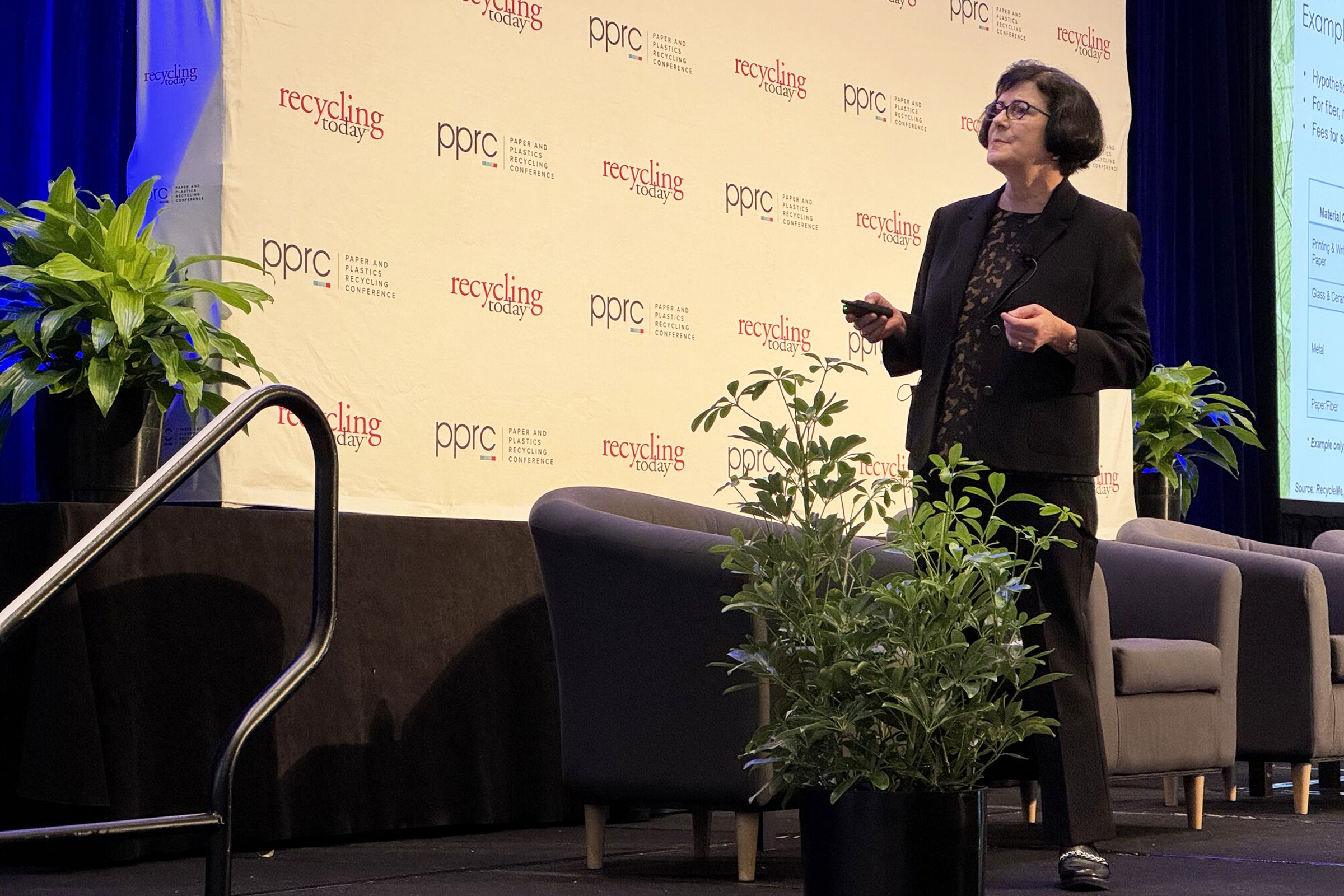
Susan Cornish told the PPRC audience that packaging EPR aims to build circularity through producer fees, stronger data and shared standards as states move to align their rules. | Courtesy Recycling Today

At the Paper and Plastics Recycling Conference in Chicago, industry leaders said extended producer responsibility (EPR) programs for packaging are changing how the US handles residential recycling, but warned that uneven state rules will slow the transition.

Moderator Bill Moore, president of Moore and Associates, opened the workshop and framed the stakes for producers, MRFs and mills that are preparing for new reporting and funding flows. He said one core premise of EPR is that the funding model for residential recycling services shifts away from the local level.

“EPR is supposed to fund residential recycling programs, which are currently coming at taxes or fees,” Moore said during the session. “But EPR has a lot of costs associated with it and I suspect there will be a lot of passing on.”

Consultant Susan Cornish walked through where laws stand and how programs work. Seven states have passed packaging EPR, and Oregon is the first mover on implementation, while California, Colorado, Maine, Minnesota, Maryland and Washington are at earlier stages. Several other states, including Illinois, are studying needs or advancing new bills.

“The concept is better circularity for packaging,” Cornish said. Under a typical EPR program, producers must enroll with a producer responsibility organization (PRO), report packaging sold in each state by substrate and form, and pay fees that reflect recyclability, processing cost and the value of recovered material. She said producers should expect significant adjustments in year two as methods and categories are refined by the program operator.

PRO Circular Action Alliance (CAA) manages several EPR programs and is working to harmonize definitions and reporting so companies do not face a different rulebook in every state, she said. She also noted that chemical recycling processes do not count toward post-consumer resin requirements and that composting pathways are included in California and Minnesota legislation.

Dan Gee, also of Moore and Associates, focused on responsible end markets, the qualification standard Oregon adopted for downstream buyers of recyclables under EPR. He said the framework requires legal compliance, chain of custody documentation, a minimum yield and environmental management systems, with self-attestation followed by third-party auditing on a set cycle.

“Oregon’s kind of the pace setter for responsible end markets,” he said. He added that Oregon set a minimum 60% yield for paper mills to qualify, which has raised questions about how proprietary operating data will be handled. He said the operator plans to rely on third-party auditors and aggregated reporting to protect confidentiality while verifying compliance. Early feedback from brokers and one MRF indicated they expect to direct more shipments to REM-approved domestic mills rather than export markets and acknowledged that the real work begins during the first full year of operation.

Moore said EPR can push design change and recovery of hard-to-recycle materials if programs are fine-tuned over time. He emphasized that the early phase will be iterative and that program operators and regulators will need to smooth friction points as they emerge.

After the session, Moore told Resource Recycling that the likely outcome is steady change rather than abrupt transformation. “The upside is that EPR pushes more recycling and pushes more recycling of difficult-to-recycle materials and develops the end markets,” he said. “The issue is really, I think, a complexity, and it’s going to take us some time to get through it. These things are going to be modified over time to make them more effective and efficient.”

He also said that national politics are unlikely to drive near-term outcomes because solid waste and recycling policy is formed at the state level. “The EPA doesn’t really control it,” he said. He added that federal interest has surfaced before but does not appear active at the moment.

Moore said history points toward eventual harmonization once enough states are in motion and producers seek a single framework. “Once a few states pass it, producers say, ‘Give us one federal rule so we can make the same product everywhere.’ That’s the history of all environmental legislation,” he said.

For now, the panelists said the focus is on accurate data, clear chain of custody, and program designs that reward recyclability and verified end-market performance while keeping industry input in view as rules mature.


Tags: EPRPolicy Now
TweetShare
Scott Snowden

Scott Snowden

Scott has been a reporter for over 25 years, covering a diverse range of subjects from sub-atomic cold fusion physics to scuba diving off the Great Barrier Reef. He's now deeply invested in the world of recycling, green tech and environmental preservation.

Related Posts

Lawsuits hover days after SB 54 approval

NAW-backed coalition seeks SB 54 injunction

byStefanie Valentic
August 21, 2026

NAW says SB 54's 2032 recyclability mandate leans on the same standard a federal judge already froze in the SB...

The Maine state capitol building.

No bidders respond to Maine’s EPR RFP

byStefanie Valentic
August 20, 2026

Following CAA's announcement that it would not submit a bid for Maine's EPR program, the state's DEP announced that no...

The Maine state capitol in Augusta.

Circular Action Alliance won’t bid on Maine’s PRO contract

byStefanie Valentic
August 19, 2026

Circular Action Alliance announced it will not submit an RFP to implement Maine's EPR packaging program.

Landfill seen from above with equipment moving materials.

PFAS, EPR reshape waste and recycling policy

byStefanie Valentic
August 19, 2026

David Biderman, industry veteran and consultant, provided a regulatory update to attendees at WR Expo.

State program revamp proposal advances in Oregon

Oregon EPR ruling looms: what legal experts think

byStefanie Valentic
August 17, 2026

A ruling in NAW v. Feldon is expected by the end of August. Here's what legal experts think will happen.

End markets, policy key to RPET viability

PET in focus: Is help on the way?

byAntoinette Smith
August 17, 2026

California market payments progress State-level PCR mandates too new to evaluate India may provide look at future  The past few...

Load More
Next Post

Coated paper group plans for EPR rollouts

2026 Buyers’ Guide

Equipment, services and technology suppliers serving the recycling industry.

Browse the Guide

More Posts

The Maine state capitol in Augusta.

Circular Action Alliance won’t bid on Maine’s PRO contract

August 19, 2026
The Maine state capitol building.

No bidders respond to Maine’s EPR RFP

August 20, 2026
State program revamp proposal advances in Oregon

Oregon EPR ruling looms: what legal experts think

August 17, 2026
Company debuts battery-containing device shredder

New battery shredding system debuts stateside

August 20, 2026
PureCycle sees easing headwinds to R-PP adoption

PureCycle says H2 outlook already playing out 

August 13, 2026
ESG

Foreign equity is moving into North America’s e-scrap origination

August 19, 2026
Google explores how to capture 4.5 billion tons of plastic

Bale pricing diverges for August

August 18, 2026
End markets, policy key to RPET viability

PET in focus: Is help on the way?

August 17, 2026
Triple-digit revenue gains propel ABTC’s expansion

LFP batteries gain acceptance. Can they be recycled?

August 17, 2026
May pricing bullish for most bales

August pricing bearish for plastic bales

August 17, 2026
Load More

About & Publications

About Us

Staff

Archive

Magazine

Work With Us

Advertise
Jobs
Contact
Terms and Privacy

Newsletter

Get the latest recycling news and analysis delivered to your inbox every week. Stay ahead on industry trends, policy updates, and insights from programs, processors, and innovators.

Subscribe

Welcome Back!

Login to your account below

Forgotten Password?

Retrieve your password

Please enter your username or email address to reset your password.

Log In

Add New Playlist

No Result
View All Result
  • The Latest
  • Analysis
  • Recycling
  • E-Scrap
  • Plastics
  • Policy Now
  • Conferences
    • E-Scrap Conference
    • Plastics Recycling Conference
    • Resource Recycling Conference
    • Textiles Recovery Summit
  • Magazine
  • About Us
  • Advertise
  • Archive
  • Jobs
  • Staff
Subscribe
This website uses cookies. By continuing to use this website you are giving consent to cookies being used. Visit our Privacy and Cookie Policy.