





This article appeared in the December 2023 issue of Resource Recycling. Subscribe today for access to all print content.
The goal is to stop contamination at the source and to improve worker safety, said Ken Tierney, product manager at AMCS Group.
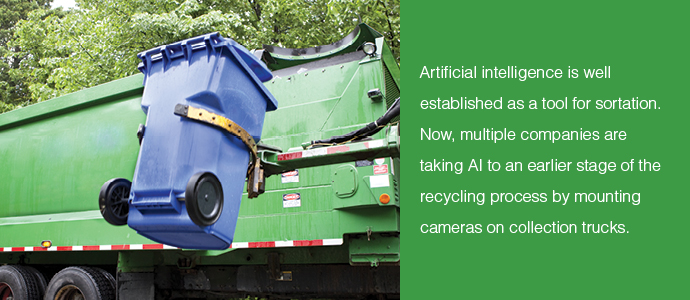
As one of several companies offering AI technology for collection, AMCS recently announced that it has deployed its Vision AI solution for the first time on Peninsula Sanitary Service’s trucks in California. “Our drive and goal is to automate as many of these processes as we can,” Tierney told Resource Recycling. “If we can reduce the load on the driver, there’s a safety aspect there as well.”
Meanwhile, Canada-based Prairie Robotics has been working with AI and collection vehicles for over five years. Sam Dietrich, CEO of Prairie Robotics, said interest in using AI and automation in vehicles has been steadily increasing, making it an exciting time for the recycling industry.
Entering the field
Prairie Robotics started out in response to a Saskatchewan province RFP to use AI to monitor what was being dumped from collection trucks into landfills. Dietrich said after building that application for the province, the team realized that “most people were not interested in the landfill data, because by then it’s too late. What people wanted was more data at the source, so we tried to dig into that more.”
That led Prairie Robotics to install cameras on recycling and organics collection vehicles to identify contaminants at the individual household level.
“What we’ve also done besides the data analysis and reporting side is build out a full education suite,” Dietrich said. “We can send personalized postcards, texts, emails, in-app notifications, to a resident and inform them of their specific sorting mistakes.”
AMCS had a similar journey. Tierney said the company specializes in transportation operations, so it was aware of the problems MRFs faced with contamination.
He said AMCS started looking into the situation and leaned on its familiarity with cameras and sensor technology to develop a solution in partnership with the University of Limerick in Ireland. It then worked with Peninsula Sanitary Service for about a year to pilot and further develop the technology.
“That’s how we got to where we are today,” he said. “It was kind of a process of, ‘OK, we understand what the obstacles are. Are there any solutions out there at the moment that can meet that challenge?’ We discovered there was not and said, ‘Look, how can we then tackle that problem?’”
On Peninsula Sanitary Service’s trucks, AMCS equipped two cameras: one focused on the hopper and one to check whether bins are overfilled. The lift of the front loader triggers the cameras to record so AMCS can use GPS coordinates and other logistics information to connect bins to households.
Currently, six of Peninsula Sanitary Service’s trucks have been fitted with the cameras, with four more due to be fitted in the new year.
The rise of AI
Extended producer responsibility legislation and other reporting requirements have helped drive the rise of AI in an industry that often lacks solid data.
Dietrich said working in British Columbia, where extended producer responsibility for various types of packaging has been in place for decades, helped Prairie Robotics learn a lot about how the data it collects can be used for EPR.
“I think EPR is going to be a driving force,” he said. “And in terms of how we use AI to capture the data that’s needed, I think we’re still in the early days, but it’s an exciting movement that we’re seeing.”
He added that AI and automation also provide needed customer feedback to improve recycling.
“We’re the only industry that doesn’t provide personal feedback to our users,” he said. “When you look at water, electricity, heating, you get monthly feedback in the form of a monthly bill. You know what your usage is.”
Tierney said for AMCS, it was less about AI specifically and more about “picking the right technology to solve the problem.”
To automate data collection and analysis, “AI is definitely that sweet spot,” he said. “It definitely fits in there.”
Some of the legislative pressure is more indirect, Tierney said. For example, requirements to reduce the level of contamination mean you first need to measure the baseline and then track changes. That’s where the AI and automation systems come in.
Technological limitations
As with any developing technology, there are still limitations that Tierney and Dietrich run up against.
Tierney said the first thing AMCS had to contend with was the challenging visual conditions in a hopper.
In a MRF, material is “moving at a consistent speed, you can control the lighting conditions and it’s always the same,” he said. “It’s easy to see the material. When you’re on the collection vehicle, you’re looking into a hopper. Every time you empty a container the picture looks different.”
Dietrich also noted that to use AI in a vehicle, you need to not only identify the material, but track it as it moves, as well.
“Very early on we realized items in a hopper can linger in a hopper for literally hours, it would seem, depending on the item,” he said. “We spent a lot of time in our early days recording videos and benchmarking.”
However, as the technology becomes more widespread and refined, Dietrich is looking forward to being able to also use it to alert drivers when a hazardous waste item is put in a truck.
It’s a popular customer request, he said, and something Prairie Robotics is still testing. The items can be identified by AI easily enough, but Dietrich said the challenge is deciding what action happens next.
“What do you do with that data?” he said. “We’re having conversations with customers on do you have to turn the truck off and stop if you’re detecting a propane tank? This is not a situation for a postcard, it’s a situation for the driver.”
Prairie Robotics is also training its systems to identify more kinds of contaminants and expanding its education platforms in partnership with its customers and how to use the data it’s collected for other things, such as increasing participation or better cart management.
“That’s the direction we see ourselves going,” he said. “How do you use this data we’ve already captured to help us in other ways?”
Tierney said automation and AI will soon be the industry standard. Not only will that improve data collection, but it could attract a whole new crop of workers.
“It makes the industry more attractive to the younger generations,” he said. “In the past, if you look at the waste and recycling industry it was not seen as the nicest or the most sought after industry to go into. But if you stand back and look at it now – and look at the level of automation and the use of tools like AI and sensors and cameras systems that have been fitted not only on the vehicles but the facilities as well – anyone interested in technology, that’s really a growing area in the waste and recycling industry.”
He also sees the approach of self-driving vehicles, which will make automated data collection even more necessary.
“We need to develop these technologies now to have them ready,” he said.
Marissa Heffernan is the staff reporter at Resource Recycling. She can be contacted at marissa@resource-recycling.com
This article appeared in the December 2023 issue of Resource Recycling. Subscribe today for access to all print content.