
Resource Recycling
  • The Latest
  • Analysis
    • All
    • Certification Scorecard
    • Industry Announcements
    • Opinion
    From claims to custody: PCR procurement grows up

    From claims to custody: PCR procurement grows up

    What the NAND flash crunch means for remarketing, refurbishment and residual values

    Telamon acquires ITAD consultancy Retire-IT

    Certification Scorecard — Week of July 6, 2026

    Tech giant pens detailed ‘plastic-free packaging’ guide

    What Google’s latest report means for ITAD

    Unpacking the Starbucks cup data

    Unpacking the Starbucks cup data

    Amazon cutting out more flexible packaging

    Amazon’s AWS hardware reuse is measured

  • Conferences
    • Resource Recycling Conference
    • Plastics Recycling Conference
    • E-Scrap: The Longevity Conference
    • Textiles Recovery Summit
  • Publications
    • E-Scrap News
    • Plastics Recycling Update
    • Policy Now
    • Resource Recycling
    • Other Topics
      • All Topics
      • Brand Owners
      • Critical Minerals
      • Glass
      • Grant Watch / RFPs
      • Markets
      • Organics
      • Packaging
      • Research
      • Technology
      • Textiles
Subscribe
No Result
View All Result
Resource Recycling
  • The Latest
  • Analysis
    • All
    • Certification Scorecard
    • Industry Announcements
    • Opinion
    From claims to custody: PCR procurement grows up

    From claims to custody: PCR procurement grows up

    What the NAND flash crunch means for remarketing, refurbishment and residual values

    Telamon acquires ITAD consultancy Retire-IT

    Certification Scorecard — Week of July 6, 2026

    Tech giant pens detailed ‘plastic-free packaging’ guide

    What Google’s latest report means for ITAD

    Unpacking the Starbucks cup data

    Unpacking the Starbucks cup data

    Amazon cutting out more flexible packaging

    Amazon’s AWS hardware reuse is measured

  • Conferences
    • Resource Recycling Conference
    • Plastics Recycling Conference
    • E-Scrap: The Longevity Conference
    • Textiles Recovery Summit
  • Publications
    • E-Scrap News
    • Plastics Recycling Update
    • Policy Now
    • Resource Recycling
    • Other Topics
      • All Topics
      • Brand Owners
      • Critical Minerals
      • Glass
      • Grant Watch / RFPs
      • Markets
      • Organics
      • Packaging
      • Research
      • Technology
      • Textiles
Subscribe
No Result
View All Result
Resource Recycling
No Result
View All Result
Home Resource Recycling Magazine

Building and reaching: EPA opens grant applications

Dan HoltmeyerbyDan Holtmeyer
October 15, 2024
in Resource Recycling Magazine
Rawpixel.com/Shutterstock.

This article appeared in the October 2024 issue of Resource Recycling. Subscribe today for access to all print content.

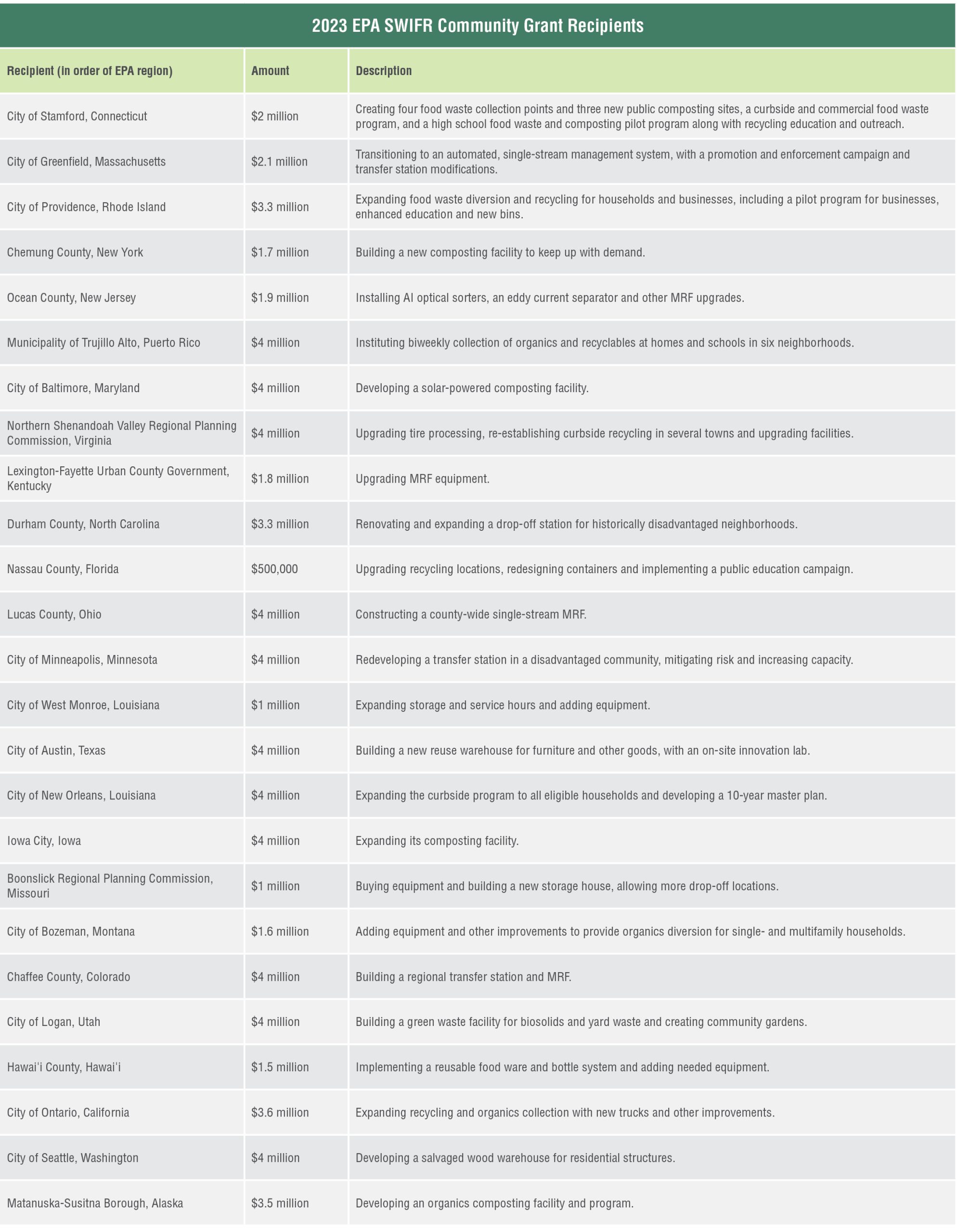
If you missed the chance to grab a slice of the $198 million federal recycling grant pie last year, your second chance has arrived.

More than $100 million is available to local governments, Native tribes and other organizations for either recycling infrastructure on one hand or public education around the topics of food waste and composting on the other, the U.S. EPA announced in September. The announcement came as recipients of the first round in 2023 began hiring staff, collecting data, buying equipment and launching local outreach campaigns.

All of those millions came courtesy of the 2021 Bipartisan Infrastructure Law, which allocated hundreds of billions of dollars to transportation, energy and other sectors.

“Thanks to President Biden’s Investing in America agenda, EPA is deploying unprecedented resources to improve recycling services and increase educational outreach to communities,” EPA Administrator Michael S. Regan said in a written statement. “When we work together to prevent waste that contributes to climate change, we support local economies, create jobs that pay well, and better protect the health of everyone in the community.”

As in the first round, the new grant program prioritizes proposals that would benefit “communities that are marginalized by underinvestment and overburdened by pollution” while bolstering a more circular economy nationwide, according to the announcement. It’s available in three buckets:

  • Solid Waste Infrastructure for Recycling grants for federally recognized tribes and intertribal consortia: $20 million total for individual grants ranging from $100,000 to $1.5 million, to establish, grow or otherwise improve recycling collection and management systems. As of this writing, applications are due March 14, 2025.
  • SWIFR grants for political subdivisions of states and territories, such as cities and counties: $58 million total for individual grants from $500,000 to $5 million, for the same purposes as the tribal grants. Applications are due Dec. 20.
  • Recycling education and outreach: a single $39 million grant for a coalition project that would implement a national consumer food waste reduction campaign, increase the market for compost and boost education and outreach about composting. Applications are due Dec. 20.

Applying for federal grants can be an intimidating process, requiring meticulous documentation and detailed planning. But it’s also an arena where even small organizations that have never received a federal grant before can succeed, said Jill Buck, founder and board member of the Go Green Initiative. The California-based nonprofit received $1.1 million last year, its first EPA grant ever, to work with school district staff and high school students in Camden, New Jersey, to spread understanding and participation in recycling programs.

“It’s not for the weak of heart, I will tell you that,” Buck said of the application process, adding that applicants should start early and take advantage of EPA’s informational sessions and other technical assistance. “This is the ultimate reading comprehension exercise; you really have to be fastidious and have tremendous attention to detail when it comes to the instructions.”

Fitting all of the needed information within the page limit can feel “like squeezing a watermelon into a Coke bottle,” she said. “Then you need to demonstrate that you can handle the money.”

A clear and compelling purpose also helps, said Susan Caswell, sustainability director for Florida’s Osceola County. The county received about $750,000 for an education and demonstration effort with a particular focus on glass, which the county had to give up in its bids for county-wide recycling and trash pickup service in 2019 — “every single potential vendor asked us to remove glass,” Caswell said. Yet why the county doesn’t recycle glass is still one of the most frequent questions she hears, and some residents pay a private service to collect it.

The education campaign will work with local schools and feature a mobile glass pulverizer, not only to process the material right in front of residents’ own eyes but also to harness the latent interest in glass to inspire recycling initiatives in the area, Caswell said. The area is full of hotels and restaurants, for example, which generate “just a tremendous amount of glass.”

“We went for the education and outreach kind of as the first step in rethinking glass recycling for the county,” Caswell said. “It allowed us to tell that story in an effective way.”

Projects such as these also highlight how the EPA grants can have ripple effects, both in their targeted communities and in others that might follow their example. Buck said the New Jersey plan — particularly environmental clubs, internships and leadership development for high school students — already proved itself in Pleasanton, California. Since the Go Green Initiative launched a similar project almost a decade ago, the city has seen recycling rates and collections rise while contamination fell by 27%, according to a letter from the city to the EPA.

“They were getting out to businesses and church groups and civic organizations,” Buck said of the Pleasanton students. And as Caswell put it, when it comes to the youth, “if you get them engaged in it, then they start getting on their parents’ case to do better.”
Tags: Local ProgramsPolicy Now
TweetShare
Dan Holtmeyer

Dan Holtmeyer

Related Posts

SB 54 draft rules generate debate on rates, review

California increases PET market payments

byAntoinette Smith
July 7, 2026

While the state extended the incentive program, the status of a separate bill with similar goals is uncertain.

Two recycled-content bills gain approval in California

California agriculture seeks SB 54 repeal

byStefanie Valentic
July 7, 2026

A coalition of state agriculture stakeholders says the packaging law could add nearly $1,400 a year to household grocery costs...

In Our Opinion: Coalitions: The EPR Differentiator

Inside NAW’s constitutional case against packaging EPR

byStefanie Valentic
July 6, 2026

The National Association of Wholesaler-Distributors is fighting EPR in Oregon, and now in California too.

EPR fees are a market signal. Here’s what they’re telling you.

Building the infrastructure behind EPR

byStefanie Valentic
July 6, 2026

CAA's Jeff Fielkow breaks down the organization's role in US packaging EPR and why being the only multi-state PRO in...

Oregon’s Recycling Modernization Act faces injunction

Oregon’s EPR program posts first-year results

byStefanie Valentic
July 6, 2026

One year into Oregon's producer-funded recycling system, CAA provides an update on new carts, and the progress achieved.

Utah highway project to reuse pavement

Utah highway project to reuse pavement

byAntoinette Smith
July 2, 2026

The state Department of Transportation is using cold in-place recycling to repurpose existing roadway, save millions and reduce emissions.

Load More
Next Post

First-person Perspective: The case for national data reporting

More Posts

Oregon’s Recycling Modernization Act faces injunction

Oregon’s EPR program posts first-year results

July 6, 2026
Two recycled-content bills gain approval in California

California agriculture seeks SB 54 repeal

July 7, 2026
Unpacking the Starbucks cup data

Unpacking the Starbucks cup data

July 8, 2026
In Our Opinion: Coalitions: The EPR Differentiator

Inside NAW’s constitutional case against packaging EPR

July 6, 2026
Tech giant pens detailed ‘plastic-free packaging’ guide

What Google’s latest report means for ITAD

July 8, 2026
EPR fees are a market signal. Here’s what they’re telling you.

Building the infrastructure behind EPR

July 6, 2026
SB 54 draft rules generate debate on rates, review

California increases PET market payments

July 7, 2026
MP Materials breaks ground on rare earth magnet campus in North Texas

ERI confirms ITAD shift toward minerals

July 3, 2026
ITAD firm wins spot for NASA purchasing

ITAD firm wins spot for NASA purchasing

July 6, 2026
Auto Draft

Digital product passports offer gateway into secondary market

July 7, 2026
Load More

About & Publications

About Us

Staff

Archive

Magazine

Work With Us

Advertise
Jobs
Contact
Terms and Privacy

Newsletter

Get the latest recycling news and analysis delivered to your inbox every week. Stay ahead on industry trends, policy updates, and insights from programs, processors, and innovators.

Subscribe

Welcome Back!

Login to your account below

Forgotten Password?

Retrieve your password

Please enter your username or email address to reset your password.

Log In

Add New Playlist

No Result
View All Result
  • The Latest
  • Analysis
  • Recycling
  • E-Scrap
  • Plastics
  • Policy Now
  • Conferences
    • E-Scrap Conference
    • Plastics Recycling Conference
    • Resource Recycling Conference
    • Textiles Recovery Summit
  • Magazine
  • About Us
  • Advertise
  • Archive
  • Jobs
  • Staff
Subscribe
This website uses cookies. By continuing to use this website you are giving consent to cookies being used. Visit our Privacy and Cookie Policy.