









This article appeared in the March 2022 issue of Resource Recycling. Subscribe today for access to all print content.
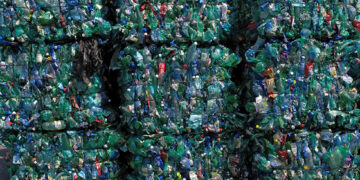
According to the most recent U.S. EPA data, the U.S. only recycles an estimated 14% of plastic packaging. The International Union for Conservation of Nature estimates at least 14 million tons of plastic end up in the ocean every year, threatening food security and human health as well as contributing to climate change.
Meanwhile, the U.S. lacks basic infrastructure capabilities for curbside recycling and composting, and affordable reuse programs are unavailable or do not yet exist at scale.
In short, packaging design and sorting technology have outpaced the U.S. recycling system, which was built to accommodate limited products. Communities that offer recycling or composting services often cannot maintain sustainable programs due to competing demand for funding and lack of value for the recyclables.
To help progress on these significant issues, the U.S. Plastics Pact is committed to helping ensure that plastics never become waste by eliminating the plastics we don’t need and innovating to ensure that the plastics we do need are reusable, recyclable or compostable. The objective is to circulate all the plastic items we use to keep them in the economy and out of the environment.
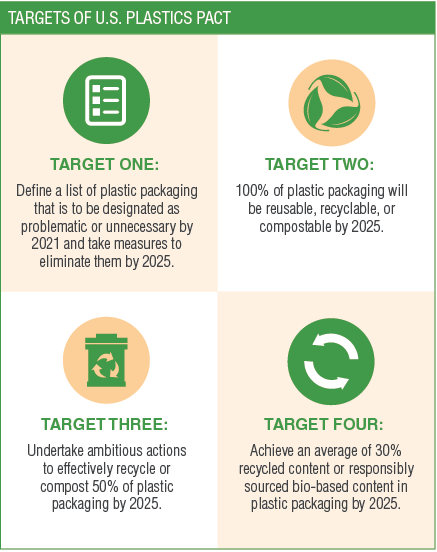
More than 100 businesses, nonprofit organizations, government agencies and research institutions have joined the U.S. Pact as “Activators” and are aligned on four 2025 targets to address plastic waste at its source (see side image below).
All U.S. Pact Activators who were members during the organization’s reporting window submitted data for a recently published baseline report (using 2020 as a baseline year). Activators will assess their portfolios and report progress from the baseline report toward the four targets in the coming years. Progress toward elimination will be documented in aggregate as part of the U.S. Pact’s annual reports. Important pathways and strategies noted in the baseline report include:
- Shifts away from non-recyclable plastic packaging and toward packaging that is more easily captured and reclaimed with higher value.
- Increases in the use of post-consumer recycled content (PCR) in plastic packaging.
- Improved technologies and increased use of technology to make the recycling process more efficient.
- Pilot projects around innovative and accessible reuse models.
- Enhanced communication to help more Americans know how to recycle plastic packaging.
The U.S. Pact’s 2020 baseline report provides information on where the journey begins and where the organization will focus efforts to propel the monumental change required to create a circular economy for plastic packaging.
The data show clearly that Activators have a lot of work to do. At the same time, the U.S. Pact is encouraged by growing support for policy measures that will enable reuse, recycling and composting infrastructure across the U.S. Many steps are needed to bolster composting and implement affordable reusable packaging. And this all comes in addition to the necessary support for recycling.
Target 1: Problematic and unnecessary packaging
Many Activators did not wait for the U.S. Plastics Pact to develop its list of problematic and unnecessary materials to act. In 2020, 66% of business Activators were already making individual plans and taking steps to eliminate specific materials, formats and packaging components to move from non-recyclable to recyclable package designs. This included:
- Elimination of PETG, PVC, PVDC, and PS/EPS by substituting
- readily recyclable resins.
- Elimination of undetectable carbon black.
- Elimination and reduction of primary films, cutlery and straws.
- Removal or redesign of components such as windows, labels, closures and fitments.
- Redesign from multi-material to mono-material packages.
- Reduction in the use of virgin material through lightweighting, right- sizing of packages, and use of PCR.
These elimination, reduction and redesign efforts conducted by Activators in 2020 are aligned with the official U.S. Pact’s Problematic and Unnecessary Materials List and Design for Recyclability Playbook (more on this below).
These actions are also consistent with actions presented in the Ellen MacArthur Foundation’s 2020 and 2021 Global Commitment Progress Reports.
Target 2: Designed to be recovered
As of 2020, 37% of plastic packaging placed on the market by U.S. Pact Activators was reusable, recyclable or compostable.
Taking action to technically design packaging for recycling is something companies have within their control and is a key element of the U.S. Pact’s definition of “recyclable packaging.” The U.S. Pact developed a Design for Recyclability Playbook to give Activators consistent guidance on design specifications to ensure plastic packages put on the market are compatible with the recycling system.
In pursuit of this target, it is also important to note that two-thirds of business Activators have a reuse model or pilot program, and 9% of business Activators increased compostable plastic options.
Target 3: Establishing the Baseline
While data regarding Targets 1, 2, and 4 are an aggregation from Activator reports, the U.S. Plastics Pact must rely on external sources to measure progress toward Target 3 (recycle or compost 50% of plastic packaging by 2025). The U.S. EPA’s annual “Advancing Sustainable Materials Management: Facts and Figures” report is the core data source, with stakeholders recognizing its shortcomings.
To arrive at the most accurate measurement, the U.S. Pact supplemented the EPA data with reliable industry data, to calculate a baseline recycling/composting rate of 13.3% for the materials within the U.S. Pact scope. For more on the details of the group’s scope, go to usplasticspact.org/us-plastics-pact-scope.
Target 4: Promoting best-in-class practices
The U.S. Plastics Pact Design for Recyclability Playbook helps Activators prioritize action by identifying best-in-class practices for the use of post-consumer recycled content per format (while acknowledging challenges) and highlighting opportunities for innovation for maximum use of PCR. The Playbook and other resources shared with U.S. Pact members explain the value of using post-consumer recycled and responsibly sourced bio-based content as well as options to certify use of these materials and facilitate their use in practice.
Such action can help Activators move toward achieving the goal of using an average of 30% recycled content or responsibly sourced bio-based content in plastic packaging by 2025.
It’s also worth noting that successful creation of a circular economy for plastics includes policy to drive action. The U.S. Pact supports extended producer responsibility (EPR), deposit return systems and PCR mandates. The U.S. Pact is also assessing the critical details of policy, including eco-modulation as part of an EPR program and mandatory recycled content that requires or incentivizes the use and certification of post-consumer recycled content.
The supply of post-consumer recycled plastics generated through an increased recycling rate per Target 3 will also help the U.S. Pact Activators to meet the Target 4 obligations.
Bringing the pieces together
The U.S. Plastics Pact is undertaking research in 2022 to develop a strategy for the achievement of Target 4 by the priority resins and formats, including analyzing model scenarios, key challenges, attention to food contact requirements and actions needed, all in line with Target 2.
It is increasingly critical that the work of the U.S. Pact run deep within each Activator as the organization implements the Roadmap to 2025. Building the circular economy rests on each of us thinking differently, constructively critiquing why we do things the way we do and asking ourselves if there is a more efficient solution.
The U.S. Pact calls on each and every business that is part of the U.S. plastic packaging value chain to join us.
Emily Tipaldo is executive director of the U.S. Plastics Pact and can be contacted at [email protected].
The U.S. Pact was launched in August 2020 by The Recycling Partnership and World Wildlife Fund. The U.S. Plastics Pact is part of the Ellen MacArthur Foundation’s Plastics Pact Network, which connects national and regional organizations around the world working to implement solutions toward a circular economy for plastic.
This article appeared in the March 2022 issue of Resource Recycling. Subscribe today for access to all print content.