










This article originally appeared in the April 2019 issue of Resource Recycling. Subscribe today for access to all print content.
Just like local governments, recycling programs come in all sizes. Some communities have a dozen or more staffers dedicated solely to recycling program service. Others might have a single employee assigned to materials diversion, and the person could be shared with another city department.
Amid today’s market uncertainties, however, communities and industry stakeholders are continuing to invest in recycling systems nationwide. From working with municipalities large and small, one thing is clear: communities could use a little bit of help with outreach to residents.
The Recycling Partnership is a national nonprofit funded by different segments of the packaging industry to “transform recycling for good” and improve recycling across the U.S. (Full Disclosure: The new owner of Resource Recycling, Inc., the Association of Plastic Recyclers, is one of more than 40 funders of the Partnership.)
As part of that work, we manage full-city campaigns, like the recently announced more than $4 million investment to bring robust educational and programmatic changes to recycling in the city of Atlanta. At the same time, we offer free tools for any community to use at recyclingpartnership.org. One example is our campaign builder, which offers easily customizable graphics and project plans to improve any recycling program.
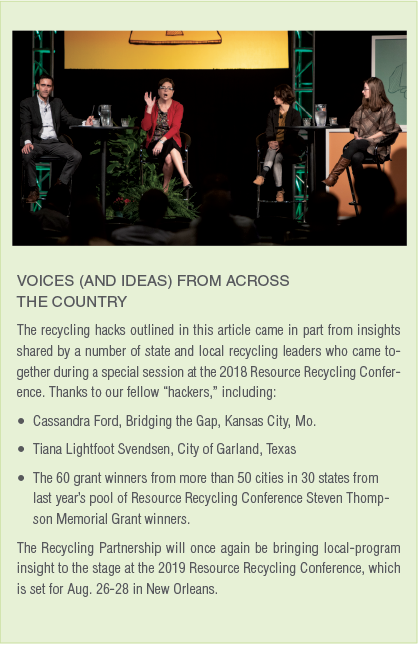 Through our experiences working in partnership with more than 1,000 municipalities and through our annual effort to bring local program officials together at the Resource Recycling Conference (see sidebar), we’ve run across a number of tips, tricks and strategies that have boosted the effectiveness of community recycling programs.
We call these concepts “recycling hacks,” and for the second year in a row, we’re pleased to share in these pages some hacks that have recently caught our attention.
Team up to extend outreach
It’s common for city officials to encounter funding shortfalls when it comes to developing comprehensive recycling outreach. But when multiple cities band together, they have the power to overcome that barrier.
For example, faced with a growing challenge of contamination, municipalities in the Tampa Bay, Fla. area joined up in 2017 to develop a regional message to help overcome that challenge.
The Tampa Bay Regional Recycling Partnership (which has no formal connection to The Recycling Partnership) includes the Tampa Bay area’s two most populated counties, along with their corresponding largest cities. Their regional goal was to deliver easy-to-understand recycling messaging that would result in behavior changes to reduce contamination in the regional recycling stream.
While the municipalities already had robust recycling education programs – and continue to maintain their individual programs – the regional campaign provided the scale they needed to reach their residents across the area.
Importantly, the effort also made sure to tie in materials recovery facilities (MRFs). Launched in April 2017, the Regional Recycling Partnership worked closely with local MRFs to determine which materials were most problematic within local streams, and the focus of the campaign was then based on those curbside realities.
The first segment delved into what was deemed the biggest issue – plastic bags and bagged recyclables. The second segment built on the first by including pesky tanglers such as hoses, ropes, cords and clothing.
The educational push around those problematic products included online videos, social media ads, billboards, print ads, mailers and a co-branded webpage – tampabayrecycles.org – that corresponds with the campaign hashtag (#TampaBayRecycles). The communication effort, which has spanned the region, also connects residents back to their individual municipalities for specifics on accepted materials.
The partners have each shared in the burden of the cost for the campaign deliverables, allowing their budgets to go much further. Overall, the outreach elements cost about $200,000 and reached more than 1 million residents.
Leaders of the initiative attribute its success to focusing on one recycling issue at a time, coordinating timing across the region, and leveraging funds to increase the overall return on investment.
Go social, but do it smartly
Increasingly, recycling coordinators are turning to social media to reach residents. But are we utilizing the tool to its full potential?
Simply placing a post on the social airwaves and hoping it makes its way to residents is likely not the best way to guarantee your social success. Luckily, social media outlets are equipped with a number of levers that, when pulled correctly, can help you reach your audience.
Step one is to clearly define who it is you are looking to reach. Facebook, Twitter and other networks will allow you to define your audience by characteristics such as age, location and general interest. By clearly specifying your target crowd, the network’s algorithms can then work to get your message to land in front of those it is most likely to influence.
Paying to “boost” selected posts will also help them cut through the clutter of social media feeds – a small budget can go a long way here. Unlike other forms of outreach, you don’t have to print anything or encounter other extraneous costs. And the few dollars you put behind the message can be well worth it: Some analysis has shown that without boosting a post, you will likely only reach 2 to 10 percent of your social media followers.
Then there is the question of what type of content to use in a social media message. Interactions are always more memorable. Ask residents a question about their recycling habits or about their recycling know-how. In addition to sparking engagement, interactive messaging can also help you gain information about what your residents do and don’t know.
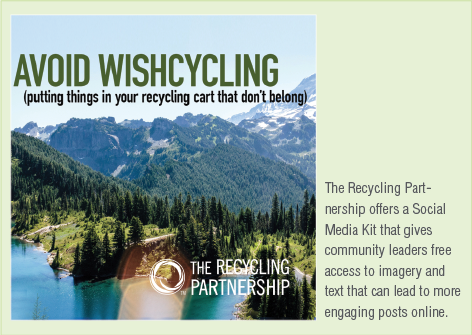 However, engagement can be a double-edged sword, potentially forcing staff to spend lots of time responding to comments online. Have draft responses to common questions and remarks ready to answer quickly and informatively, and put an FAQ page on your website.
The Recycling Partnership included a list of these messages as part of the latest update to our Social Media Kit (available at recyclingpartnership.org/social-2018). The kit also includes free imagery and customizable text for communities to grab and post.
It’s important to also remember that though it carries exciting possibilities, social media should not be viewed as the primary source of education about recycling in a community. Think of social media as the frosting to the cake, not the cake itself.
Don’t forget reuse
While all programs want to push higher volumes of recyclables into the manufacturing stream, the power of materials reuse should not be overlooked. And some communities have emerged as models on the reuse front.
Take, for example, Kansas City, Mo., where the multifaceted nonprofit organization Bridging the Gap regularly finds reuse opportunities through materials that are either reusable or not recyclable through its network of area charitable organizations.
One such program has kept more than 50 tons of usable ceramics out of the landfill every year while also giving hundreds of people needed reusable dishware for free.
In St. Louis, quarterly events run by city staff with volunteers aim to collect and deconstruct expired car seats – child safety organizations recommend that seats are retired after six years – with the resulting rigid plastic sent to a local plastics reclaimer.
St. Augustine, Fla., meanwhile, found a unique application for the large bristly brushes taken off of street sweepers. The items go to area dairy farms where cows use them as back scratchers (now there’s an engaging Facebook post).
Diversion doesn’t take a holiday over the holidays
One great way to bring attention to local recycling is finding ways to tie into specific seasons or holidays.
In Henderson County, N.C., a food waste collection program run at the county’s drop-off site was ramped up from October through December, a time of year when pumpkin carvings and family feasts are on the calendar. The effort helped to keep holiday organics out of the landfill, and it was coupled with a canned food drive at the center.
Another festive partnership took place recently in Wisconsin in multiple locations statewide, where recycling program leaders worked with local hardware stores to help run a Christmas light take-back program. Running from October through December, the collection move helped to keep the tangling material out of MRFs.
Helping those in need
Local programs can also find ways to blend materials recovery with humanitarian causes.
A community revitalization program in Jackson, Miss. took paint from drop-off locations and gave it to citizens to re-paint homes and worn-looking buildings. The action helped to beautify the community and increase home values.
In addition, “Operation Bedroll” in Greensboro, N.C. recovered clean, dry plastic bags. Volunteers then used the film to craft cushioning bedrolls for members of the city’s homeless population.
Small steps, big impact
All recycling programs require imagination and good amount of moxie on the part of the people running them. After all, a key attribute of a recycling coordinator is being able to handle everything that’s thrown at you – and we don’t mean just the dozens of bowling balls that likely end up at your MRF.
The best leaders harness that sense of ingenuity to connect with residents. Small operational changes can help make a big impact down the road, in the form of either higher diversion totals or more educated residents putting out cleaner materials.
So, take some of the recycling hacks outlined here and put them into practice in your community. And if you have any bright ideas that are lifting diversion or enlightening a community about diversion, don’t be shy about sharing them with your industry colleagues. Like we said at the start, all programs are looking for help right now.
Dylan de Thomas is vice president of industry collaboration at The Recycling Partnership and can be contacted at [email protected]. Alita Kane is the group’s community liaison and can be contacted at [email protected]. She is the former recycling coordinator for the city of Tampa, Fla.
The nonprofit Recycling Partnership has served more than 1,000 communities with best-in-class tools, data, resources and technical support. It has helped place 500,000 recycling carts, reached 50 million households, and helped companies and communities invest more than $37 million in recycling infrastructure.