



This story originally appeared in the June 2016 issue of Resource Recycling.
Subscribe today for access to all print content.
Foam polystyrene is one of the most commonly used consumer packaging materials that is not commonly recycled. While this has made it a target of environmental and regulatory scrutiny, it is also motivating some companies and groups in the recycling sector to focus their attention on increasing opportunities for consumers to recycle the material.
In short, stakeholders are discovering that providing opportunities to recycle foam can help programs reach diversion goals, and certain materials recovery facilities (MRFs) are finding that a focus on foam can help them meet growing resident and customer expectations.
Answers to economic challenges
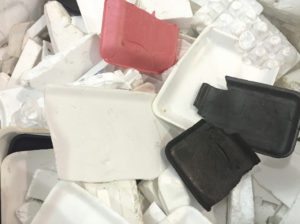
Foam polystyrene comes in a couple of varieties – expanded polystyrene (EPS), which has a bead-like structure (think foam cups and coolers), and extruded polystyrene (XPS), which has a smoother structure and is used in meat trays and egg cartons. Both deliver protection, insulation and other performance properties at a very low weight and cost. These factors make foam attractive as a packaging material, but they also make the economics of recovering it challenging.
There are some additional reasons why foam is not commonly accepted and processed at MRFs. Large foam blocks used in protective packaging for products such as large electronics and furniture typically have different densities than other foam packaging applications. Furthermore, some EPS foam products tend to break into small pieces if subjected to the impacts of a collection truck and typical MRF processing equipment. Those small foam pieces become residue at the MRF and can also contaminate other commodities.
A number of best practices have been developed to address these challenges.
First is the use of curbside collection carts, which can more easily accommodate large foam packaging than bins. Some communities accept these materials at drop-off sites, a strategy that can serve as a transition step on the way to curbside acceptance.
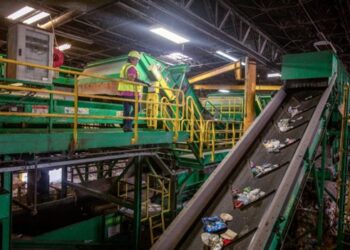
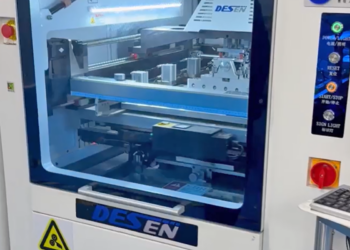
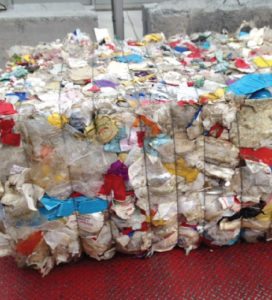
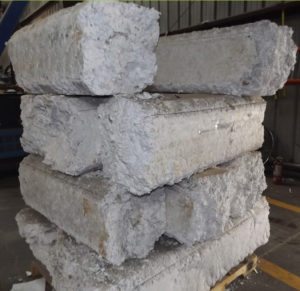
Once the foam arrives at the MRF, it’s most easily handled if removed at the beginning of the processing line, thus minimizing loss and contamination due to breakage. Where this is not feasible due to constraints such as space, foam (including fragments) can be captured by an optical sorter at a later point. Several other types of equipment can also be helpful for MRFs. Densifiers improve the logistical and economic aspects of recycling foam by reducing the volume. A 48-foot truckload of densified foam will weigh around 40,000 pounds, but an undensified load will be just
16,000 pounds.
Michael Westerfield, director of recycling programs at Dart Container Corporation, a major producer of foam packaging, has extensive experience testing different types of densifying equipment and has found that hydraulic densifiers work best with mixed-density material, such as packaging for furniture, electronics and food.
Westerfield also recommends some other strategies to help MRFs minimize footprint and labor requirements. One efficient solution is placement of a grinder under the catwalk so that foam sorted from the line can drop through a chute to the grinder hopper. A blower and piping can automatically transport the ground foam to the densifier so that no additional labor is needed. Automated densifiers sense when the hopper is full, turning on and off automatically, further minimizing the number of touches required. Labor is required for quality assurance (to remove non-foam material before it is ground) and for transferring logs of densified foam onto pallets. But these steps might only be needed for a few hours per day or week, depending on the MRF throughput and volume of foam collected.
Colorado case study
Some facility operators note that in a competitive recycling market, the acceptance of a wide variety of materials, including foam, can help to differentiate a company and improve its offering to customers.
Last year a Denver-based MRF operator, Alpine Recycling, decided to begin accepting foam as a way of demonstrating leadership in a tight marketplace.
Founded as a waste disposal company in 1999, Alpine still operates its own landfill in a rural area 35 miles from its MRF. However, Alpine is focused on growing its recycling business in the commercial and residential sectors, and in 2007, the company built the second single-stream recycling facility in Colorado. It is now the largest independently owned waste and recycling company in the state.
Alpine’s move to begin taking in foam materials was made possible in part through an equipment grant from the Foodservice Packaging Institute’s Foam Recycling Coalition, or FRC. [Editor’s note: The authors of this article work for RRS, which provides consulting services for FRC.] In mid-2015, Alpine was scheduled for a complete update and retooling of all plant equipment, which created an ideal situation to fulfill its goal of adding foam collection to local commercial and residential recycling programs.
“As a company, Alpine is always trying to look at different things we can take out of the waste stream,” said Brent Hildebrand, operations manager at Alpine. He noted the company began recycling aseptic cartons in 2009 and then also started accepting mixed rigid plastics.
Hildebrand believes adding foam is possible for MRFs of varying sizes and streams.
“It takes a little bit of effort and out-of-the-box thinking,” said Hildebrand.
The foam densifier at Alpine entailed a new level of staff and customer training. The MRF manually sorts XPS and EPS (for white and colored foam) to be densified, with workers at all stations on alert to pull the foam from the single-stream processing line. Alpine worked with its collection customers and third-party haulers to educate them about the addition of foam.
“As with any commodity, there is some level of contamination, but foam has been really clean,” said Hildebrand. “The program has exceeded my expectations. It is a training process with our staff, and they have done a great job of listening to what we are trying to create.”
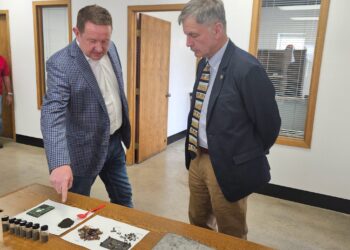
According to Hildebrand, Alpine had been exploring opportunities for marketing foam for several years and had always found receptive buyers. Indeed, some end markets such as picture frame manufacturers have indicated a demand for more material.
A 2014 study commissioned by the FRC and conducted by the Berkeley Research Group found that demand was growing and identified an extensive list of more than 130 buyers, including end users and re-processors. A list of buyers is also maintained at homeforfoam.com, a site developed by Dart Container.
Fulfilling resident desire
In some communities, resident demand to divert more materials from disposal has been the impetus for adding foam to residential recycling programs. Residents of Colchester, Nova Scotia could begin diverting foam through their residential dual-stream system on April 1 of this year.
“The residents have been wanting this for a long time,” said Jann McFarlane, materials recovery facility manager in Colchester. “I’m actually a little bit shocked at the amount of material coming in. There have been rumors of some residents storing it in their basements in anticipation of our start date.”
The municipality of Colchester also received a grant from the FRC to purchase a densifier for its municipally run MRF. The grant helped the municipality, which has a population of around 50,000 people, achieve a long-standing diversion goal.
“Adding foam was our director’s dream,” said McFarlane.
The success of foam recycling in Colchester can also be attributed to a robust residential education program. Colchester has a web widget and phone app to help residents with ongoing recycling education. The municipality featured the new program on the front page of its app, website, distributed postcards, newsletters and e-mails.
“A big focus of our education was around meat trays,” said McFarlane. “We told residents the absorbent pad and the wrapping go in the garbage and that they should give the tray a quick rinse, then put it in the container bag. People have been following that for the most part.”
Also in Nova Scotia, waste management authority Valley Waste Resource Management (VWRM) has been accepting EPS and XPS foam for more than a year from seven municipalities. The residential curbside programs it serves added foam to the container recycling bags as part of a dual-stream collection system. The source-separated recycling trucks are equipped with internal doors allowing for increased space for bulkier items like foam.
VWRM received a grant from Resource Recovery Fund Board Inc. (RRFB) Nova Scotia, a nonprofit corporation encouraging waste diversion efforts, to purchase a densifier for the program. VWRM works with Scotia Recycling Ltd. to process and market foam and other recyclables, and VWRM spent $10,000 on an outreach campaign to promote acceptance of the material.
“The business case for us was that disposal is an expensive process to manage,” said Andrew Garrett, communications manager at VWRM. “We ship our garbage an hour away. So by recycling foam, we save on trucking and the life of the landfill.”
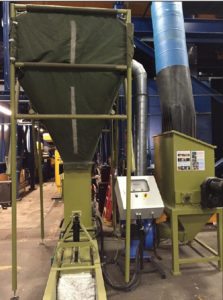
Over the past year, VWRM has recycled more than 22 metric tons of foam.
“It is overwhelmingly popular with residents,” said Garrett. “I think it is something people have always had but have felt guilty throwing out.”
Two types of PS in a single bale
While the efforts mentioned above focus on handling recovered foam separate from other materials, an innovative approach being pioneered by Plastic Recycling Inc. (PRI), a recycler of polystyrene (PS) and other plastics, is the acceptance of both rigid and foam polystyrene in a single bale for processing and recovery. According to Brandon Shaw, marketing manager for PRI, the company has been recycling foam since 1988.
“We got into post-consumer PS recycling because we saw this as the next untapped market,” Shaw said. “The post-industrial market was tapped out, and our customers demanded more recycled content and especially PCR content.” As part of an arrangement with Omni Recycling LLC (an affiliate of Dart), PRI recently opened a facility in Indianapolis with an annual capacity of 25 million pounds.
The facility is designed to handle residential rigid and foam PS from MRFs and has been operating since January 2016. Incoming material from mixed rigid and foam bales undergoes quality assurance via an optical sorter before it is ground and washed. Foam is separated from rigid PS using float-sink separation, and then the two fractions are spun, dried and pelletized.
Post-consumer PS from both recovered foam and rigid PS is then custom compounded, pelletized and sold to customers.
The processing of mixed rigid and foam PS bales offers some promising synergies. By capturing both materials together, MRFs that do not have a large stream of incoming foam can achieve a critical mass of material to make foam recovery feasible. It is also an alternative to densifying foam that allows MRFs to increase the density of the PS bales to make transporting the material economical. Like a densified foam load, a mixed rigid/foam PS load can exceed 40,000 pounds.
However, it’s not simply that the rigid PS helps to facilitate the recovery of foam – the converse is also true. The mixed PS bale provides an avenue for recovery of the rigid PS, which would otherwise typically be included in a mixed plastics bale but which might not ultimately be recovered from that bale. That makes mixed PS a bale with a whole that’s greater than the sum of its parts.
Differing perspectives
It’s clear that debate over foam management in North America is far from over. As the examples in this article show, a number of companies in different markets are finding foam PS collection and processing to be a viable and valuable undertaking.
Interestingly, these moves happen as large cities such as San Francisco continue to consider bans on foam products, often noting that the material cannot be recovered economically. The progress of operations that fine-tune best practices to handle the material could go far in affecting public debate around the material in the years ahead.
Catherine Goodall is a senior consultant at RRS and can be reached at cgoodall@recycle.com. Marissa Segundo is a communication consultant at RRS and can be reached at msegundo@recycle.com.