



This article appeared in the August 2024 issue of Resource Recycling. Subscribe today for access to all print content.
As executive director of the Tahoma Indian Center, a nonprofit serving Indigenous people in Tacoma, Washington, Colette August generally hasn’t had a positive impression of working with the city government. Some of its initiatives have been difficult for the nonprofit to participate in, she said, and city employees generally don’t take the time to visit the center, to speak with the people seeking its help with food or housing or other needs, and to understand the distinctions among the region’s tribes.
She has had a different experience, however, with Preston Peck, a senior sustainability analyst for the city. Peck oversees a community ambassador program that leans on trusted individuals among diverse communities to spread the word about the city’s utilities. Over the last two years or so, he has come to the Tahoma center and forged meaningful connections that have culminated in a $2 million, federally funded partnership, which includes the center and four other community-based organizations, to grow public understanding of recycling. It’s part of a nationwide, multicultural collaboration to reach groups that have long been neglected by messaging efforts or dismissed by the industry.
“They are people who will help break down those barriers, and they truly care about making sure our community is being served, is being heard,” August said of Peck and his colleagues. “One of the reasons for me to say yes is for me to have someone willing to listen to the concerns that we have.”
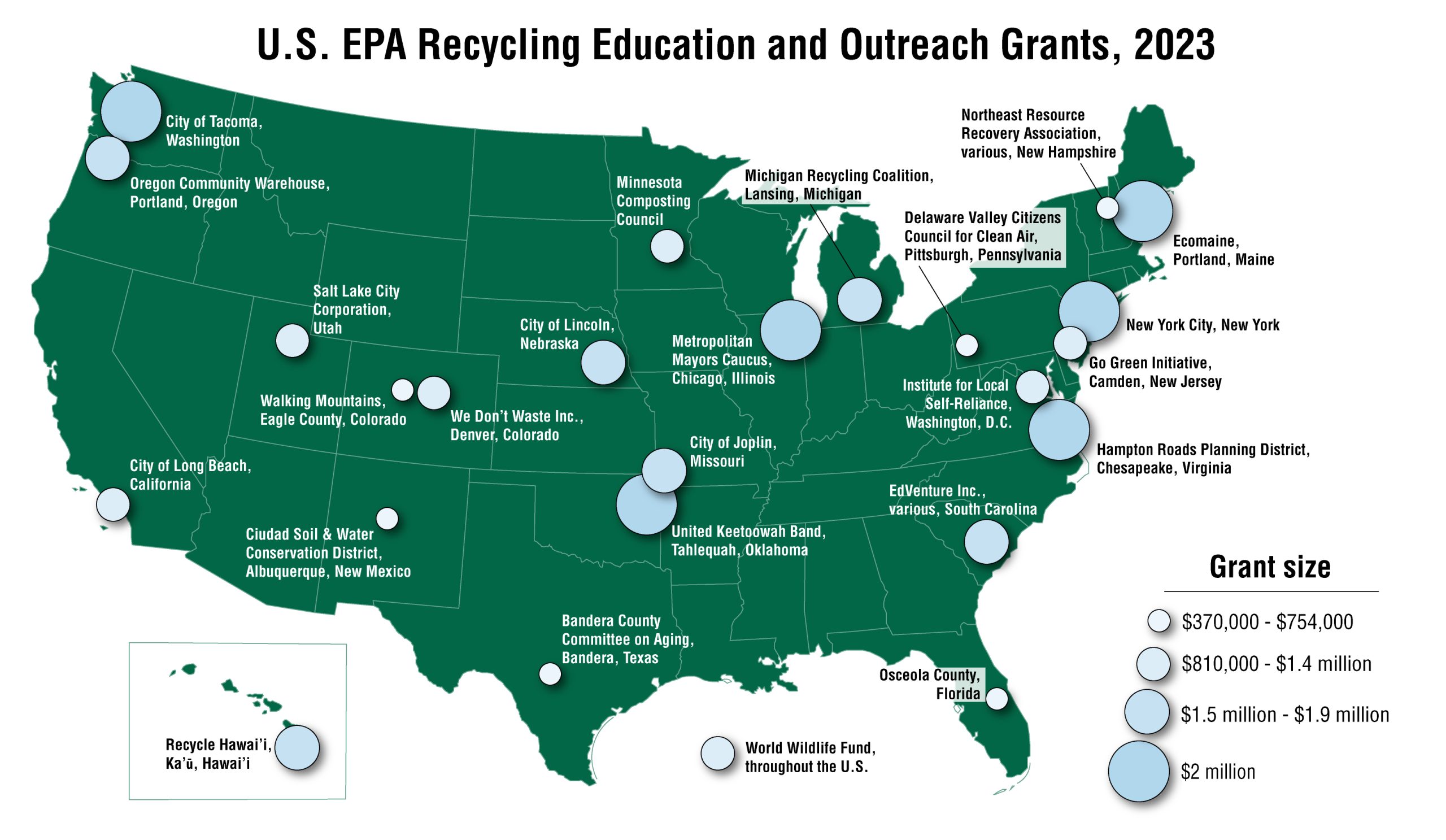
That’s precisely the purpose of the U.S. EPA Recycling Education and Outreach grants benefiting Tacoma and other locations across the country. The agency late last year announced 25 projects would receive a total of $33 million, which came from the 2021 Bipartisan Infrastructure Law and put particular emphasis on underserved populations disproportionately burdened by environmental problems. Even more money went toward infrastructure and heavy equipment needs.
“These grants reflect the Biden-Harris Administration’s commitment to tackling environmental justice and the climate crisis,” the agency wrote in a press release at the time, calling the program the largest investment in recycling in 30 years. “These recycling grants will help tackle consumer confusion and outdated recycling infrastructure, the largest barriers to proper recycling.”
Diverse communities, diverse approaches
The multiyear projects, many of which are still in the early stages of hiring managers and putting out preliminary bids, vary widely in dollar amount, geographic area and tactics, according to factsheets provided by the EPA and several participants. Tacoma, for example, will grow the community ambassador program while also using artificial intelligence on collection trucks to flag contamination and send direct feedback in the mail, Peck said.
Projects range in size from a $370,000 plan to build household and neighborhood composting programs in Pittsburgh to $2 million ad campaigns in the Chicago area, Virginia and eastern Oklahoma, among others. Recipients stretch from Maine, where the nonprofit recycling processor Ecomaine is working to reach multifamily residents, to the Big Island, where Recycle Hawai’i plans to train several cohorts of educators who will carry out their own education initiatives.
“This is an area where there is room for significant improvement, there’s a high ceiling that hasn’t been hit,” said Jamie Garvin, director of communications and public affairs for Ecomaine, referring to multifamily recycling. Multifamily properties tend to skew toward low-income, more diverse groups, he added, and the project will create toolkits for property managers and residents to help increase recycling participation from both directions.
“Even well-intentioned residents that might be motivated to do recycling don’t have the same access” compared to single-family neighborhoods, Garvin said. “That’s where we see opportunity to sort of level the field.”
Across the board, the projects aim to build existing initiatives to new heights, such as supporting New York City’s expansion of its curbside composting collection or building new exhibits at EdVenture Children’s Museum in South Carolina — featuring dinosaurs made of recycled materials, of course. The Oregon Community Warehouse, a Portland nonprofit that collects donated furniture and other home goods for refugees, formerly homeless families and others in need, is receiving $1.6 million as it expands to a third “furniture bank” location, said Phil Gerigscott, the group’s communications manager.
“We know there’s more than enough furniture in our community, it’s just a lack of awareness that we exist,” he said.
Past outreach was almost entirely word-of-mouth because of limited resources, so the money will help bring in a few more staff members and contractors, update the center’s website and develop culturally specific ads to reach potential donors in multiple languages, Gerigscott said. After English, Portland’s most common tongues include Spanish, Chinese, Vietnamese, Russian, Ukrainian, Korean and Arabic.
“We’re breaking down our constituent groups and figuring out who we’re already reaching and who we’re not reaching,” he said. “Even if they have heard of us, what are some potential barriers that are keeping them from donating?”
Gerigscott’s comments highlighted common threads throughout the 25 projects, including meeting residents of all backgrounds where they are, incorporating their particular backgrounds and replacing program administrators’ assumptions or ignorance with real knowledge.
Project leaders spoke of holding in-language gatherings at convenient and familiar locations rather than at City Hall, providing culturally appropriate meals so families can attend, and generally setting the scene for candid dialog. They also often used the term transcreation, in contrast to translation. Rather than converting a flier word-for-word from English to Spanish, transcreation would take a collaborative approach that might adapt the flier into an ad on a popular Spanish-speaking radio station, for example, or create a new flier with phrasing, images and other details that are familiar to the intended audience.
“A lot of times we talk at people,” rather than talking to or with them, said Will DiCostanzo, waste diversion coordinator for the city of Lincoln, Nebraska. The city’s focusing its $1.7 million grant on low-income and minority residents, including the city’s refugee population, as well as University of Nebraska-Lincoln students.
“You could always think of income as a barrier, because you have to pay for recycling here, which is a very obvious barrier that we have. But is it the only one?” DiCostanzo mused. “What do we need to know before we then create education that will motivate people to do the right thing with their waste?” The project aims to answer those questions.
 A widespread need
The need for multi-channel, multicultural education reaches far beyond the 25 grant recipients, and it’s only growing clearer as the U.S. becomes more diverse and the country’s recycling activity stagnates.
In surveys across the country, Black and Latino respondents are more likely than their white counterparts to cite lack of access, lack of knowledge, perceived costs and social pressures as barriers that keep them from recycling, for example, according to The Recycling Partnership’s Equitable Outreach Guide. Asian, Pacific Islander and Indigenous respondents felt the same obstacles, though somewhat less intensely.
“If residents haven’t been given what they need to be successful, then it’s unrealistic to expect low contamination and high recycling,” said Michelle Metzler, TRP’s director of community programs. “That’s up to us as industry leaders and program administrators.”
Amelia Kovacs, sustainability programs manager with Walking Mountains Science Center in Eagle County, Colorado, said the nonprofit’s $570,000 grant will help recruit and train recycling advocates among the local Latino community.
While Spanish-speaking residents have often been left out of environmental initiatives in the area and live farther away from services, their obstacles go even deeper than language and proximity, Kovacs said. Many of them immigrated from Latin American countries that don’t widely collect recycling.
“Therefore, many community members do not understand the need to recycle, and more do not know how or where to do it,” she wrote in an email. “This project will amplify current recycling programs ensuring everyone in Eagle County understands where, why, and how to recycle and has equitable access to do so.”
On the other hand, TRP’s surveys have also found widespread interest in the topic, though specific motivations can vary.
“Across demographics and across ethnic groups, recycling is really seen as a common social good,” Metzler said. “It may be less challenging than it’s perceived to get people on board.”
Even when a recycling program’s leaders understand the need for tailored outreach, addressing it takes staff and money and time, she added, which makes grants like the EPA’s essential for the many local governments that lack the needed resources.
That was certainly true for Joplin, Missouri, Assistant City Manager Tony Robyn said. Boosting the city’s recycling programs had been a topic of discussion ever since the city began rebuilding from a devastating EF5 tornado that struck in 2011. Now the city finally has $1.7 million to make it happen. The plan includes a multimedia advertising campaign with a particular focus on partnering with schools and residents of disadvantaged census tracts. Its goal is to increase participation in Joplin’s opt-in curbside program, which services around 1,650 households out of more than 20,000, based on U.S. Census and city data.
“We really saw this grant as an opportunity to build that program out and do some unique and cool partnerships,” Robyn said.
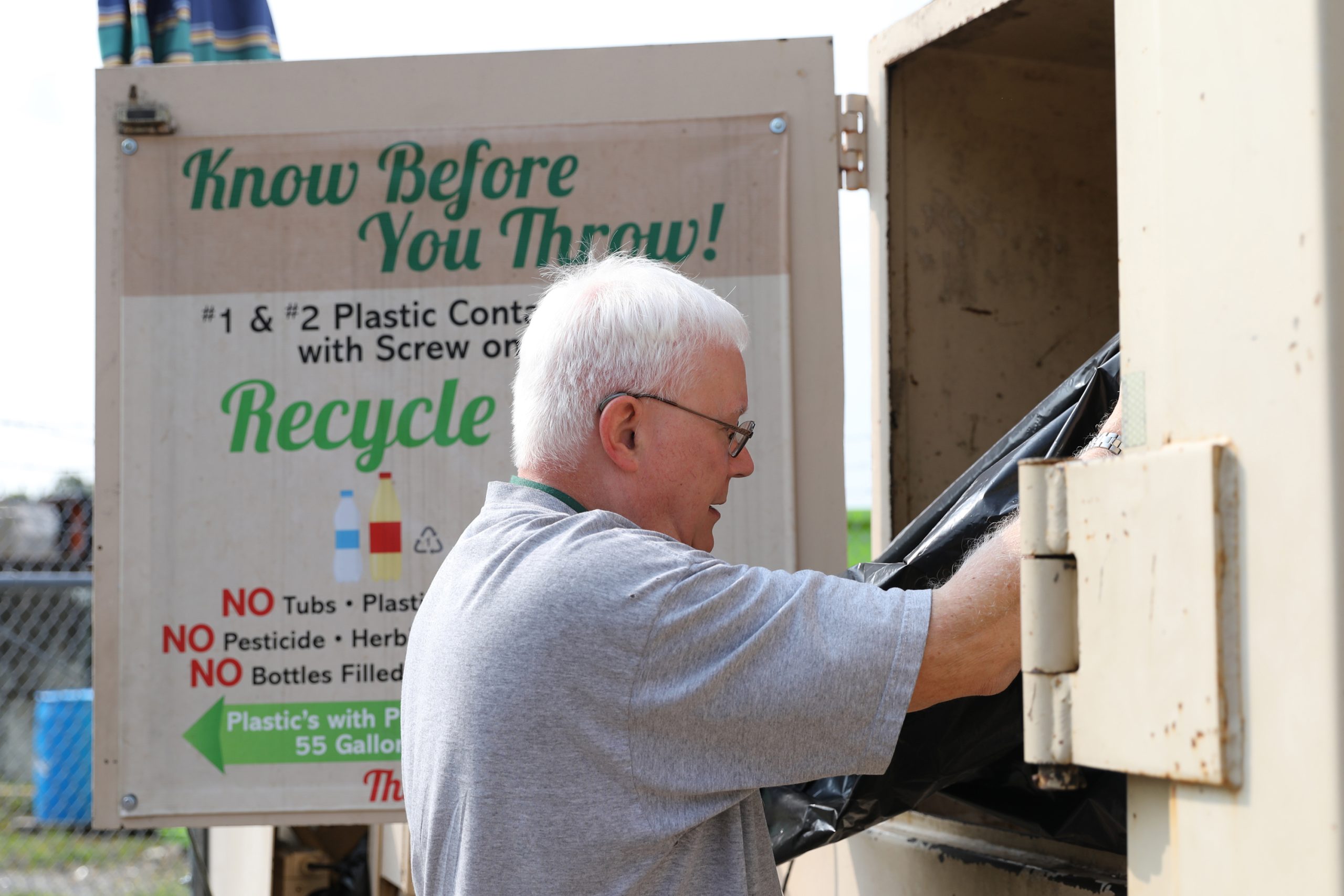
The potential impact was immediately clear one recent morning at Joplin’s recycling drop-off center, where resident George Haubein said he had learned about the curbside option for the very first time.
“I’m gonna sign up,” he said, adding that he stores his recyclables in his garage, and it was his second trip of the day to bring them all in.
Kandi Potter, a resident of nearby Webb City who comes to Joplin’s center because it accepts more materials than a drop-off closer to home, said her whole family takes part in recycling, but many locals might not see recycling as worth their time.
“It depends on the person,” she said.
At the other end of the spectrum from Joplin is Seattle, which wasn’t among the outreach and education grant recipients but has spent years working to better communicate with a wide variety of residents about its recycling services. Informational materials are available in more than a dozen languages, and residents receive transcreated guidelines once a year in the mail, said Becca Fong, Seattle Public Utilities’ residential compost and recycling program manager.
It wasn’t always this way, Fong said: “We used to do a lot of translating. But we also found that doesn’t necessarily lead to culturally resonant materials.”
That inspired her and her colleagues to start visiting community centers, gathering focus groups and simply sitting down with people going about their days to talk recycling. Now the city has a compendium of recycling terms in multiple languages, images of culturally relevant products and lasting relationships that can be called upon as recycling programs grow and change in the city and across the state.
“We took a big step back and looked at more than just the words,” Fong said. The learning process continues with regular feedback sessions and check-ins with the public as well.
“You can design the most beautiful program … but getting that feedback from customers is what has made us more successful over the years,” she said. “That partnership piece, that is never done.”
While Seattle and many of the EPA grant recipients are particularly populous and diverse places, their efforts to reach multiple audiences — simultaneously teaching and learning from residents, speaking in terms they understand, touching upon the priorities and beliefs they care about — are examples that any community can follow, Metzler with TRP said.
“That two-way street is needed, and it looks different in every community,” she said. “The most important part is starting somewhere, and this is all a journey.”