




In May 2018, as the global recycling industry was reeling from the Chinese government’s move to ban or heavily restrict imports of key recovered paper grades, the largest paper company in China made an investment that drew some attention.
Nine Dragons that month announced it would buy two U.S. virgin paper mills in Rumford, Maine, and Biron, Wisconsin. Just three months later, the company announced it would purchase a recycled paper mill in Fairmont, West Virginia. And in October 2018, the company announced it would buy a fourth U.S. mill in Old Town, Maine, producing virgin fiber.
Although Nine Dragons was well-known as a massive buyer of U.S. recovered paper through its sourcing arm America Chung Nam, these purchases marked the company’s first entrance into the U.S. market as more than a material buyer. And the company’s next move was equally striking: Nine Dragons announced it would install recycled fiber processing capacity at two of the virgin paper mills, and the company said it would begin shipping the vast majority of recycled pulp produced at the U.S. mills into China.
Other companies followed suit, announcing plans for projects that would export finished pulp to China. And indeed, recycled pulp exports rose fast in the years that followed. But six years later, they have now slowed almost to a halt, export figures show.
“These projects in the U.S. have just never panned out,” said Bill Moore, a longtime recovered paper consultant, in a recent interview. Resource Recycling spoke with Moore and others to learn about the industry challenges and the few bright spots.
Roots in the China ban
The concept of shipping recycled pulp from the U.S. to China – or, indeed, to any country – was unusual in 2018. That year, just 16,000 short tons of recycled pulp were exported to China, and just 48,000 tons were exported altogether. Export volumes had hovered around that range since at least 2002, the earliest year export records are available, although they spiked above 100,000 tons for a few years in the early 2010s. Mostly, it was a negligible export commodity.
That’s partially because there is a lot of work involved in transporting pulp: After processing the raw recovered paper and pulping it, the pulp must be dried before being loaded into shipping containers for the long journey across the ocean. In its wet form, pulp only has a few days before it would start to mold or otherwise deteriorate in quality. Those steps didn’t make sense as long as raw mixed paper and OCC could be shipped into China, where the pulping would then take place.
So the series of actions by the largest paper company in China underscored how the global paper recycling industry was evolving in the wake of China’s import restrictions. The purchases were part of a broad fiber sourcing strategy laid out by Nine Dragons, which was significantly impacted by losing access to abundant recovered fiber imports.
The company sought to diversify its feedstock channels as the Chinese government continued to heighten restrictions on fiber imports: U.S. recovered paper exports to China dropped from 14.5 million short tons in 2016, down to 12.0 million short tons in 2017, 8.3 million in 2018, 5.9 million in 2019, 5.0 million in 2020, and plummeted to just 500,000 short tons in 2021, a whopping 89% drop year over year. That means in 2021, U.S. exports of recovered fiber to China were down 96% from what they were just five years earlier.
By mid-2021, Nine Dragons had secured 313,000 tons per year of U.S. recycled pulp production. And the company wasn’t alone in pursuing this business model. Another major Chinese paper firm, Shanying International, purchased a shuttered paper mill in Wickliffe, Kentucky in 2018, and in 2019 the company announced plans to develop a paper recycling facility onsite to produce recycled pulp and export it to China. Over the next few years, a handful of other companies announced plans to develop recycled pulp mills from scratch.
The activity – particularly Nine Dragons’ mill acquisitions and export plan – translated into exponential growth in the previously nascent pulp export market: Recycled pulp exports jumped from 48,000 short tons in 2018 up to 295,000 short tons in 2019, year-over-year growth of more than 500%. They grew to 362,000 short tons in 2020, 458,000 short tons in 2021 and a whopping 531,000 short tons in 2022.
But in 2023, the upward trajectory crashed down, with recycled pulp exports dropping 60% to hit 211,000 short tons. By the end of 2023, pulp exports had dwindled to just 8,000 short tons in November and 4,000 short tons in December – a far cry from 33,000 short tons and 38,000 short tons in November and December 2022, respectively.
The low volumes have continued this year, with monthly volumes averaging around 4,000 short tons.
Projects stall, and market forces take a toll
Many of the planned recycled projects have been paused or canceled, and existing plants have scaled back.
Shanying International’s Kentucky facility is indeed active and successful, operating as Phoenix Paper, but the recycled pulp portion never materialized. The facility produces a bleached virgin pulp product.
At Nine Dragons, macroeconomic factors played into a substantial pullback in U.S. operations. A year ago, the company announced it would “significantly reduce” pulp production at its Fairmont, West Virginia, mill, and that it would idle its Old Town, Maine, facility. Both facilities were previously producing recycled pulp. The announcements came as Nine Dragons reported a loss for the latter half of 2022, the first time the company had reported a loss since 2006. Additionally, the company cited rising costs of fiber and energy contributing to the scaling back of U.S. operations.
Multiple attempts to solicit comment from Nine Dragons on the current status of those two U.S. mills and recycled pulp exports were not successful by press time.
Moore has firsthand knowledge of the challenges with recycled pulp exports. He was part of the team developing Empire Recycled Fiber, a planned recycled pulp mill in the Northeast U.S. It was announced in 2020, with a planned location in Fairless Hills, Pennsylvania. The project was later relocated to Dayton, Ohio.
But now, Moore says, the project is dead. He identified a few key challenges that the project couldn’t overcome.

“In order to finance a project to sell pulp to China, you have to have a long-term, 20-year guaranteed contract that you’ve got a buyer in China,” Moore said. The Empire mill had a buyer in place who was ready to purchase the material, but the buyer didn’t want to sign on to numerous terms and credit guarantees that would be needed for the facility to secure funding, Moore explained.
It’s a financing issue, and Chinese mills simply don’t want to sign 10- or 20-year purchase contracts, he said.
“That, and COVID, really nixed the project,” Moore said.
Additionally, for companies looking to sell recycled pulp to external buyers – as opposed to companies like Nine Dragons that were aiming to use it internally – recycled pulp prices have added another headwind: Recently they were hovering at $300 to $325 per metric ton delivered to China, which Moore noted is very low.
Total Fiber Recovery is now operational
There are a few exceptions to the overall trend.
Three projects by a company called Celadon Development Corporation were announced in 2019, 2021 and 2022, in Savannah, Georgia; Chesapeake, Virginia; and Tampa, Florida. Local media reports indicate the Georgia and Virginia facilities came online. Resource Recycling was unable to reach company leaders to learn about the current scope of operations or pulp export volumes.
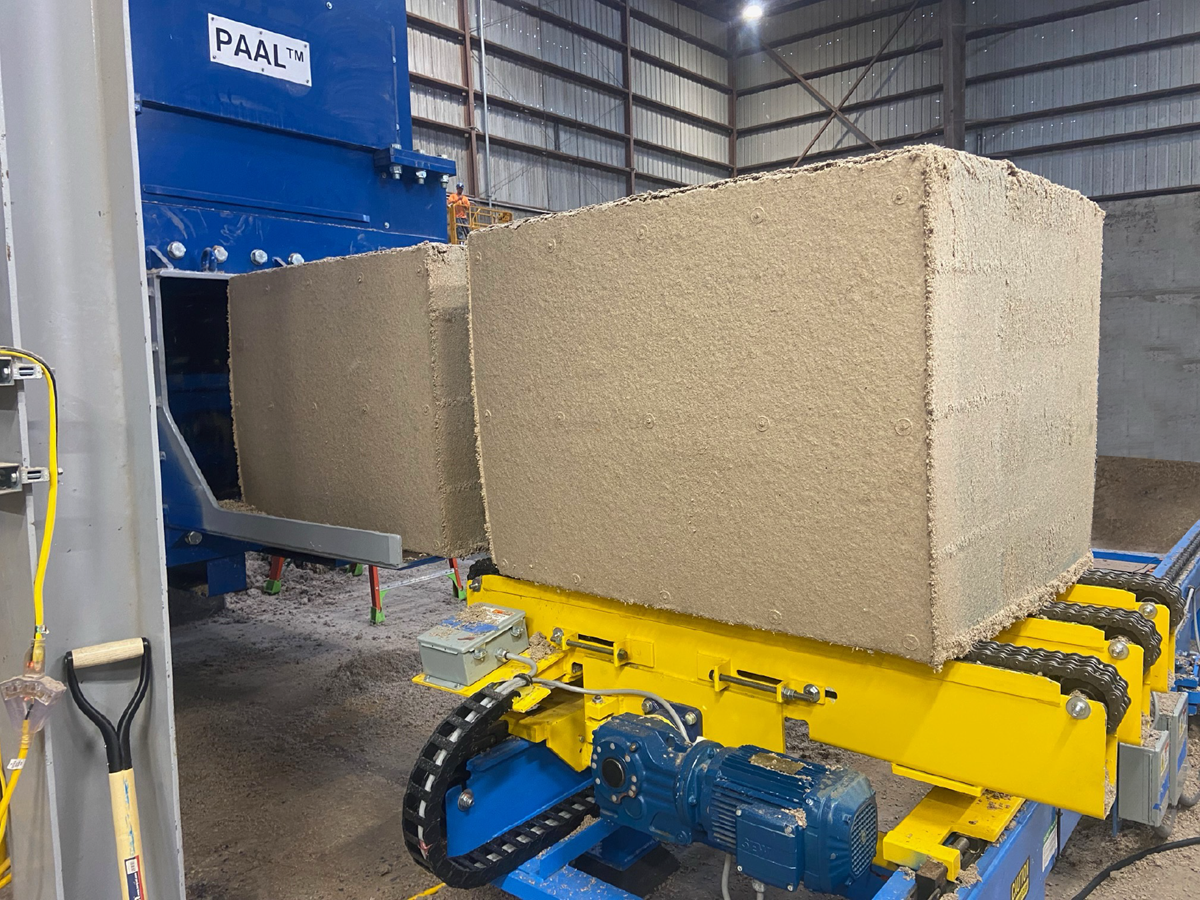
One highly-watched project is Total Fiber Recovery, also located in Chesapeake, Virginia. It’s a joint-venture between equipment supplier Bulk Handling Systems and recovered commodities broker Cellmark. First announced in 2020, the mill has been in the process of starting up since last October.
In an April 30 interview, BHS CEO Steve Miller said the mill is currently operating at about 50% of its projected capacity. At full capacity, it expects to bring in about 800 short tons per day of mixed paper and OCC, and to produce about 660 short tons of recycled pulp per day.
Miller offered a look at the logistics of producing recycled pulp for export.
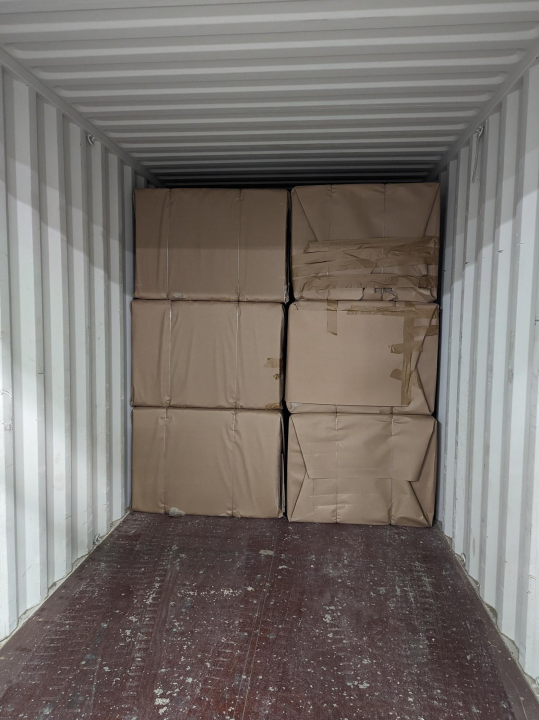
“We’re making a product that is pulped, and dried, and baled, and wrapped,” he explained.
The mill’s input is heavily weighted towards mixed paper, Miller said, but the mix primarily depends on orders from customers. The mill has flexibility to modify that mixture.
The input paper is processed by pulping equipment supplied by Kadant Black Clawson, a major equipment manufacturer for paper mills. This process removes impurities and mixes the fiber into a consistent pulp. Then, in a step that’s unusual for pulp mills, the pulp is put into an industrial dryer. Drying is necessary to prepare the pulp for the multi-week shipping voyage overseas, because wet pulp would degrade during that time frame.
After the pulp is dried, it is conveyed into a baler, which produces 1,100-pound dried pulp bales. It’s a solid bale, Miller said, but the company has been wrapping the bales – using OCC-based linerboard material – because the bales have a tendency to slough off some of their outer material otherwise.
The buyer can feed the pulp into their process alongside raw recovered fiber or on its own as the standalone feedstock. Miller noted U.S. recovered fiber – and the resulting pulp – remains attractive to overseas buyers in part because of its strength, which is due to U.S. fiber products typically including higher levels of virgin content. One effect of China’s recovered paper import ban was to take away a source of recovered paper with higher virgin content, and buying bales of recycled pulp is one way for Chinese paper companies to add in some of that structural integrity.
Even if many of the big plans of recent years haven’t come about just yet, Miller says the underlying factors laying the groundwork for a successful recycled pulp export industry remain in place. Total Fiber Recovery has begun shipping its bales to buyers in Asia, Miller said. But it is also selling to domestic customers, and it has received inquiries from buyers in South America.
“The interest is very high,” he said.