
Another busy legislative season is winding down in California. Several recycling-related bills made it to the governor’s desk this year, dealing with the right to repair, extended producer responsibility and the state’s deposit return system. Others didn’t make it to the finish line.
Signed bills
SB 244, the electronics right-to-repair bill, was sent to Gov. Gavin Newsom on Sept. 13 and signed Oct. 10. It requires manufacturers to make tools and parts available to repair facilities and owners of certain covered products.
Apple and HP both supported the bill this year, along with 82 independent repair shops, 109 local elected officials and more than 50 environmental and consumer groups. Supporters of the bill have been trying to get similar legislation passed for over five years, but previous bills died in the state’s Senate Appropriations Committee.
Nick Lapis, director of advocacy for Californians Against Waste (CAW), said although “nobody gets 100% of what they want when they sponsor a bill,” he doesn’t feel like CAW was “forced to make any concessions that undercut the fundamental intent of the bill.”
“I was nervous when I saw how watered down the New York bill was that we wouldn’t really be able to go further than they did,” he said, adding that he’s “really impressed that a relatively small group of passionate advocates was actually able to overcome the opposition of incredibly well-funded companies with teams of lobbyists.”
Bills on the governor’s desk
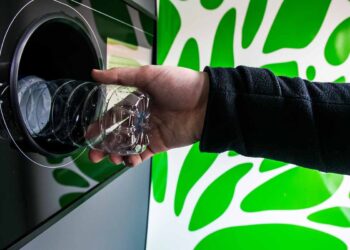
Making some administrative changes to the deposit return system, SB 353 hit the governor’s desk Sept. 14. It will allow CalRecycle to be more nimble in adjusting the amount of money paid to bottle and can recycling businesses by basing the payment formula on the prior three-month average of scrap value instead of the prior 12 months.
It will also expand the state’s container redemption program to include all 100% juice containers, including bottles 46 ounces and larger starting Jan. 1, 2024.
Mark Murray, executive director of Californians Against Waste, said it’s been clear that “California’s once best-in-the-nation Beverage Container Recycling Infrastructure is in need of policy maker attention.”
SB 353 is a “positive step in the right direction,” he added, as it will increase consumer recycling incentives on juice containers, reduce consumer confusion and provide “a modest level of increased support for rural recycling program operators.”
Susan Collins, president of the Container Recycling Institute (CRI), said SB 353 accomplished a lot of long-standing goals for her organization.
The juice bottle expansion will only bring a small number of additional containers into the program, an estimated less than 1% increase, but “it closed a loophole,” she said.
That’s something CRI has advocated for for a long time, she said, along with the increase in payments to redemption centers.
“It’s the No. 1 fix we were looking for for the program so we’re very pleased that SB 353 passed,” she said, noting that the more flexible payment adjustments will help prevent redemption locations from closing.
“All together, I think SB 353 contains important measures to help stabilize the system,” she said.
Vetoed bills
On the legislative cleanup side of things, SB 303 went to the governor Sept. 18 and was vetoed Oct. 8. The bill would have made some tweaks to last session’s landmark SB 54, which introduced extended producer responsibility for packaging.
The new bill would have set out that if an entity claimed that the producer responsibility organization (PRO), a producer or an entity under contract with the PRO were disrupting the operation or commercial viability of the industry or a specific hauler, the parties would have gone to binding arbitration. It also noted that going to binding arbitration would not delay the approval of a proposed plan or plan amendment.
SB 303 also clarified the California Department of Resources Recycling and Recovery (CalRecycle) would adopt regulations to establish standards for the PRO regarding responsible end markets for covered material, not general regulations for the whole industry, as the original bill could have been interpreted to mean.
According to the governor’s veto statement, he worried that SB 303 would interfere with the implementation timeline.
Michael Washburn, a consultant on sustainability and public affairs, said in his eyes, SB 303 showed that “Sen. Allen and others are open to that continuing dialogue, because this really is a journey for everybody.”
“I appreciate the humility in being willing to go back and do some cleanup,” he said, adding that more tweaks might be necessary in the future.
SB 665 was also on the Governor’s desk as of Sept. 21, but was vetoed Oct. 8 for being too similar to SB 54. It would have established a Single-Use Plastic Alternatives Working Group tasked with creating a framework for evaluating new plastic and plastic-alternative material types.
Dan Felton, executive director of AMERIPEN, said the group worked to shape the bill and he appreciated that the legislators “maintained an open dialog with us.”
Bills that failed to move forward
SB 707, which would have created EPR for textiles encompassing reuse, repair and recycling, passed the Senate on May 31 but later had a July 10 hearing in the Assembly canceled by the author and did not continue any further into the process.
Washburn said the failure of SB 707 to pass this session gives CalRecycle time to implement SB 54 before turning its attention to textiles.
“I think you could implement it faster and better because it’s been delayed,” he said.
AB 863, which would have reformed the EPR program for carpet, passed the Assembly May 30 and was ordered to the inactive file Sept. 11. It did not move forward before the end of the session deadline.
That bill would have increased the daily fines for violating the law to $10,000 per day (up from $5,000) or $50,000 per day (up from $10,000) if the violation is intentional, knowing or reckless. It would also have made any carpet stewardship organization that violates the law three times ineligible to continuing acting as the steward.
A bill that failed after industry pushback was AB 1290, which would have prohibited the sale of opaque or pigmented PET plastic bottles and plastic packaging that contained certain chemicals, pigments or additives. AMERIPEN was one of the groups in opposition, and Felton said he was “pleased to see it moved to the inactive file in the Assembly in late May.”
Mapping trends
Overall, Washburn said he’s seeing a lot of momentum around efforts to create a circular economy.
“These broader issues – right to repair, EPR for products and materials other than packaging – I just think the floodgates are going to blow open here for the next couple years,” he said.
While there’s plenty of potential for competition between PROs in the EPR space, Washburn also said he’s seeing “an underlying sense of common challenge.”
“There’s a pre-competitive, community-shared anxiety, where people are like ‘yeah we’re competition, but we’ve all got to move through this together,'” he said. “There’s a spirit to it I find energizing.”
Washburn also expects to see more combined EPR and deposit return system efforts in coming years.
“I do see the wisdom in getting those two things to talk to each other better, and I do think we’re going to see more of that in proposals,” he said. “If it will pass is another story.”
Collins said she foresees several years of big on-the-ground work as changes voted into law over the past few years are implemented.
Lapis echoed that, noting that “especially when taken together with the banner years we’ve had in 2021 and 2022, this legislative session proved that California is committed to turning the tide on the completely unsustainable ‘take-make-waste’ consumption economy.”
He does see some unfinished business, such as clarifying expiration dates and phasing out toxic and unrecyclable plastic, as well as work to “reduce the impacts of disposal and to support reuse.”
“Year after year, the California legislature continues to show courage in tackling contentious environmental issues despite a well-funded corporate lobbying-industrial complex dedicated to preserving the status quo,” he said, adding that “we are lucky to have a lot of legislators and staff who have really gotten into the weeds on waste-reduction policy, which has really allowed us to tackle a lot of important issues at once.”
This story has been updated with the information that SB 303 and SB 665 were vetoed Oct. 8 and SB 244 was signed into law Oct. 10.