


Resource Recycling
  • The Latest
  • Analysis
    • All
    • Certification Scorecard
    • Industry Announcements
    • Opinion
    From claims to custody: PCR procurement grows up

    From claims to custody: PCR procurement grows up

    What the NAND flash crunch means for remarketing, refurbishment and residual values

    Telamon acquires ITAD consultancy Retire-IT

    Certification Scorecard — Week of July 6, 2026

    Tech giant pens detailed ‘plastic-free packaging’ guide

    What Google’s latest report means for ITAD

    Unpacking the Starbucks cup data

    Unpacking the Starbucks cup data

    Amazon cutting out more flexible packaging

    Amazon’s AWS hardware reuse is measured

  • Conferences
    • Resource Recycling Conference
    • Plastics Recycling Conference
    • E-Scrap: The Longevity Conference
    • Textiles Recovery Summit
  • Publications
    • E-Scrap News
    • Plastics Recycling Update
    • Policy Now
    • Resource Recycling
    • Other Topics
      • All Topics
      • Brand Owners
      • Critical Minerals
      • Glass
      • Grant Watch / RFPs
      • Markets
      • Organics
      • Packaging
      • Research
      • Technology
      • Textiles
Subscribe
No Result
View All Result
Resource Recycling
  • The Latest
  • Analysis
    • All
    • Certification Scorecard
    • Industry Announcements
    • Opinion
    From claims to custody: PCR procurement grows up

    From claims to custody: PCR procurement grows up

    What the NAND flash crunch means for remarketing, refurbishment and residual values

    Telamon acquires ITAD consultancy Retire-IT

    Certification Scorecard — Week of July 6, 2026

    Tech giant pens detailed ‘plastic-free packaging’ guide

    What Google’s latest report means for ITAD

    Unpacking the Starbucks cup data

    Unpacking the Starbucks cup data

    Amazon cutting out more flexible packaging

    Amazon’s AWS hardware reuse is measured

  • Conferences
    • Resource Recycling Conference
    • Plastics Recycling Conference
    • E-Scrap: The Longevity Conference
    • Textiles Recovery Summit
  • Publications
    • E-Scrap News
    • Plastics Recycling Update
    • Policy Now
    • Resource Recycling
    • Other Topics
      • All Topics
      • Brand Owners
      • Critical Minerals
      • Glass
      • Grant Watch / RFPs
      • Markets
      • Organics
      • Packaging
      • Research
      • Technology
      • Textiles
Subscribe
No Result
View All Result
Resource Recycling
No Result
View All Result
Home Recycling

GP brings its Juno fiber recovery technology on-line

byJared Paben
May 18, 2021
in Recycling
At full capacity, the Juno unit will process 300 tons per day, or about 100,000 tons per year. | Courtesy of Georgia-Pacific

Paper products manufacturer Georgia-Pacific has opened a processing unit to recover fiber from particularly contaminated streams that would otherwise be landfilled.

Headquartered in Atlanta, Georgia-Pacific (GP) finished construction of the Juno technology unit at the company’s Toledo, Ore. plant in recent weeks.

First announced in 2018, the Juno process extracts fiber from soiled and otherwise contaminated streams, such as paper napkins, cups, plates and wrappers from restaurants and other public gathering spots. The process involves using heat, pressure and screening techniques to separate the fiber from food waste, plastic linings, metals or other contaminants.

In Toledo, GP will use the fiber, along with fiber from OCC, in linerboard used to make cardboard boxes.

“It’s a new-to-the-world waste recycling technology that can recycle and divert up to 90% of what goes to landfills today,” Christer Henriksson, president of Juno, told Resource Recycling.

Setting up sourcing agreements

Henriksson said GP is negotiating agreements to source material from haulers in Oregon.

Lowering equipment into place at the facility.The first such deal was with Dahl Disposal Service, which is also located in Toledo, a small town just upriver from the city of Newport on Oregon’s coast. Dahl trucks will bring material collected on routes serving restaurants and grocery stores to its transfer station, where the material will be baled and wrapped for shipment to GP’s plant a few miles away.

GP has already completed another contract with a waste hauler in the Eugene, Ore. area, Henriksson  said, and third and fourth agreements are already in the works. So far, GP has purchased some baling and wrapping equipment as part of the agreements, but some haulers already have their own equipment they can use, he said.

Separated at waste facilities, not MRFs, the material would be otherwise destined for landfills or incineration, Henriksson said. GP charges to accept the material, with prices in line with market rates for garbage transportation and disposal, he said.

“What we’re creating is a win-win between the hauler and us and also the cities,” he said.

He emphasized the public shouldn’t see the process as a replacement for recyclables collection systems. GP’s recycling arm already buys and sells millions of tons of recyclables each year.

“We want people to continue recycling as they do today, because that way you can generate very clean recyclables that can be sent to MRFs,” Henriksson said.
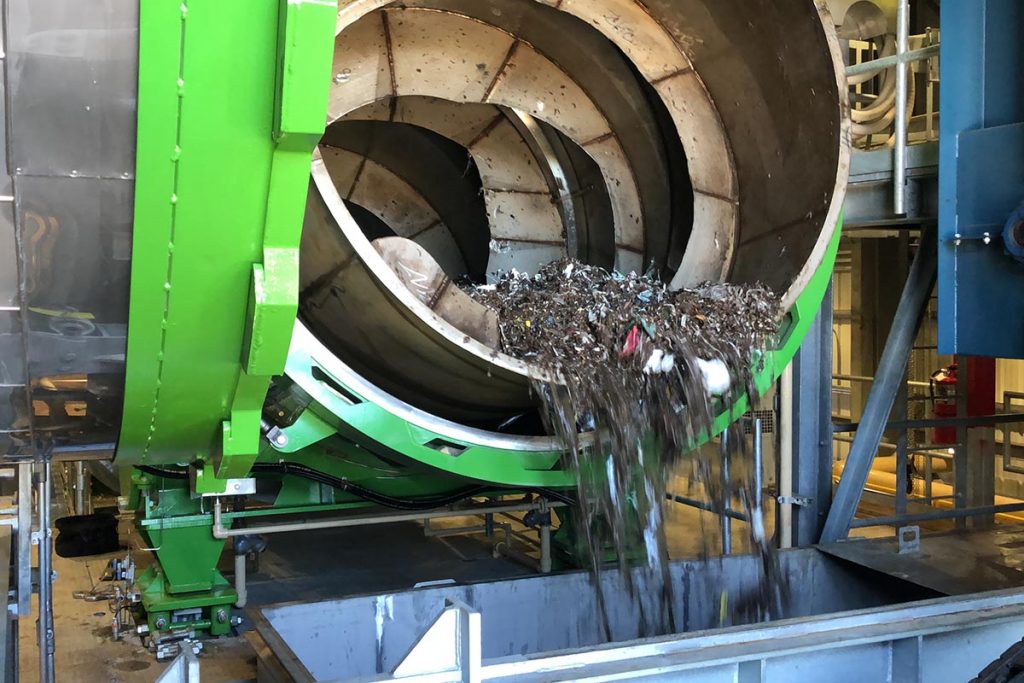
Output from the Juno system.
Juno-derived fiber will make up 10% of the linerboard, which is used in corrugated boxes.

Expansion possible in the future

GP provided financial approval for the commercial-scale Juno project two years ago, Henriksson said. It took two years to secure the permits and build the plant, a timeline Henriksson said he feels good about, particularly considering the pandemic and last summer’s devastating West Coast wildfires, which destroyed entire towns in parts of Oregon.

The Toledo plant is GP’s first commercial-scale facility. At full capacity, the Juno unit will process 300 tons per day, or about 100,000 tons per year, Henriksson said. The brown fiber produced by Juno will be used in the Toledo mill’s three linerboard machines along with fiber from OCC.

At most, the Juno-derived fiber will make up 10% of the linerboard, which is used in corrugated boxes. Because the Juno process uses steam to sanitize the material, the brown recovered fiber would also work well in products such as napkins or hand towels, Henriksson noted.

In the next several months, GP officials hope to gain a good understanding of how Juno is working at commercial scale. They’ll be looking at which types of feedstock are most valuable to run, what kind of yields to expect, whether there are throughput concerns and more, Henriksson said.

If everything goes well, GP plans to expand the technology to other plants around the world, he added, noting that he’s already in discussions about a second and third site for Juno plants.

Juno gives GP the ability to use a negative-value feedstock at a time when other recovered fiber, such as OCC, has gotten more expensive. According to RecyclingMarkets.net, the price of OCC has increased to a national average of over $90 a ton. It has generally increased over the past 10 months. Along with OCC, mixed-paper bale prices have more than doubled in the past year.

But Henriksson said Juno is about more than just securing low-cost feedstock sources. He noted that GP makes a lot of the paper products Juno is processing.

“We thought of this technology as kind of a way to improve recycling rates for our customers and also just citizens in general,” he said, “and, at the same time, bring fiber and other recyclables back to the market.”

 

TweetShare
Jared Paben

Jared Paben

Related Posts

From claims to custody: PCR procurement grows up

From claims to custody: PCR procurement grows up

byPuneet Thadani
July 10, 2026

In this guest column, the founder of Ecolar Global says the growing use of recycled content without standardized documentation presents...

Auto Draft

AI can boost strength of secondhand device market

byPaul Lane
July 10, 2026

Players in the preowned mobile device industry say continual self-evaluation will help them adapt to a changing marketplace.

APR adds PCR content verification to cert program

APR adds PCR content verification to cert program

byAntoinette Smith
July 9, 2026

The Association of Plastic Recyclers (APR) is expanding its PCR Certification Program to verify the percentage of PCR content in...

What the NAND flash crunch means for remarketing, refurbishment and residual values

Telamon acquires ITAD consultancy Retire-IT

byDavid Daoud
July 9, 2026

Telamon will be retaining Retire-IT founder Kyle Marks, who built that business over 21 years.

Building trust, infrastructure key to survival in secondhand device market

Building trust, infrastructure key to survival in secondhand device market

byPaul Lane
July 9, 2026

Price, trust and supply issues will create the chasm that separates the next wave of players in the second-hand mobile...

Certification Scorecard — Week of July 6, 2026

byEditorial Staff
July 8, 2026

The following facilities have achieved, renewed or otherwise regained industry certifications.

Load More
Next Post

Industry group calls for billions in recycling investment

More Posts

Two recycled-content bills gain approval in California

California agriculture seeks SB 54 repeal

July 7, 2026
Unpacking the Starbucks cup data

Unpacking the Starbucks cup data

July 8, 2026
Oregon’s Recycling Modernization Act faces injunction

Oregon’s EPR program posts first-year results

July 6, 2026
Tech giant pens detailed ‘plastic-free packaging’ guide

What Google’s latest report means for ITAD

July 8, 2026
In Our Opinion: Coalitions: The EPR Differentiator

Inside NAW’s constitutional case against packaging EPR

July 6, 2026
SB 54 draft rules generate debate on rates, review

California increases PET market payments

July 7, 2026
EPR fees are a market signal. Here’s what they’re telling you.

Building the infrastructure behind EPR

July 6, 2026
MP Materials breaks ground on rare earth magnet campus in North Texas

ERI confirms ITAD shift toward minerals

July 3, 2026
Auto Draft

Digital product passports offer gateway into secondary market

July 7, 2026
Canada EV battery reuse pilot to start

Canada EV battery reuse pilot to start

July 8, 2026
Load More

About & Publications

About Us

Staff

Archive

Magazine

Work With Us

Advertise
Jobs
Contact
Terms and Privacy

Newsletter

Get the latest recycling news and analysis delivered to your inbox every week. Stay ahead on industry trends, policy updates, and insights from programs, processors, and innovators.

Subscribe

Welcome Back!

Login to your account below

Forgotten Password?

Retrieve your password

Please enter your username or email address to reset your password.

Log In

Add New Playlist

No Result
View All Result
  • The Latest
  • Analysis
  • Recycling
  • E-Scrap
  • Plastics
  • Policy Now
  • Conferences
    • E-Scrap Conference
    • Plastics Recycling Conference
    • Resource Recycling Conference
    • Textiles Recovery Summit
  • Magazine
  • About Us
  • Advertise
  • Archive
  • Jobs
  • Staff
Subscribe
This website uses cookies. By continuing to use this website you are giving consent to cookies being used. Visit our Privacy and Cookie Policy.