




Resource Recycling
  • The Latest
  • Analysis
    • All
    • Certification Scorecard
    • Industry Announcements
    • Opinion

    From CES to the shredder: What 2026 PCs mean for ITAD

    Certification scorecard for week of Jan. 12, 2026

    Industry announcements for January 2026

    Certification scorecard for Dec. 18-30, 2025

    Certification scorecard for Dec. 18, 2025

    Industry announcements for the week of Dec. 15

    Certification scorecard for December 10, 2025

    Industry Announcements for Week of December 8

    Certification Scorecard for December 3, 2025

  • Conferences
  • Publications

    Other Topics

    Textiles
    Organics
    Packaging
    Glass
    Brand Owners

    Metals
    Technology
    Research
    Markets
    Grant Watch

    All Topics

Subscribe
No Result
View All Result
Resource Recycling
  • The Latest
  • Analysis
    • All
    • Certification Scorecard
    • Industry Announcements
    • Opinion

    From CES to the shredder: What 2026 PCs mean for ITAD

    Certification scorecard for week of Jan. 12, 2026

    Industry announcements for January 2026

    Certification scorecard for Dec. 18-30, 2025

    Certification scorecard for Dec. 18, 2025

    Industry announcements for the week of Dec. 15

    Certification scorecard for December 10, 2025

    Industry Announcements for Week of December 8

    Certification Scorecard for December 3, 2025

  • Conferences
  • Publications

    Other Topics

    Textiles
    Organics
    Packaging
    Glass
    Brand Owners

    Metals
    Technology
    Research
    Markets
    Grant Watch

    All Topics

Subscribe
No Result
View All Result
Resource Recycling
No Result
View All Result
Home Recycling

Recycled fiber end users put new focus on residential stream

Colin StaubbyColin Staub
September 1, 2020
in Recycling
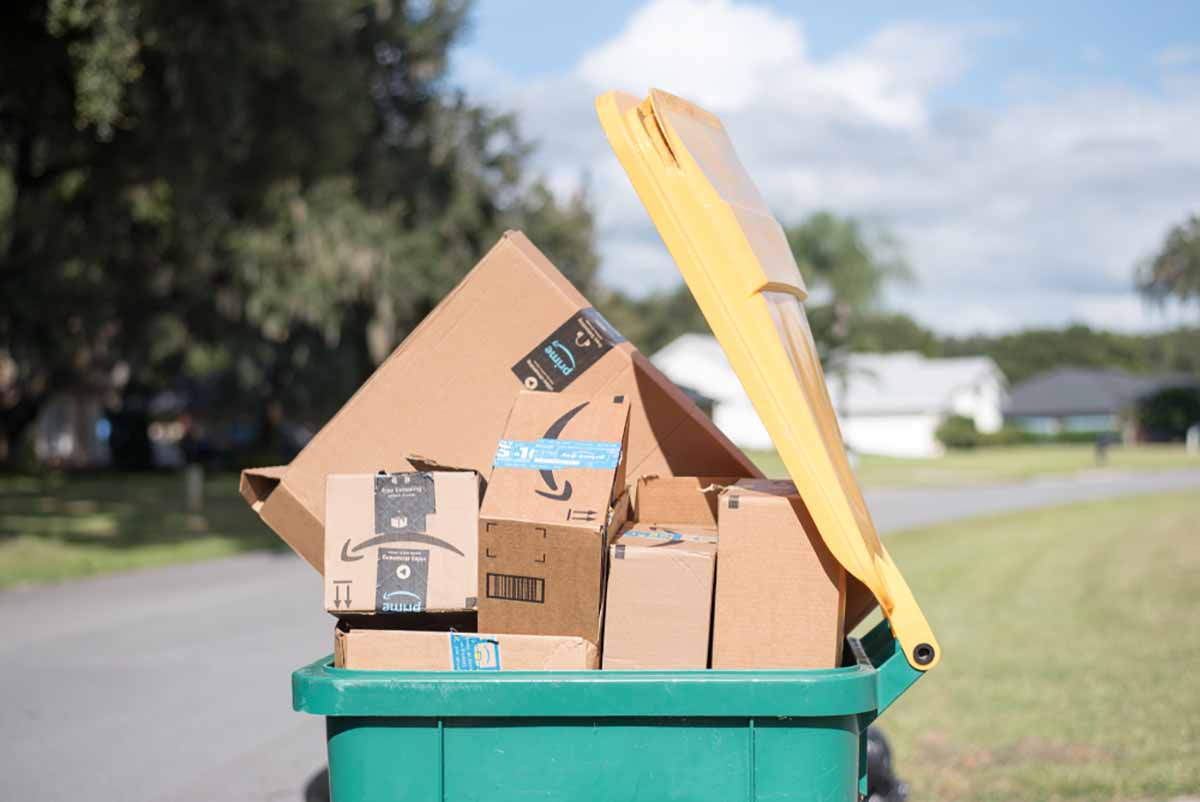
Greater fiber tonnages are coming in through the residential stream, which typically includes higher numbers of small boxes. | Cari Rubin Photography/Shutterstock

OCC generation has shifted away from the commercial realm amid COVID-19, and tonnages might never go back. A paper association leader described that trend and what it means for the industry’s future.

The pandemic has accelerated society’s transition to e-commerce, driving more OCC into the residential stream. For the fiber packaging industry, that means placing a greater emphasis on supporting the residential recycling sector.

“If you shift that distribution channel to going more residential and more things ending up on people’s doorsteps, then naturally we also have to shift the way we think about recycling,” said Rachel Kenyon, vice president of the Fibre Box Association (FBA), which represents the corrugated production industry. “We’re not going to be getting as much from those commercial outlets as we are going to have to rely on residential recycling. That’s why residential recycling becomes even more important to us.”

Kenyon described how that change occurred, what it means for the fiber packaging industry and how end users are responding.

Commercial decline has big ramifications

The corrugated production industry has long relied on grocery retailers and other commercial outlets to generate a clean stream of high-quality OCC, Kenyon explained. These are “places where there’s a baler in the back of the room and they’re able to collect the corrugated, bale it and get it back to us,” she said.

Those commercial entities generated about 85% of the feedstock for recycled corrugated manufacturing in recent years, she explained.

There was a simultaneous shift in consumer spending patterns, with people shopping online with e-commerce rather than going to stores. That shift has substantial implications for OCC generation.

“When that package comes to an individual’s home, [recycling] no longer is a business policy, it’s an individual choice,” Kenyon said.

It’s too early to tell whether there has been enough of an increase in the residential OCC to offset the commercial decline, she noted. But even when the OCC is captured through the residential stream, there is a difference on the quality front. Retail-generated OCC is typically not mixed with other materials, meaning it is baled with other clean, dry corrugated boxes. In curbside recycling programs, OCC comes in the form of smaller boxes and is often mixed with other recyclables as well as organics and other contaminants.

Recovered fiber end users are anticipating the recent trends will remain even after the pandemic passes.

“We know that in the future, it’s not going to be an 85-15 [ratio], it’s going to be somewhere closer to 75-25 or even greater than that,” Kenyon said. “We know we’re going to have to rely more heavily on the residential recycling stream.”

Kenyon noted that although e-commerce is growing by as much as 15% per year, there isn’t a corresponding spike in corrugated box demand. Similarly, the e-commerce shift doesn’t necessarily mean there is more OCC coming into the recycling system.

E-commerce is “not purely additive to the market; it is a substitution,” Kenyon said. “If things are being shipped in e-commerce, that means they’re not going to a store, they’re not going to the traditional supply chain.”

Global factors ahead

The first eight months of 2020 presented a rollercoaster for the OCC market, with wild price swings. Kenyon noted that the future market will be dependent on global factors, and she pointed to a recent dynamic to illustrate that fact.

U.S. OCC recovery has been on a steady climb since the early 1990s and has hovered around 90% since about 2011, according to American Forest & Paper Association (AF&PA) data. But in 2017, OCC recovery dropped to just under 89%.

That was in part due to the Chinese import restrictions that upended the global recycling sector. During the multi-decade climb in OCC recovery, the U.S. also had a growth in net exports of OCC, and China was – and remains – by far the largest importer of U.S. OCC.

When the country enacted new import restrictions, it significantly tightened quality limits on imported OCC and disrupted the flow of other recyclables from the U.S. to China. Some companies stockpiled OCC temporarily, and some recycling programs experienced service disruptions. That all impacted the recovery rate and the supply of material making its way to end users.

But throughout 2018, U.S. recycling operators found a variety of alternative overseas markets for OCC, and by the end of the year, the U.S. saw a 27% increase in OCC exports compared with 2017.

That surge led to a spike in the AF&PA recovery rate, which was reported at 96.2% in 2018.

Kenyon said that shift illustrates the global nature of the OCC market, and how international developments will impact demand for the material.

“You can see where those changes in not necessarily North America but global policy, impacted the rate here,” she said.

The AF&PA recovery rate indicates the amount of OCC that is recovered, as a ratio of the overall amount produced in the U.S. The production figure does not take into account corrugated material that enters the county as packaging for imported products, as there is no feasible method for tracking that generation, Kenyon explained. But that imported fiber does factor into the recovery rate.

That’s the norm for calculating fiber recovery worldwide, and it’s why some countries have reported recovery rates of greater than 100%, Kenyon noted.
 

Tags: Paper Fiber
TweetShare
Colin Staub

Colin Staub

Colin Staub was a reporter and associate editor at Resource Recycling until August 2025.

Related Posts

FV Recycling acquires Mid America Paper Recycling

byScott Snowden
October 21, 2025

FV Recycling, a commercial and industrial recycler based in Hattiesburg, Mississippi, has acquired Mid America Paper Recycling of Chicago, strengthening...

Coated paper group plans for EPR rollouts

byScott Snowden
October 21, 2025

A coalition of paper and packaging leaders is launching a national effort to make poly coated paper products, such as...

Box demand slump signals strain in US economy

byScott Snowden
September 30, 2025

Cardboard box demand has fallen to its lowest level since 2016, a sharp reversal for a sector that expanded rapidly...

Diversion Dynamics: Threading together a circular system for textiles

byStefanie Valentic
September 23, 2025

As seasons change, so do fashion trends, contributing to 92 million metric tons of textile waste globally. Today's consumer habits...

Containerboard prices begin slow recovery

byStefanie Valentic
September 16, 2025

The North American containerboard industry is slowly recovering from a post-COVID inventory contraction and demand is expected to bounce back...

Reopened Iowa plant recycles cartons into roofing materials

byPaul Lane
September 9, 2025

Editor’s Note: End markets will be featured in sessions at the 2026 Resource Recycling Conference, Feb. 23-25 in San Diego,...

Load More
Next Post
End users report pandemic-period financials

End users report pandemic-period financials

More Posts

mobile phone fix

Repair movement reshapes reuse as laws reshape ITAD

December 17, 2025
Austria’s DRS on track for 80% collection in first year

Austria’s DRS on track for 80% collection in first year

December 17, 2025
Deposit schemes garner support, despite ‘awareness gap’

Deposit schemes garner support, despite ‘awareness gap’

December 18, 2025
paint cans recycling

PaintCare brings stewardship to Illinois, Maryland on deck

December 19, 2025
WM Facility

Modern recycling meets AI 

December 18, 2025
small format coalition

Small format packing collaboration

December 18, 2025
Carbios delays French PET recycling plant to secure funds

Carbios delays French PET recycling plant to secure funds

December 19, 2025
Mitsubishi Materials buys into Elemental e-scrap pact in US

Mitsubishi Materials buys into Elemental e-scrap pact in US

December 19, 2025
#PRC2026 Speaker Spotlight: Joel Morales

#PRC2026 Speaker Spotlight: Joel Morales

December 22, 2025
Panel tracks shifts in e-scrap as policy, AI reshape

Panel tracks shifts in e-scrap as policy, AI reshape

December 22, 2025
Load More

About & Publications

About Us

Staff

Archive

Magazine

Work With Us

Advertise
Jobs
Contact
Terms and Privacy

Newsletter

Get the latest recycling news and analysis delivered to your inbox every week. Stay ahead on industry trends, policy updates, and insights from programs, processors, and innovators.

Subscribe

Welcome Back!

Login to your account below

Forgotten Password?

Retrieve your password

Please enter your username or email address to reset your password.

Log In

Add New Playlist

No Result
View All Result
  • The Latest
  • Analysis
  • Recycling
  • E-Scrap
  • Plastics
  • Policy Now
  • Conferences
    • E-Scrap Conference
    • Plastics Recycling Conference
    • Resource Recycling Conference
    • Textiles Recovery Summit
  • Magazine
  • About Us
  • Advertise
  • Archive
  • Jobs
  • Staff
Subscribe
This website uses cookies. By continuing to use this website you are giving consent to cookies being used. Visit our Privacy and Cookie Policy.