




Resource Recycling
  • The Latest
  • Analysis
    • All
    • Certification Scorecard
    • Industry Announcements
    • Opinion

    AI and the changing economics of retired hardware

    Certification Scorecard — Week of June 8, 2026

    ITAD is moving past its adolescent phase: beyond end-of-life

    Rainforest

    Inside the Circle: What the rainforest can teach us about EPR

    Closeup of a printed circuitboard

    Hardware demand puts new focus on parts harvesting

    Rare look inside the world’s largest plastics recycler

    Mass balance matters: Why different rules can lead to different outcomes 

  • Conferences
    • Resource Recycling Conference
    • Plastics Recycling Conference
    • E-Scrap: The Longevity Conference
    • Textiles Recovery Summit
  • Publications
    • E-Scrap News
    • Plastics Recycling Update
    • Policy Now
    • Resource Recycling
    • Other Topics
      • All Topics
      • Brand Owners
      • Critical Minerals
      • Glass
      • Grant Watch / RFPs
      • Markets
      • Organics
      • Packaging
      • Research
      • Technology
      • Textiles
Subscribe
No Result
View All Result
Resource Recycling
  • The Latest
  • Analysis
    • All
    • Certification Scorecard
    • Industry Announcements
    • Opinion

    AI and the changing economics of retired hardware

    Certification Scorecard — Week of June 8, 2026

    ITAD is moving past its adolescent phase: beyond end-of-life

    Rainforest

    Inside the Circle: What the rainforest can teach us about EPR

    Closeup of a printed circuitboard

    Hardware demand puts new focus on parts harvesting

    Rare look inside the world’s largest plastics recycler

    Mass balance matters: Why different rules can lead to different outcomes 

  • Conferences
    • Resource Recycling Conference
    • Plastics Recycling Conference
    • E-Scrap: The Longevity Conference
    • Textiles Recovery Summit
  • Publications
    • E-Scrap News
    • Plastics Recycling Update
    • Policy Now
    • Resource Recycling
    • Other Topics
      • All Topics
      • Brand Owners
      • Critical Minerals
      • Glass
      • Grant Watch / RFPs
      • Markets
      • Organics
      • Packaging
      • Research
      • Technology
      • Textiles
Subscribe
No Result
View All Result
Resource Recycling
No Result
View All Result
Home Recycling

How one state is addressing uneaten food

Dan LeifbyDan Leif
October 24, 2017
in Recycling
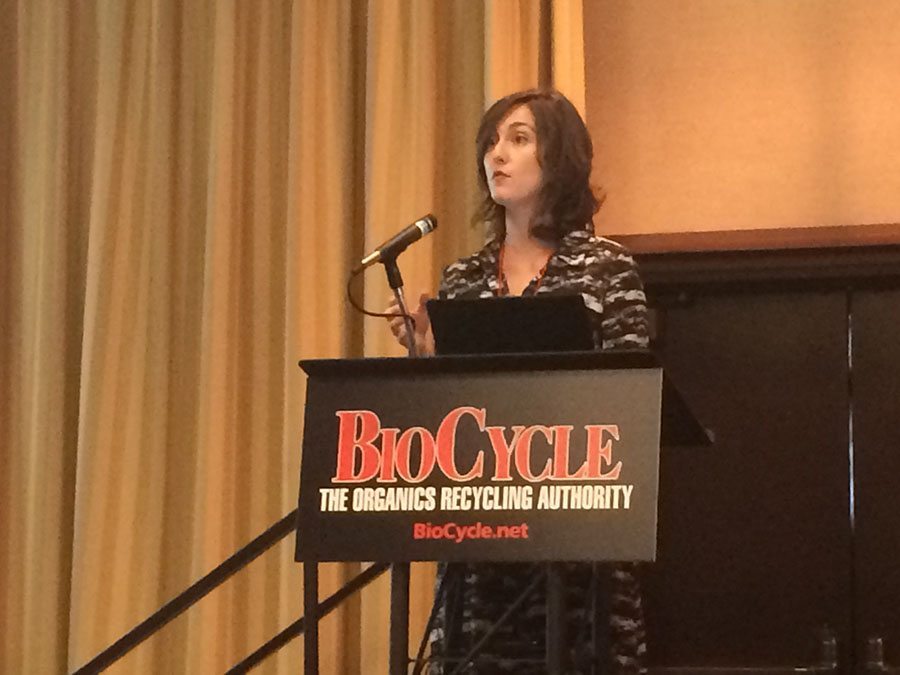
Ashley Zanolli of Oregon DEQ speaks at REFOR 2017.

In recent years, efforts out of Oregon have helped set the national pace on topics such as sustainable materials management and recycling metrics. Now, the state is beginning to do the same when it comes to food waste – or, more precisely, wasted food.

At the annual BioCycle Renewable Energy From Organics Recycling (REFOR) event held last week in Portland, Ore., three officials from the Beaver State took to the stage to discuss their ongoing work to intensively study how much potentially edible food is sent to disposal by residents and commercial generators and how those tonnages can be cut down by making adjustments upstream.

The state refers to leftovers and other loads of prepared but uneaten food as wasted food. The term food waste, on the other hand, is a broader category that also includes the inedible portions, such as egg shells and other residuals.

Oregon’s Department of Environmental Quality (DEQ) sees the task of more specifically classifying these different organics subsections as a big part of moving the needle on waste diversion as a whole.

“What we really wanted to do at DEQ was change the conversation,” said Elaine Blatt, senior policy and program analyst at DEQ. “We’re looking to get more of a focus on prevention.”

Building on “Vision” initiative

Reports from Oregon DEQ are cited regularly in industry presentations and conversations across North America. The agency’s “2050 Vision” document has emerged as an influential policy framework, offering an example of how a jurisdiction can try to account for the full life cycle of different materials when making waste decisions.

On the food front, the state earlier this year finalized a formal strategy geared toward limiting wasted food. The plan, which aims to support goals laid out in the 2050 Vision, identifies nine areas in which the state can nibble away at the tonnages of edible food going to disposal.

DEQ points to statistics that lay out the enormity of the wasted food situation. According to the department’s strategy document, between 25 and 40 percent of food produced or imported for consumption in the U.S. is never actually eaten and $218 billion is spent nationally growing, processing, distributing and preparing food that ends up in the waste stream.

In a presentation at REFOR, DEQ’s Ashley Zanolli compared the cost of wasted food to an iceberg. A relatively small amount appears above the surface as disposal fees. But the bulk of the financial impact lurks unseen, with expenses going into growing, transportation and preparation.

“When we only focus on disposal, we’re selling ourselves short,” noted Zanolli, who formerly worked on food waste issues for the U.S. EPA.

A big part of Zanolli’s work at DEQ to date has been a study to better understand both residential and commercial behaviors that lead to wasted food. Such research is one of the nine bullet points noted in the larger food strategy.

The state is currently in the process of finishing a statewide survey to residents, and DEQ staff also undertook qualitative interviews with 32 Oregonians to dive deeper into the specific ways individuals handle food.

Additionally, the state is working on case studies of 15 different commercial and institutional outlets to understand and articulate realities of wasted food in the food-service realm.

“Ideally, the case studies we’re doing in Oregon can be a launch pad for other jurisdictions,” Zanolli said.

Governor’s office taking note

Regardless of how much attention DEQ’s work gets from leaders elsewhere, top decision-makers in Oregon itself seem committed to addressing the issue.

In its opening keynote session, the REFOR event featured Ruchi Sadhir, the energy policy advisor to Oregon Gov. Kate Brown.

In her talk, Sadhir said the average Oregon family spends $1,600 annually on food that never gets eaten.

“The biggest gains can be made when we can reduce this on the front end,” she noted. “We have to be tireless, and we can’t do it alone.”

 

Tags: Organics
TweetShare
Dan Leif

Dan Leif

Dan Leif is the managing editor at Resource Recycling, Inc., which publishes Resource Recycling, Plastics Recycling Update and E-Scrap News. He has been with the company since 2013 and has edited different trade publications since 2006. He can be contacted at [email protected].

Related Posts

California extends compostable labeling law

California bills crack down on false recycling, compostable claims

byStefanie Valentic
May 29, 2026

Three bills targeting recycling and compostables labeling have cleared key hurdles as California's session deadline nears.

California extends compostable labeling law

Report finds path forward for compostable packaging

byKeith Loria
April 28, 2026

A new report by Closed Loop Partners’ Composting Consortium examined five years of research, field testing and cross-industry collaboration and...

Wisconsin outlines steps to cut landfill food waste

Wisconsin outlines steps to cut landfill food waste

byScott Snowden
March 18, 2026

Wisconsin officials say food makes up about 20% of landfill material. A new state evaluation maps the policy, collection and...

Nebraska awards $7m in recycling grants

byAntoinette Smith
February 18, 2026

The grants will help fund waste and litter reduction projects, recycling programs, and costs to collect scrap tires, HHW, electronic...

Wisconsin food waste amounts to 1,033 pounds per resident each year

byStefanie Valentic
January 28, 2026

Wisconsin's nearly 6 million residents discard 1,033 pounds of food per person annually, creating the state's largest waste stream and...

BioCycle shifts leadership as Paula Luu takes the reins

byScott Snowden
January 23, 2026

BioCycle, a long-running publication covering composting, anaerobic digestion and organics recycling, has named Paula Luu as managing director while longtime...

Load More
Next Post

Small steps, big difference

More Posts

House resolution aims to make recyclability central to product design

NY EPR bill fails to advance after third try

June 8, 2026
Various PET thermoform containers.

Thermoform recovery soars, PCR content falls

June 10, 2026
CalRecycle withdraws proposed regs for SB 54

Oceana, NRDC, CAW sue CalRecycle over SB 54 regs

June 5, 2026

Three-bill package aims to revamp Michigan’s bottle return system

June 9, 2026
Circular Materials to supply PlasCred chem recycling plant

Circular Materials to supply PlasCred chem recycling plant

June 4, 2026
Rare look inside the world’s largest plastics recycler

Mass balance matters: Why different rules can lead to different outcomes 

June 5, 2026

Battery fires still a major risk to recyclers: report

June 9, 2026
Recycling industry addresses Beyond Plastics report

Recycling industry addresses Beyond Plastics report

May 26, 2026
Rainforest

Inside the Circle: What the rainforest can teach us about EPR

June 8, 2026
How electronics legislation fared this legislative season

NY sends repairability labeling bill to governor

June 8, 2026
Load More

About & Publications

About Us

Staff

Archive

Magazine

Work With Us

Advertise
Jobs
Contact
Terms and Privacy

Newsletter

Get the latest recycling news and analysis delivered to your inbox every week. Stay ahead on industry trends, policy updates, and insights from programs, processors, and innovators.

Subscribe

Welcome Back!

Login to your account below

Forgotten Password?

Retrieve your password

Please enter your username or email address to reset your password.

Log In

Add New Playlist

No Result
View All Result
  • The Latest
  • Analysis
  • Recycling
  • E-Scrap
  • Plastics
  • Policy Now
  • Conferences
    • E-Scrap Conference
    • Plastics Recycling Conference
    • Resource Recycling Conference
    • Textiles Recovery Summit
  • Magazine
  • About Us
  • Advertise
  • Archive
  • Jobs
  • Staff
Subscribe
This website uses cookies. By continuing to use this website you are giving consent to cookies being used. Visit our Privacy and Cookie Policy.