





Resource Recycling
  • The Latest
  • Analysis
    • All
    • Certification Scorecard
    • Industry Announcements
    • Opinion
    Auto Draft

    Umicore highlights strength in recycling, catalysis

    Apto, Tusaar partner on rare earths recovery

    Apto, Tusaar partner on rare earths recovery

    Certification scorecard for the week of Feb. 16, 2026

    Sims Lifecycle leverages hyperscale decommissioning

    Sims Lifecycle leverages hyperscale decommissioning

    The electronics recycling industry is undergoing a transformation from labor-intensive manual operations to highly automated, AI-driven facilities that use advanced robotics, cleaner chemistry and digital tracking systems to extract critical materials.

    The cyber-physical MRF: AI and robotics reshape e-waste recovery

    Certification scorecard for the week of Feb. 9, 2026

    Meta-Corning deal signals IT hardware retirement wave

    Meta-Corning deal signals IT hardware retirement wave

    Malaysia clamps down on illegal e-waste imports amid probes

    Malaysia clamps down on illegal e-waste imports amid probes

    URT builds alliance to remake electronics plastics at scale

    ICYMI: Top 5 e-scrap stories from January 2026

  • Conferences
  • Publications

    Other Topics

    Textiles
    Organics
    Packaging
    Glass
    Brand Owners

    Metals
    Technology
    Research
    Markets
    Grant Watch

    All Topics

Subscribe
No Result
View All Result
Resource Recycling
  • The Latest
  • Analysis
    • All
    • Certification Scorecard
    • Industry Announcements
    • Opinion
    Auto Draft

    Umicore highlights strength in recycling, catalysis

    Apto, Tusaar partner on rare earths recovery

    Apto, Tusaar partner on rare earths recovery

    Certification scorecard for the week of Feb. 16, 2026

    Sims Lifecycle leverages hyperscale decommissioning

    Sims Lifecycle leverages hyperscale decommissioning

    The electronics recycling industry is undergoing a transformation from labor-intensive manual operations to highly automated, AI-driven facilities that use advanced robotics, cleaner chemistry and digital tracking systems to extract critical materials.

    The cyber-physical MRF: AI and robotics reshape e-waste recovery

    Certification scorecard for the week of Feb. 9, 2026

    Meta-Corning deal signals IT hardware retirement wave

    Meta-Corning deal signals IT hardware retirement wave

    Malaysia clamps down on illegal e-waste imports amid probes

    Malaysia clamps down on illegal e-waste imports amid probes

    URT builds alliance to remake electronics plastics at scale

    ICYMI: Top 5 e-scrap stories from January 2026

  • Conferences
  • Publications

    Other Topics

    Textiles
    Organics
    Packaging
    Glass
    Brand Owners

    Metals
    Technology
    Research
    Markets
    Grant Watch

    All Topics

Subscribe
No Result
View All Result
Resource Recycling
No Result
View All Result
Home Recycling

A testing ground for expanded collection of food-service items

Colin StaubbyColin Staub
June 27, 2017
in Recycling

Washington, D.C. will join the ranks of a select few municipalities next year when it begins accepting a wider array of food-service packaging for recycling, including paper-based coffee cups.

Starting Jan. 1, 2018, all residents and businesses within the district will be able – and, in fact, required – to recycle coffee cups as well as a variety of paper and plastic plates, cups, lids, trays, pizza boxes and more.

Surveys and studies

According to program leaders, the upcoming changes follow a number of studies and surveys that have revealed food-service packaging is more acceptable in the recycling stream than is generally believed, provided the right circumstances are in place. Through collaboration, the nation’s capital will put that data to the test.

“There’s work going on to help the MRFs in the area, to help them make any changes and help develop end markets locally,” said Annie White, manager of the office of waste diversion at the Washington D.C. Department of Public Works (DPW). “That is an area where both the district and industry have mutual aims to help grow the local recycling and recovery of this material.”

The decision was made in response to legislation in 2014 that set a timeline for increased diversion targets and additional program offerings. As part of that legislation, DPW was tasked with compiling a single, clear list of what was recyclable and compostable for residential and commercial recycling programs within the district.

To come up with such a list, DPW surveyed eight MRFs within a 45-mile radius of the district, identifying 70 product types and asking whether the MRFs accepted, rejected, or accepted but did not want those materials in their streams. Materials the majority of MRFs accepted were added to the list, and those rejected by most MRFs were removed.

That led DPW to remove films including LDPE bags and wrap from the local collection program – due to the tendency for film to clog up machinery. But the research also showed that most MRFs were willing to accept food-service packaging.

MRFs say they can take coffee cups

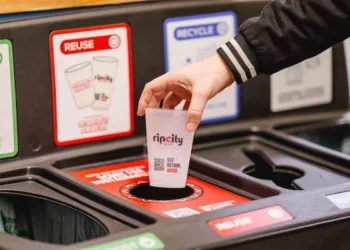
Coffee cups have been a particularly problematic product to recover in jurisdictions around the world. Consumers often assume they are recyclable due to their paper base, but the coating that provides a barrier to heat and moisture commonly derails recycling efforts. Stakeholders have worked to come up with solutions to facilitate recycling of coffee cups, but they remain a challenge for most recycling programs.

Cups today are typically manufactured using a paper stock base and a polyethylene coating, rather than the older method of wax coating.

The Washington, D.C. move to include the product in curbside recycling was driven by the fact that local MRFs stated during the recent survey process they would accept coffee cups. White also pointed to a Foodservice Packaging Institute (FPI) study that found polyethylene-coated paper cups and containers, which make up about a third of paper food-service packaging, are sometimes included in carton bales.

“The sheet of polyethylene separates fairly cleanly in a paper mill in the bath where it’s recycled. It tends to do very well,” White said. She added mills have reported different experiences in recovering the cups.

The FPI study also referenced current efforts to determine whether cups can be introduced to mixed-paper bales.

The district’s list of accepted materials will be updated every two years, with materials added or removed based on the MRF responses.

Concurrent with developing this list, the district announced a new requirement that all restaurants would need to use “recyclable” or “compostable” food-service packaging that fits certain definitions, ensuring the materials being introduced into the stream were compatible with what MRFs can accept.

That means, for example, that restaurants have to provide products made entirely of rigid plastics Nos. 1-6, made entirely of pulp or paper, or made of pulp or paper with a thin plastic coating.

Keeping markets front and center

As with all materials, the viability of recycling food-service packaging comes down to end markets.

“Everyone loves to talk about whether you can recycle those products,” said Lynn Dyer, president of the Foodservice Packaging Institute (FPI). “The short answer is yes. The longer answer is, you have to find the appropriate mill that’s able to take it.”

Another consideration is the fact that when food-soiled materials are introduced into the stream, cleanliness and quality are generally anticipated to drop.

“MRFs are concerned about contamination, they’re concerned that if you say you’ll accept food-service packaging you’re going to get a lot of food residue,” Dyer said.

But when an FPI effort looked at two case studies, Boston and Delaware, to gauge the actual amount of residue found within food-service packaging in MRFs, the results came in relatively low. In Boston, a study found “no appreciable difference in contamination rates” between food-service packaging and non-food-service packaging, with the exception of food-service corrugated containers which were slightly more contaminated.

And in Delaware, a study found food-service packaging and other standard recyclables that had come into contact with food had about the same levels of food residue.

Each case had its own qualifiers, such as Boston’s program having a penchant for very clean recyclables overall. But those results, mixed with other case studies detailing research in cities like Seattle and Torrance, Calif., have contributed to other programs taking the leap.

“I’m excited by our strategy and I think we’re on a good path,” White said. “We look forward to sharing our experiences and results so that other communities can learn from us.”

For more insight on recycling food-service packaging, attend the 2017 Resource Recycling Conference Aug. 28-30 in Minneapolis. 

Rollrite

Tags: Hard-to-Recycle MaterialsLocal Programs
TweetShare
Colin Staub

Colin Staub

Colin Staub was a reporter and associate editor at Resource Recycling until August 2025.

Related Posts

Nebraska grant recipients include electronics, battery programs

byAntoinette Smith
February 19, 2026

The grants will help fund collection of used electronics in the state, which last year passed a battery EPR law.

Nebraska awards $7m in recycling grants

byAntoinette Smith
February 18, 2026

The grants will help fund waste and litter reduction projects, recycling programs, and costs to collect scrap tires, HHW, electronic...

Wisconsin proposes E-Cycle target revisions

Wisconsin proposes E-Cycle target revisions

byScott Snowden
February 17, 2026

The state proposed updates clarifying target calculations, waiver standards and adding select battery devices to eligible collections, with public comment...

Texas sues over dumped wind turbine blades

Texas sues over dumped wind turbine blades

byScott Snowden
February 10, 2026

The state attorney general sued Global Fiberglass Solutions over alleged illegal storage and disposal of all turbine blades at two...

Greenchip launches fund for community impact and trust

byScott Snowden
February 5, 2026

The Greenchip Legacy Foundation formalizing the company's community work while reinforcing its 2026 focus on domestic processing, compliance and transparency...

Solarcycle starts up Georgia recycling plant

Solarcycle starts up Georgia recycling plant

byScott Snowden
January 30, 2026

Solarcycle has begun operating its Cedartown solar panel recycling facility, clarifying the status of a long-planned project that was previously...

Load More
Next Post

The big upsides from breaking down bales

More Posts

Sims Lifecycle leverages hyperscale decommissioning

Sims Lifecycle leverages hyperscale decommissioning

February 18, 2026
Republic Services waiting on fourth Polymer Center

Republic Services waiting on fourth Polymer Center

February 18, 2026
NERC: Blended average prices fell 40% in third quarter

HDPE, PP bales rise as paper fiber and cans stabilize

February 12, 2026
Chinese processing group details goals for US visit

AMP lays out vision of next-generation, AI-driven MRFs

July 24, 2024
Bipartisan reps introduce bill on recycling claims

Bipartisan reps introduce bill on recycling claims

February 12, 2026
Textile clothing bins

Report details how to make CA textile recycling work

February 16, 2026
Sony heads renewable plastic supply chain

Sony heads renewable plastic supply chain

February 19, 2026

Focus on recycling film, flexibles takes shape in two reports

February 13, 2026

Origin Materials to reduce staff in reorg

February 13, 2026

APR, industry create proactive guidance for PET caps

February 12, 2026
Load More

About & Publications

About Us

Staff

Archive

Magazine

Work With Us

Advertise
Jobs
Contact
Terms and Privacy

Newsletter

Get the latest recycling news and analysis delivered to your inbox every week. Stay ahead on industry trends, policy updates, and insights from programs, processors, and innovators.

Subscribe

Welcome Back!

Login to your account below

Forgotten Password?

Retrieve your password

Please enter your username or email address to reset your password.

Log In

Add New Playlist

No Result
View All Result
  • The Latest
  • Analysis
  • Recycling
  • E-Scrap
  • Plastics
  • Policy Now
  • Conferences
    • E-Scrap Conference
    • Plastics Recycling Conference
    • Resource Recycling Conference
    • Textiles Recovery Summit
  • Magazine
  • About Us
  • Advertise
  • Archive
  • Jobs
  • Staff
Subscribe
This website uses cookies. By continuing to use this website you are giving consent to cookies being used. Visit our Privacy and Cookie Policy.