





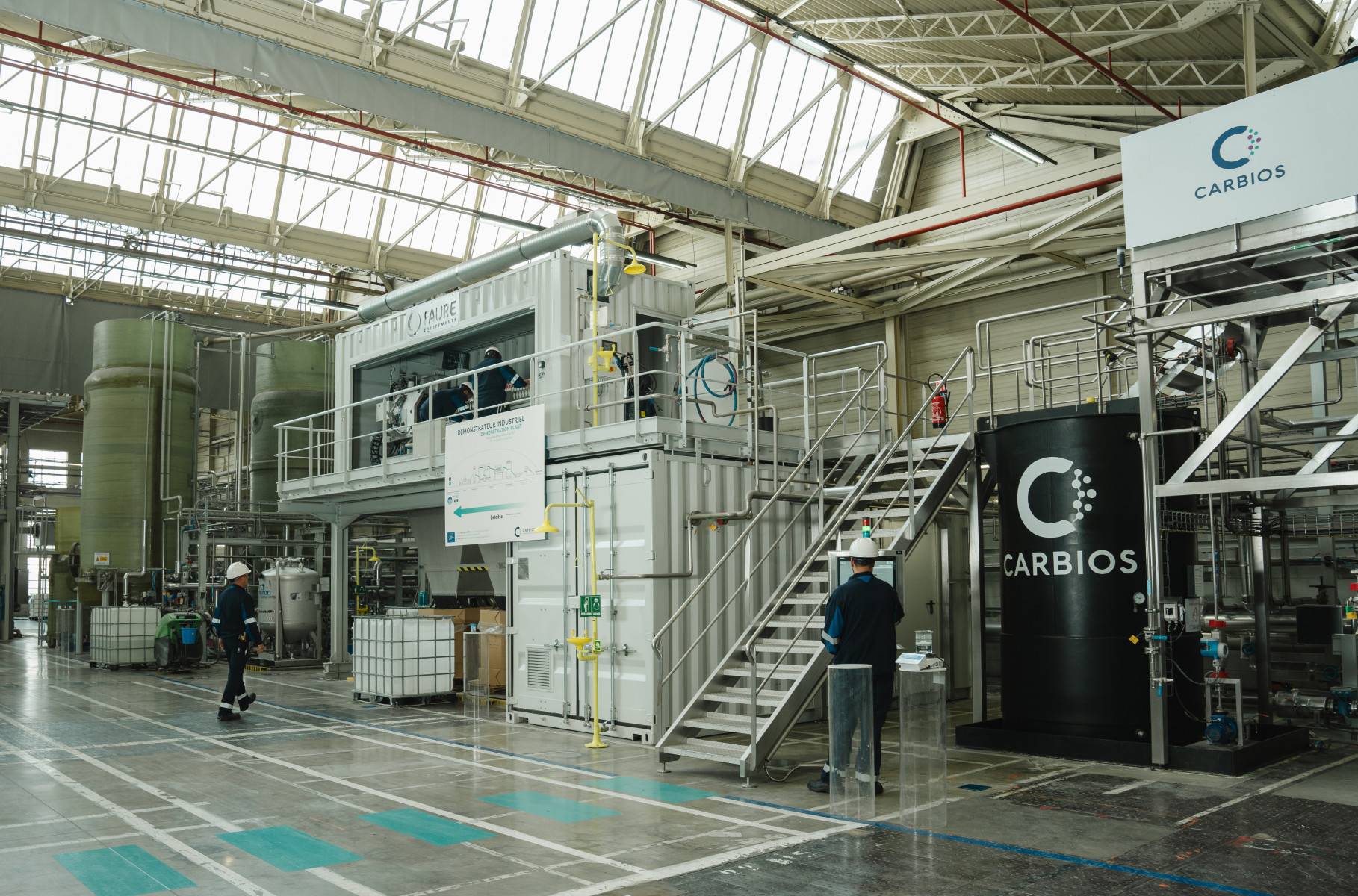
French biotech firm Carbios is delaying its PET depolymerization plant by three months while it works to secure “a small portion” of remaining financing.
While reiterating its “ambition to pursue” the project, the company said Dec. 18 that it needed to structure about 10% of the remaining funding before construction could proceed. If Carbios can secure the financing by the end of the first quarter of 2026, it expects to commission the plant during the first half of 2028, rather than the previously planned second-half 2027.
Shortly after France announced incentives for using PCR, Carbios decided to restart construction on the Longlaville plant, which had stalled in late 2024 amid financial concerns.
In late November, Carbios announced two new multi-year supply agreements for RPET, marking the company’s first customers in the beverage sector and bringing offtake commitments to about 50% of the new plant’s capacity. Earlier in 2025, cosmetics brands L’Oreal and L’Occitane en Provence signed long-term contracts, as well as Indorama Ventures, to provide RPET filament for use in Michelin tires.
In 2023, Indorama and Carbios signed a non-binding memorandum of understanding to form a joint venture for the plant. The deal was set to be finalized by the end of 2023, but in a December 2024 statement, Carbios said negotiations were not yet finalized. And in September 2025, the company said plant construction now would be supported by public financing and private investment, the latter of which was contingent on pre-sale of 70% of the plant’s capacity.
Other funding for the project includes a €30 million ($35 million) grant from the French Environment and Energy Management Agency, and €12.5 million from the Grand Est Regional Council, which is roughly equivalent to a North American state or province.
Entry into Asia
Carbios also recently formed a joint venture with Wankai New Materials to build a 50,000 metric ton/year, €115 million ($135 million) PET recycling plant in China, with construction scheduled to start on Wankai’s existing site in Haining, Zhejiang province, in first-quarter 2026. Commissioning is planned to take place about a year later, as the Haining site features existing infrastructure that the companies said will lower capital investment requirements.
Under the JV agreement, Wankai is the majority shareholder at 70%. The Chinese company also is the exclusive Asia licensee for the Carbios RPET technology for three years, if Wankai licenses at least 100,000 mt/year of additional capacity. The term extends in five-year increments if licenses for at least 200,000 mt/year of extra capacity are signed.
Carbios also aims to license its enzymatic recycling technology – which breaks down PET into its chemical intermediates purified terephthalic acid (PTA) and ethylene glycol (MEG) – in Europe, North America and South America.