











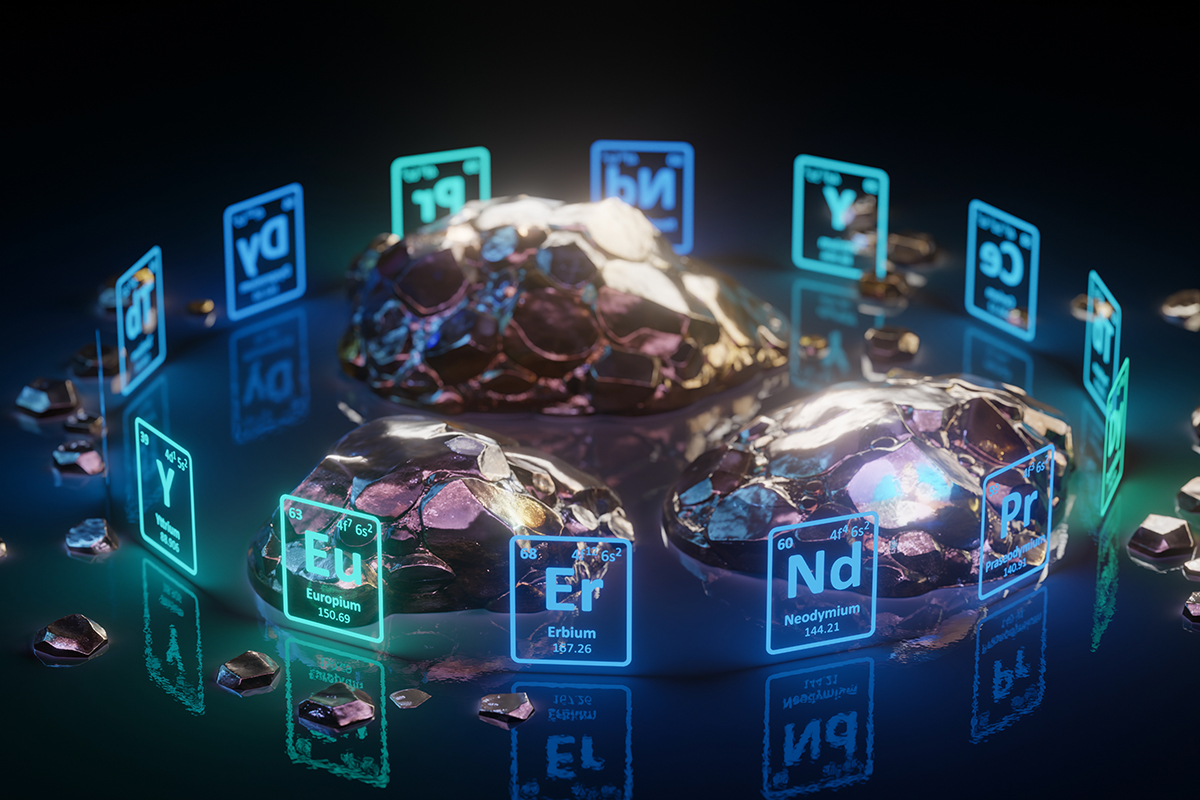
MP Materials has selected a 120-acre site in Northlake, Texas, for its 10X rare earth magnet manufacturing campus, a $1.25 billion facility developed under a public-private partnership with the US Department of Defense aimed at reducing American dependence on foreign rare earth sources.
The Northlake location sits fewer than 10 miles from MP’s existing Independence facility in Fort Worth, extending the company’s downstream footprint in the region. The project adds an estimated 10,000 metric tons of NdFeB rare earth magnet capacity per year and builds upon MP’s existing end-to-end operations, spanning mining and refining at Mountain Pass, California, through metallization, alloying, sintering, finished magnet production and closed-loop recycling.
The DOD partnership, announced in July 2025, represents a $1.25 billion package of investments and long-term commitments. It includes a 10-year NdPr price floor commitment of $110 per kilogram, a 10-year magnet offtake agreement covering 100% of 10X production and a $400 million preferred equity investment that positions the Pentagon to become MP’s largest shareholder.
The company also secured $1 billion in construction financing from JPMorgan Chase and Goldman Sachs, alongside a $150 million DOD loan to expand heavy rare earth separation capabilities at Mountain Pass.
“This initiative marks a decisive action by the Trump administration to accelerate American supply chain independence,” said MP CEO James Litinsky.
The company noted the magnets produced at the facility underpin critical and emerging technologies, including drones, robotics, AI data centers, electrification and advanced semiconductor fabrication – sectors central to both economic resilience and national security.
The project secured roughly $200 million in state and local incentives, including $66 million in grants from the Texas Enterprise Fund and Texas Semiconductor Innovation Fund, with additional support from Denton County and the city of Northlake through abatements and exemptions.
Commissioning is anticipated in 2028, with the campus expected to bring more than 1,500 manufacturing and engineering jobs to the region.