





This article originally appeared in the Winter 2018 issue of E-Scrap News. Subscribe today for access to all print content.
Material markets have undergone shifts of late, but commodity pricing is just one of myriad forces that are constantly shaping and reshaping the e-scrap and ITAD sector.
Equally impactful are changes in device design, growing safety and data security concerns, adoption of downstream tracking techniques, and a shift in the fundamental business model for e-scrap processors.
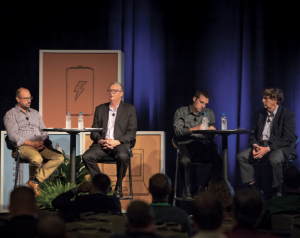
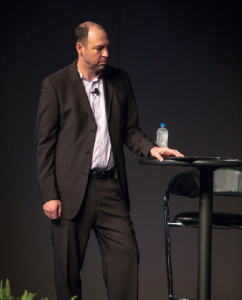
In the closing plenary session at the 2018 E-Scrap Conference, held in New Orleans this October, a handful of speakers took part in an off-the-cuff discussion covering the wide range of factors that are impacting the electronics recovery industry.
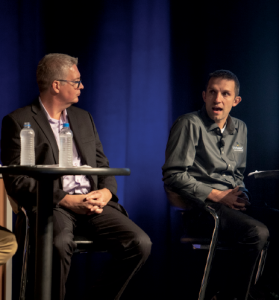
The session featured Serdar Bankaci of CyberCrunch, Gary Curtis of Schupan Recycling, Miles Harter of Dynamic Lifecycle Innovations and Rob Schafer of research firm Gartner. It was moderated by Adam Dumes of Cohen Recycling.
Commodity markets in flux
A variety of forces over the past year have created changes in industry market dynamics, Curtis said. A lot more material is staying in the U.S. due to China’s policies barring recyclables imports, tariffs coming into effect, Russian sanctions and more.
“I think, in some cases, it’s going to be very difficult to sell certain items, certain grades of scrap,” Curtis said. There will be wider fluctuations in scrap pricing, he said, and he anticipates China’s policies will only continue to tighten.
Curtis noted non-ferrous metals and scrap plastics have been hit particularly hard. They will continue to be hard to move, “and they’re also going to be at a much lower value than [they have been] historically.”
For some companies, he added, further declines in commodity markets could be the fateful push that sends them under. But for operators that have diversified their sales avenues, they’ll have the flexibility to weather the storm.
Harter of Dynamic said his operation has worked to combat the impact of lower commodity values in multiple ways. Pricing and world events are difficult to predict, he noted, but in some cases, the new market situation can open doors.
“Everything before was kind of sent off, and now I think there’s some gaps in the market,” Harter said. “And I think it’s going to create a lot of opportunities for more jobs … and taking more responsibility for the stuff we’re generating.”
Schafer, who serves a market analyst for Gartner, agreed there could be a silver lining to the China issue.
“Once you come out of this at the other end of it, you’re less dependent and you have more alternatives,” he said.
Focus on challenging items
Plastic has been particularly hard hit by the market downturn because a large percentage of the plastic recovered from e-scrap was previously shipped to Chinese buyers.
Meanwhile, the value of some types of scrap plastic has decreased as oil prices have dropped.
The market pressures have reached the point where it can be most cost effective to landfill plastics. But this is often at odds with what e-scrap generators want. The question, then, becomes who will pay the higher costs to keep material out of disposal streams.
“Somebody has to bear that cost, and most likely it’s going to be the upstream customer,” Bankaci said.
Schupan has found markets for its scrap plastic, Curtis said, but it’s unclear how existing markets will pan out long term. All speakers agreed the downturn will likely force innovation in terms of domestic e-plastics processing.
Lithium-ion batteries are another challenging item, not due to market fluctuations but because of concerns over safety. The batteries have emerged as a top safety hazard in e-scrap facilities, as well as materials recovery facilities (MRFs) that handle the municipal recycling stream. When punctured, the batteries can explode, and if flammable material is nearby, conflagrations could result.
“I think the biggest thing, at least for us, is staying on top of it, getting proactive, with a little bit of paranoia, honestly,” Harter said.
Speakers agreed that regulations focused on the manufacturing of batteries would be a good step forward. They also discussed future factors that will compound the safety concerns. For example, internet of things (IOT) devices are becoming more common – Schafer said Gartner estimates in the next few years there will be roughly 26 billion IOT devices produced, many relying on lithium-ion batteries.
“The challenge we’re talking about here is multiplied several-fold,” Schafer said. “I think we’re still in the early days of that challenge.”
Debating certifications and ‘bad actors’
One of the chief concerns expressed by the industry voices on stage was certified companies caught not following the practices required of them. When this happens, Dumes stated, it hurts the credibility of the certification standards.
Bankaci said it would be helpful if the standards organizations provided more assistance in educating e-scrap companies’ upstream customers about certification. He also said it’s important for companies to consider why they are getting certified in the first place.
“What are you looking to accomplish with that certification? Are existing customers asking for it? If they’re not, why? Why do it?” he said. “Once you have the customers in place that want the R2, I think that’s when you go for it, because it’s expensive, especially for the smaller guys.”
Although it’s a financial undertaking, getting certified can also help reduce brand risk for clients, Schafer said, describing it as “almost invaluable.” If a data breach happens, the customer wants to be able to say every precaution was taken, including the use of certified service providers.
Meanwhile, a new trend is emerging on the heels of several high-profile investigations and reports from the Basel Action Network (BAN), which uses GPS tracking devices to monitor downstream movement when devices leave e-scrap collection sites. The investigations have been part of BAN’s E-Trash Transparency Project, which names companies allegedly exporting e-scrap devices to developing nations.
Now, BAN and some companies are offering voluntary GPS tracking to companies to monitor device movement for themselves.
Two processors represented in the plenary session, Dynamic and Schupan, have employed voluntary tracking services. Doing so tells clients the company has absolute confidence in its downstream network, Harter said.
Much of the impetus behind certifications and trackers is to make it more difficult for “bad actors” to operate. Although speakers agreed unscrupulous operations represent a small portion of the industry, panelists also said it’s important to focus on the issue, because such outfits have the potential to deal hard blows to the industry’s reputation.
“A lot of times we smooth over the bad actors, in a sense, and say, ‘Well, they won’t be around forever.’” Dumes said. “But while they’re there, they can hurt you. You’re trying to do things the right way, and you’re at a competitive disadvantage. So they go out of business, but the next one comes.”
Shifting cost burden
As margins go down amid declining commodity values and device lightweighting, e-scrap companies are starting to change how they frame the economics of recycling.
Gartner is already advising companies that hire e-scrap and ITAD vendors to not expect a check from their service provider, and, in fact, to be prepared for an invoice. Schafer noted that e-scrap operators should be prepared for pushback from customers, and that there will always be competition from small collectors either accepting material for free or offering to pay generators.
But Schafer also pointed out that doing business with those types of operators carries major risks.
“You certainly want to focus on value for money, but at the end of the day, the bottom line is it’s all about your brand,” Schafer said. “And the last thing you want to do is have your brand splattered on a ‘60 Minutes’ exposé that either [shows] your assets are in a landfill in Africa somewhere or your data is for sale on the internet.”
Bankaci noted that there’s more understanding of the cost equation at the enterprise level but less so when working with smaller customers or within the residential realm.
Controversy on the horizon
There are plenty of hot issues and unknowns in the e-scrap world, and the panelists made it clear controversy is not leaving this industry anytime soon.
Unsurprisingly, stockpiling of low-value material was identified as a problem that will likely continue and could actually worsen. Responding to a poll-the-panel question, half the speakers felt an e-scrap stockpile will be designated a Superfund site in 2019. (Federal Superfund law designates highly contaminated areas as priority sites that can receive federal resources to help with cleanup efforts.)
“We all know they’re out there. It’s just a matter of if they’re uncovered next year or the year after that,” Curtis said.
Bankaci, offering a counterpoint, noted electronics were simply disposed of in landfills for 20 or 30 years. Therefore, he doubted any e-scrap stockpile would be given Superfund status.
Bankaci said his biggest concerns are in data destruction. A lot of e-scrap operators have come out of the scrap metal world, he noted, and technology is becoming increasingly complex. Many companies just don’t have a full understanding of which devices contain data and which data removal methods should be used.
“I expect a data breach coming from an R2- or an e-Stewards-certified company within the next year,” he said. Bankaci applauded the e-Stewards standard for a recent agreement it entered with the National Association for Information Destruction (NAID). But he still expressed pessimism about data security and recycling in the near future.
“Something’s going to happen, and it’s going to damage all of our reputations, in my opinion,” he said.
Schafer agreed but offered a different take: A large-scale data breach from an e-scrap or ITAD company’s practices could be good for a heightened focus on data security in the industry.
Colin Staub is the staff writer for E-Scrap News. He can be contacted at colin@resource-recycling.com.