



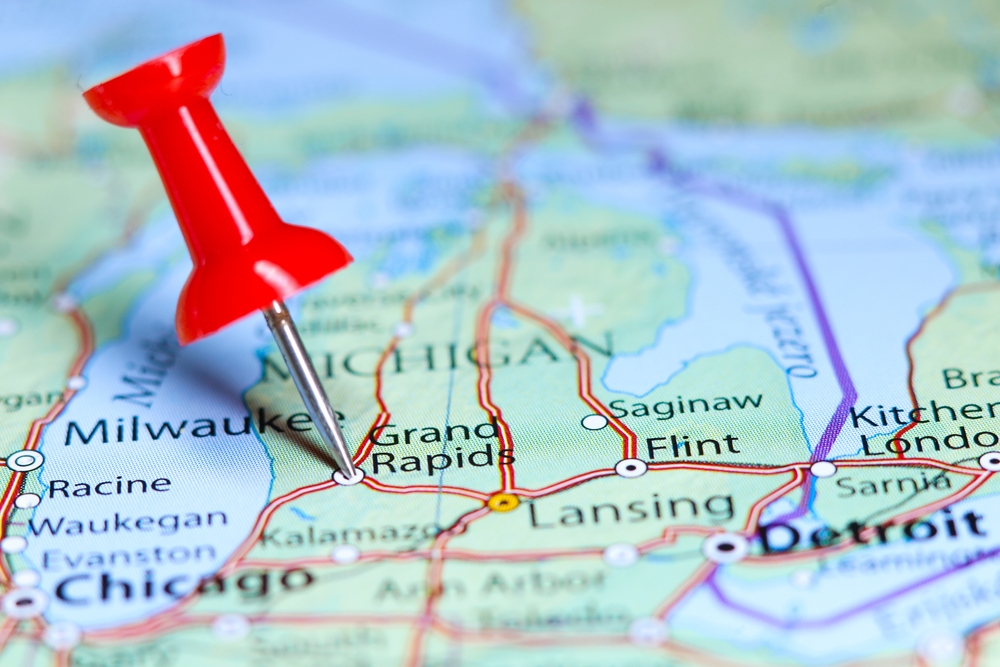
A county in western Michigan is leveraging AMP AI-assisted technology to recover recyclable commodities from households, but with a twist: The sortation system sits upstream of a waste-to-energy facility.
Although the setup is unique, the problem it will address is a familiar one: Kent County’s recycling rate has plateaued, and an estimated 75% of recyclables still end up in the trash, said Dar Baas, director of the county’s Department of Public Works.
Kent County is home to the state’s second-largest city, Grand Rapids. The Department of Public Works is installing AMP’s technology at its waste-to-energy facility to recover recyclables from mixed municipal solid waste (MSW) before it hits the combustion chamber, Baas said.
The system will process about 25 tons per hour, initially targeting plastics and OCC to route directly to the commodities market or to the county MRF for a final sort. Completion is targeted for third-quarter 2027.
Unlike most jurisdictions, a single public operator controls Kent County’s transfer stations, landfill, MRF and WTE facility. That unified ownership enables the county to direct materials strategically — routing loads either to the MRF or to WTE with a pre-sort depending on composition and market conditions, Baas said.
Stuck at 10%
The county has operated in the recycling space since 1990, and in 2010 opened a merged single-stream facility – state of the art at the time. But despite a long and progressive history and employing three full-time educators, who provide tours and conduct outreach with area schools, the county’s recycling rate is stuck at 10%, Baas said.
The county generates about 1 million tons of trash a year, and about 60% of that is considered municipal and commercial solid waste, most of which is combustible or processable, Baas said.
The team’s outreach efforts indicated that to increase recovery rates, “we need to go back into the waste stream itself.” So while curbside and drop-off options will remain the primary means to recover materials, the new setup will provide a second line of defense to recover even more, he said. “What they’re telling us is after 30 years, they’re only going to put about 25% of the right stuff in the right container for recycling.”
The ‘best next step’
Due to the cost of building a greenfield MSW facility, the county decided upgrading its existing MRF with robotics and embedding mixed-waste sortation directly into the WTE plant was a “best next step,” Baas said.
The county’s Recycling & Education Center already uses AMP technology to process source-separated curbside recyclables at the MRF level. The new WTE deployment extends that relationship to the same underlying platform, creating what amounts to a shared identification and recovery architecture across the county’s system.
The new bolt-on system also reduces financial and political risk compared to building a new MRF or a mega-processing plant, Baas said. It also provides a real-world test of what additive technology can do within existing infrastructure — and possibly spur investment in similar systems, he added.
Upstream, better source separation yields cleaner, lower-cost feedstock for MRF commodity markets. Downstream, the WTE pre-sort catches materials that would otherwise be lost to combustion.
AMP CEO Tim Stuart noted a secondary operational benefit at the WTE end: pre-sorting recyclables before combustion also improves combustion efficiency by removing materials that affect burn temperature and throughput. “We don’t see any derogation by material coming through there,” he told Resource Recycling, pointing to results from the company’s recent project in Virginia.
Project uses Virginia roadmap
The Michigan design will draw directly on what AMP is learning from its recent project in Portsmouth, Virginia.
In June, the company completed a new single-stream recycling facility fed by the adjacent 108,000 ton/year MSW sorting site AMP runs under a 20-year contract with the Southeastern Public Service Authority (SPSA).
Stuart said lessons from the ramp are already being carried into Kent County planning. “The Virginia facility process is going great, exceeding our expectations from an efficiency and recovery perspective,” he said. “And we’re going to take those lessons learned and continue to learn as we put new AMP One facilities out there.”
The company is also working on a second facility there to recover recyclables and organics from MSW, expected to come online in late 2027. The project will increase processing capacity to up to 540,000 tons/year.
The MSW facility was commissioned in early February and is running at about 20% of its ultimate processing capacity, said Andrew Trump, AMP general manager, in an interview with Resource Recycling.
Under the AMP contract with SPSA, the company must divert at least 50% of the waste stream — capturing essentially all organics (about 40% of incoming material) and all traditional recyclables (about 10%), with additional recovery potential depending on end markets.
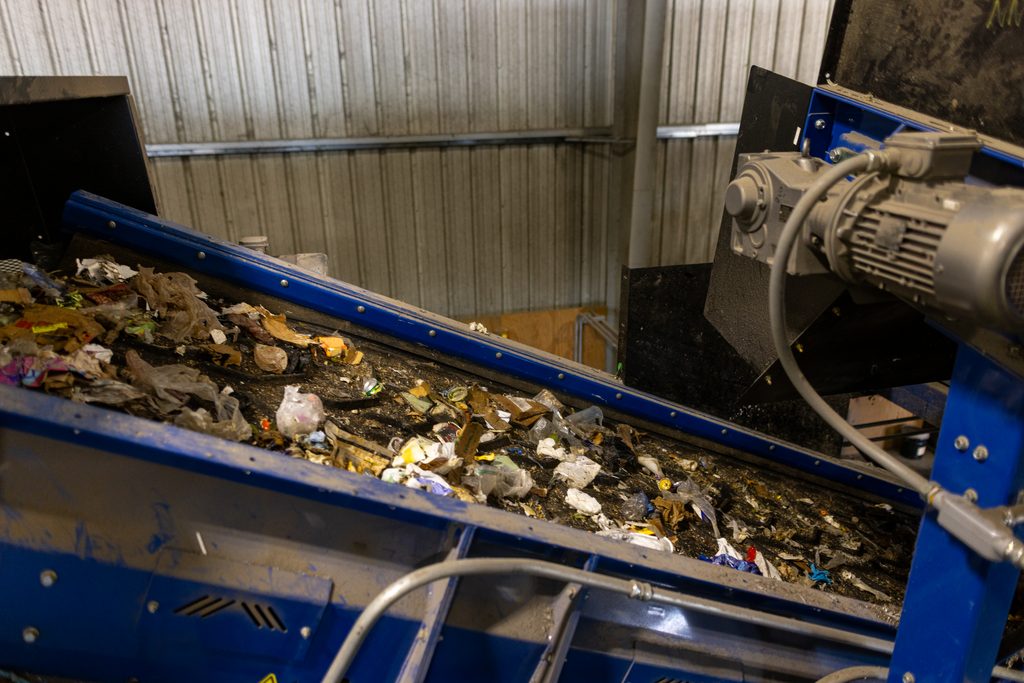
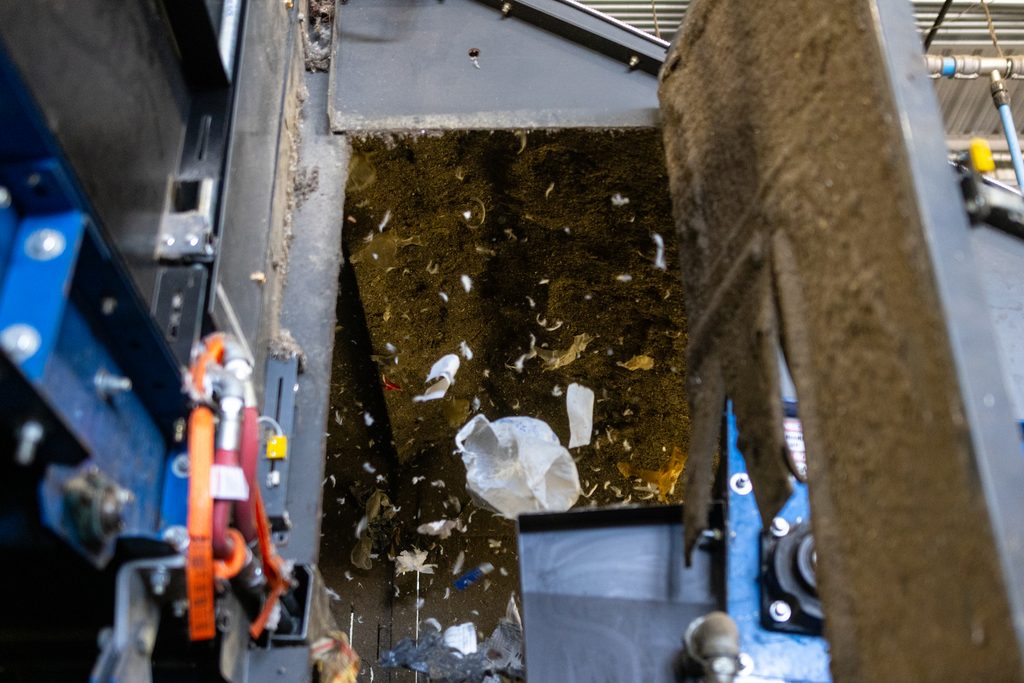
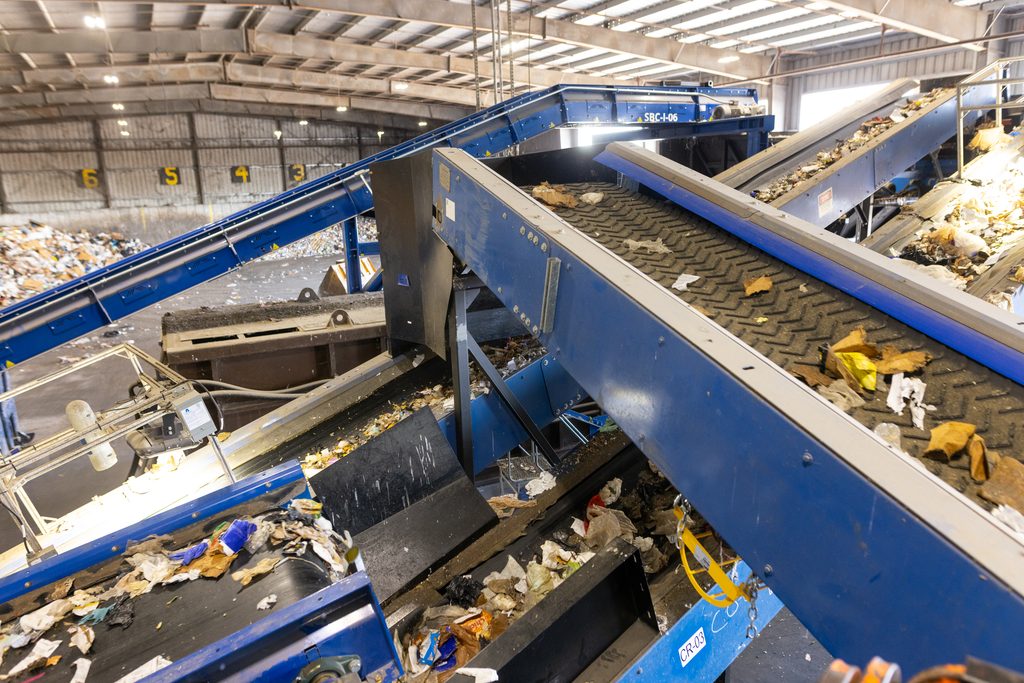
The operation also includes pyrolysis of the organics fraction, producing biochar used as landfill daily cover. In March, Google signed a carbon credit purchase agreement for the first several years of biochar production.
By focusing first on plastics and OCC, the Kent County system can establish a baseline for commodity recovery and generate data on what is actually moving through the MSW stream. Stuart said the county and AMP will refine recovery targets as they better understand material composition.
“Unfortunately, there’s still a lot of valuable recycling material that makes its way into the MSW,” Stuart said. “We’ll be working with Kent County to understand the material coming through there, and what makes sense for us to continue to build on those initial recovery sources.”
In the meantime, the project provides an example of the evolving role of the modern MRF, from the recycling plant to part of an integrated, multi-facility recovery platform.