


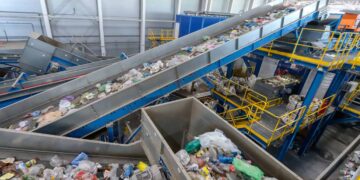



The electronics recycling industry is entering a new phase of technological acceleration. Advances in artificial intelligence, robotics, advanced chemistry, and digital tracking are transforming facilities from manual operations into more automated, data-driven systems capable of recovering critical materials with greater precision and transparency.
A useful analogy comes from NVIDIA’s “AI factory” concept, which treats data centers as continuous production systems. In similar fashion, the next generation of recycling plants is evolving into cyber-physical factories that turn discarded devices into usable materials and compliance data. Integrated robotics, sensors, and software now enable real-time monitoring, automated adjustments, and detailed reporting, features long common in semiconductor or automotive manufacturing but new to recycling.
From pilot to production
AI and robotics have moved from the lab to the sorting line. We are seeing systems from companies like AMP Robotics, ZenRobotics, and Waste Robotics use machine vision, hyperspectral imaging, and X-ray fluorescence to identify and separate metals, plastics, and batteries with higher speed and accuracy than manual crews.
Likewise, vendors such as Max-AI and CP Group are building “Industry 4.0” platforms that unify robotics, sensors, and process controls under one interface, giving operators live performance dashboards and resource tracking tools.
Cleaner chemistry, the magnet challenge and digital tracking
Automation isn’t limited to sorting. A quieter revolution is taking place in metallurgy. Emerging hydrometallurgical and electrochemical processes are offering cleaner, more selective metal recovery than traditional smelting.
UK-based DEScycle, for example, is using deep eutectic solvents (DES) to extract precious and critical metals with lower energy input and fewer emissions. Similar progress in electrochemical and biological leaching could expand recovery of rare earths and other high-value elements from complex scrap.
Rare earth magnets remain a critical and difficult material stream. Hydrogen processing of magnetic scrap (HPMS), commercialized by HyProMag in the UK, uses hydrogen to demagnetize and reduce magnets into powder for reuse. This “magnet-to-magnet” method consumes up to 88% less energy than mining and refining, and new projects in Europe and North America are targeting data center drives and other magnet-rich e-scrap as key feedstock.
On the data front, new digital systems are allowing e-waste processors to log material provenance and recovery metrics in real time. These records are increasingly demanded by OEMs, regulators, and critical mineral users as evidence of responsible sourcing.
In parallel, AI-enabled collection tools and robotics are being explored for smarter logistics. Over time, detailed recovery data could feed upstream to product designers, helping create electronics built from the start for disassembly and material reuse.
As we look at the next two to three years, it is evident that the industry won’t change overnight, as capital costs are high and adoption remains uneven, but the shift is unmistakable. The e-waste facility of the future will look more like a high-tech manufacturing plant than a scrapyard, with robotics, cleaner chemistry, and connected systems forming the backbone of the next-generation resource recovery network.