



Resource Recycling
  • The Latest
  • Analysis
    • All
    • Certification Scorecard
    • Industry Announcements
    • Opinion
    Intel sign outside of company building.

    Intel’s CapEx tops $20B on server demand while PC volume shrinks

    Google sign on company building with blue sky and clouds above.

    Inside Alphabet’s Q2 results: More capital spending and cloud backlog

    Alpek closing Pennsylvania RPET plant

    Alpek seizing on war-related opportunity 

    Our top stories from March 2023

    Iron Mountain’s data center report: Strong on power, quiet on hardware

    Dow touts US PE advantage amid Iran war

    Dow bullish on August PE pricing

    Certification Scorecard — Week of July 20, 2026

  • Conferences
    • Resource Recycling Conference
    • Plastics Recycling Conference
    • E-Scrap: The Longevity Conference
    • Textiles Recovery Summit
  • Publications
    • E-Scrap News
    • Plastics Recycling Update
    • Policy Now
    • Resource Recycling
    • Other Topics
      • All Topics
      • Brand Owners
      • Critical Minerals
      • Glass
      • Grant Watch / RFPs
      • Markets
      • Organics
      • Packaging
      • Research
      • Technology
      • Textiles
Subscribe
No Result
View All Result
Resource Recycling
  • The Latest
  • Analysis
    • All
    • Certification Scorecard
    • Industry Announcements
    • Opinion
    Intel sign outside of company building.

    Intel’s CapEx tops $20B on server demand while PC volume shrinks

    Google sign on company building with blue sky and clouds above.

    Inside Alphabet’s Q2 results: More capital spending and cloud backlog

    Alpek closing Pennsylvania RPET plant

    Alpek seizing on war-related opportunity 

    Our top stories from March 2023

    Iron Mountain’s data center report: Strong on power, quiet on hardware

    Dow touts US PE advantage amid Iran war

    Dow bullish on August PE pricing

    Certification Scorecard — Week of July 20, 2026

  • Conferences
    • Resource Recycling Conference
    • Plastics Recycling Conference
    • E-Scrap: The Longevity Conference
    • Textiles Recovery Summit
  • Publications
    • E-Scrap News
    • Plastics Recycling Update
    • Policy Now
    • Resource Recycling
    • Other Topics
      • All Topics
      • Brand Owners
      • Critical Minerals
      • Glass
      • Grant Watch / RFPs
      • Markets
      • Organics
      • Packaging
      • Research
      • Technology
      • Textiles
Subscribe
No Result
View All Result
Resource Recycling
No Result
View All Result
Home Plastics

How a novel EPS recycling approach is propelling a Canadian company

byJared Paben
August 31, 2016
in Plastics

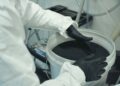
Polystyvert_ConcentrateurporteouverteImagine a lump of sugar dissolving in coffee – Solenne Brouard uses that image to describe the first step in her company’s expanded polystyrene recycling process.

Now image the sugar is later extracted from the coffee, formed into pellets and sold right back into the fresh sugar market, without any discoloration or quality tradeoffs. That’s how one might liken the key step in the recycling process employed by her company, Polystyvert.

“The quality is really important, because our claim is that our process recycles the polystyrene (PS) with quality very close to virgin PS, so we can sell this PS to better prices than regular repro pellets,” said Brouard, president and founder of the company.

Brouard spoke with Plastics Recycling Update: Technology Edition recently to provide additional details about her fast-growing Montreal company’s novel recycling technology. In August, Plastics Recycling Update: Technology Edition reported Polystyvert has raised about $3.77 million to build a larger processing facility capable of recycling more EPS.

Essential step

Founded in 2011, Polystyvert sells what it calls “concentrators” to large generators of EPS, including appliance distribution centers, grocery stores and businesses in the pharmaceutical industry. Those concentrators, which are installed at the generators’ sites, include an input chute into which workers drop EPS. They also include a removable cartridge holding essential oils called p-Cymene, which dissolve the EPS on contact.

Brouard said the oils are a natural product, similar to oils found in eucalyptus or peaches, as examples. They are different from limonene, a liquid derived from citrus fruits that dissolves PS.

Polystyvert’s oils change the plastic’s state, similar to freezing and melting water, but no chemical reaction takes place, she said.

“A chemical reaction would change the molecular chain of the PS,” she said. “In our case, it does not change. That’s very import for the PS end product.”

Contaminants, including labels, food and other materials, are easily filtered out later, although they do raise Polystyvert’s costs, she noted. She pointed to the fact cardboard works as a sponge to soak up the oils, preventing their recovery for reuse.

The concentrators automatically notify Polystyvert when they’re full, each holding up to 660 pounds of dissolved PS. Polystyvert collects the concentrators and loads them in a truck, replacing the cartridge with a new one full of oils.

Separation approach

At its recycling facility, Polystyvert uses a proprietary process to separate the PS from the oils, which are distilled for reuse.

The company has applied for an international patent for the separation technology. According to the patent application, the mix of PS and p-Cymene is added to a hydrocarbon-based compound or mixture in which PS is insoluble. That creates a precipitated PS, which is again washed with the hydrocarbon solution. Then the PS is dried before being extruded.

Depending on the batch size, separation can take an hour or less, Brouard said.

The company is currently recycling EPS of various colors into a gray pellet and white EPS into a natural pellet. The current pilot plant can produce 550 pounds per hour of recycled PS, but the new facility, expected to open in late 2017, will be capable of recycling 10 times that amount, Brouard said.

The pellets aren’t yet being sold into food packaging markets because regulatory approvals haven’t yet been obtained, she said. Polystyvert is working first to obtain approval from Health Canada. It also plans to seek U.S. Food and Drug Administration approval.

Brouard said Polystyvert’s process allows recovered plastics to be sold for higher prices than when a densifier is used. That’s because a densifier’s melting of the plastic generates fumes and results in material with lower shock resistance and tensile strength and higher melt flow.

That being said, a densifier is a step in the right direction.

“If you have a choice between landfill and densifier, take the densifier, but you won’t make a lot of money with that,” she said.

Scaling up

Polystyvert sells or rents concentrators to EPS generators and charges for pickups, with prices depending on the volume of material, level of contamination and distance from the pilot plant.

The company currently works with commercial entities across Quebec, including grocery store chain Sobeys. Through a pilot project, Sobeys is using the concentrators to recycle back-of-house food trays.

Most of the company’s revenue, however, comes from the sale of recycled commodities, Brouard said.

Polystyvert also collects EPS from the public via drop-offs in the Quebec towns of Granby and Waterloo. Contamination hasn’t been a problem from those locations, Brouard noted, because the people willing to drive their foam down to the drop-off sites are conscientious and do a good job of removing contaminants and sorting foam.

Polystyvert has also talked with officials at the city of Montreal about recycling foam collected from households, Brouard said, although details on how that service could look are yet to be determined.


Tags: EPS FoamHard-to-Recycle MaterialsTechnology
TweetShare
Jared Paben

Jared Paben

Related Posts

Intel sign outside of company building.

Intel’s CapEx tops $20B on server demand while PC volume shrinks

byDavid Daoud
July 29, 2026

As a result ITAD firms should plan for two separate asset cycles.

Greyparrot positions waste intel as key to effective EPR

Greyparrot secures $27m for growing AI waste data

byAntoinette Smith
July 28, 2026

The AI waste intelligence firm has now raised a total of $60 million to help expand its Analyzer network and...

Google sign on company building with blue sky and clouds above.

Inside Alphabet’s Q2 results: More capital spending and cloud backlog

byDavid Daoud
July 28, 2026

The tech giant spent $44.9 billion in a single quarter building AI infrastructure, with major implications for the ITAD space.

Our top stories from March 2023

Iron Mountain’s data center report: Strong on power, quiet on hardware

byDavid Daoud
July 24, 2026

The company’s 2025 Sustainability Overview tells a story both in the data it presents and in the data it omits.

Rare earth processor lands $5.1M in Defense funds

ERI, Cyclic Materials team up on e-scrap

byDavid Daoud
July 21, 2026

Partnership pairs one of the country's largest electronics recyclers with a rare earth recovery specialist, aiming to build a domestic...

What the NAND flash crunch means for remarketing, refurbishment and residual values

Telamon acquires ITAD consultancy Retire-IT

byDavid Daoud
July 9, 2026

Telamon will be retaining Retire-IT founder Kyle Marks, who built that business over 21 years.

Load More
Next Post

FDA gives green light to range of recycling proposals

2026 Buyers’ Guide

Equipment, services and technology suppliers serving the recycling industry.

Browse the Guide

More Posts

2024 legislatures focus on batteries, state programs

NAW sues Colorado over EPR packaging law

July 30, 2026
CarbonLite to open $60 million Pennsylvania plant

Federal judge blocks CA ‘Truth in Recycling’ (SB 343) law

July 15, 2026
Alpek closing Pennsylvania RPET plant

Alpek seizing on war-related opportunity 

July 27, 2026
California releases deposit system update draft rules

Groups move to intervene in SB 343 lawsuit

July 27, 2026

MTA loses track of recycling, costing NYC Transit $800,000

July 23, 2026
Women in Circularity: Christine Nikander

Women in Circularity: Christine Nikander

July 28, 2026
Ivan Rangel of Happen Ventures speaks at the PROP conference in Lancaster, PA July 24, 2026.

Making reuse as easy as possible

July 27, 2026
Industry announcements for January 2026

Industry announcements for July 2026

July 1, 2026
Waste Connections company truck on an urban street.

Waste Connections sees Q2 lift on recycled commodity values

July 24, 2026
Dow touts US PE advantage amid Iran war

Dow bullish on August PE pricing

July 24, 2026
Load More

About & Publications

About Us

Staff

Archive

Magazine

Work With Us

Advertise
Jobs
Contact
Terms and Privacy

Newsletter

Get the latest recycling news and analysis delivered to your inbox every week. Stay ahead on industry trends, policy updates, and insights from programs, processors, and innovators.

Subscribe

Welcome Back!

Login to your account below

Forgotten Password?

Retrieve your password

Please enter your username or email address to reset your password.

Log In

Add New Playlist

No Result
View All Result
  • The Latest
  • Analysis
  • Recycling
  • E-Scrap
  • Plastics
  • Policy Now
  • Conferences
    • E-Scrap Conference
    • Plastics Recycling Conference
    • Resource Recycling Conference
    • Textiles Recovery Summit
  • Magazine
  • About Us
  • Advertise
  • Archive
  • Jobs
  • Staff
Subscribe
This website uses cookies. By continuing to use this website you are giving consent to cookies being used. Visit our Privacy and Cookie Policy.