





Resource Recycling
  • The Latest
  • Podcast
  • Analysis
    • All
    • Certification Scorecard
    • Industry Announcements
    • Opinion
    IT asset disposition and electronics recycling: Now and then

    Data center moratoriums cast development shadow

    Recycling tracking data is already on your truck

    Recycling tracking data is already on your truck

    A five star ranking with one under a microscope

    Certification scorecard — week of Nov. 9

    Data centers and AI combine to create ITAD ‘growth engine’

    Component shortages drive demand for data center hardware

    Ingram Micro again files to take company public

    Ingram Micro sees lifecycle services rise 35%

    Inside the Circle: Will we lose our shirts over CA textile EPR?

    Inside the Circle: Will we lose our shirts over CA textile EPR?

  • Conferences
    • Resource Recycling Conference
    • Plastics Recycling Conference
    • E-Scrap: The Longevity Conference
    • Textiles Recovery Summit
  • Publications
    • E-Scrap News
    • Plastics Recycling Update
    • Policy Now
    • Resource Recycling
    • Other Topics
      • All Topics
      • Brand Owners
      • Critical Minerals
      • Glass
      • Grant Watch / RFPs
      • Markets
      • Organics
      • Packaging
      • Research
      • Technology
      • Textiles
Subscribe
No Result
View All Result
Resource Recycling
No Result
View All Result
Home Recycling

East Coast PRF on the road to reopening

Colin StaubbyColin Staub
March 6, 2018
in Recycling

Wheels are in motion to resume operations at an idled plastics recycling facility outside Baltimore. But if it does start up again, it will do so without one of its original partners.

The Dundalk, Md. QRS facility, which launched as a joint venture between QRS Recycling and Canusa Hershman Recycling, suspended operations last summer. As a plastics recovery facility (PRF), the operation had been separating materials out of mixed-plastics bales for sale to downstream outlets.

At the time, the companies said the downtime would “enable an optimization of the equipment” at the facility, and they noted market challenges were impacting operations across the post-consumer resin industry.

Efforts have been progressing over the past six months to bring it back on-line, sources told Plastics Recycling Update. But in the meantime, QRS Recycling exited the joint venture as of November 2017, company QRS CEO Greg Janson confirmed, and the PRF is now owned entirely by Canusa Hershman Recycling.

“We are no longer involved in the QRS of Maryland facility,” Janson stated.

But as QRS exits, another player has expressed interest in acquiring the facility.

A new operator

The Closed Loop Fund originally provided financial backing to get the PRF operational. Bridget Croke, external affairs director for the Closed Loop Fund, told Plastics Recycling Update the facility has received a letter of intent from “a major company in the industry” and hopes to close on a transaction in the coming months. It would be an acquisition by a new operator, she said.

“Current market conditions have driven additional interest,” she added.

Few specifics are public at this point, as the parties are operating under a confidentiality agreement, said Jonathan Sloan, president of Canusa Hershman.

“We’ve been working diligently to find various parties who are interested in restarting the facility,” he said.

Sloan said China’s import restrictions and rising oil prices have contributed to renewed interest in the secondary sortation operation.

“We’re hopeful that, in the near future, we have consummated a transaction,” Sloan said, noting the relevant stakeholders would share more details when appropriate.

As for the facility’s moniker, given QRS’s departure, Sloan noted that will likely change as well.

“I would suspect any new owner would re-brand the facility to their name,” he said.

Pioneering in its field

QRS and Canusa Hershman opened the 128,000-square-foot Baltimore-area PRF in November 2015, focusing on separating materials out of Nos. 3-7 bales. The Maryland location was sited to serve regional materials recovery facilities (MRFs) and reclaimers, according to QRS. It had a capacity of nearly 55,000 tons per year.

Under the original partnership, Canusa Hershman’s role was to acquire feedstock for the facility, and QRS was responsible for operating it. Both companies had an equity position in the venture.

The QRS operation has been viewed as a pioneer in the push for domestic processing of mixed-plastic bales, which have traditionally been shipped overseas.

At the Plastics Recycling Conference in Nashville, Tenn. last month, Janson recounted the factors that led to the facility’s development. QRS initially started a PRF to serve the Louisville, Ky. area. Based on the results seen at that facility, QRS expanded with another similar operation in Atlanta.

Both facilities “had tremendous success,” Janson said.

Oil was trading at $105 per barrel, and PET was priced between 20 and 30 cents per pound. QRS had a “major relationship with some brands on PET supply,” Janson said. With all the positive factors, the company quickly expanded with another location in the Baltimore area, in partnership with Canusa Hershman.

Then, Janson said, oil went to $28 a barrel and the PET market collapsed. The mixed No. 3-7s faced substantial difficulty trying to survive those market conditions, and QRS “ended up having to close our 3-7 PRFs,” Janson said.

Despite the downturn, Janson expressed optimism about the lessons learned through the PRF challenges. QRS is more focused on securing buyers for the material it sorts and sells.

“When you go through a situation like that, it’s obviously going to influence how you look at things,” Janson said. “We’re just a more realistic company, and I think we understand now more than ever how important it is to stimulate demand, so we can have movement of these materials in all market conditions.

During the facility’s development, the project received a $2 million loan through the Closed Loop Fund. The project, which cost $15 million overall, was featured prominently in a New York Times profile of the Closed Loop Fund.

Shortly after the PRF idled last summer, the Closed Loop Fund discussed the situation in an interview with Resource Recycling. Rob Kaplan, managing director of the fund, said the organization “knew there were a lot of challenges” for a facility like the Dundalk plant.

“Finding the right opportunity to capitalize the facility and put a business model together that will work in the long term is for the good of the model and is what we want to see,” Kaplan said at the time.

 

SDS Logistics

Tags: Hard-to-Recycle MaterialsPlastics
TweetShare
Colin Staub

Colin Staub

Colin Staub was a reporter and associate editor at Resource Recycling until August 2025.

Related Stories

EPR at work: Sask adds foam densifier

EPR at work: Sask adds foam densifier

byAntoinette Smith
October 29, 2026

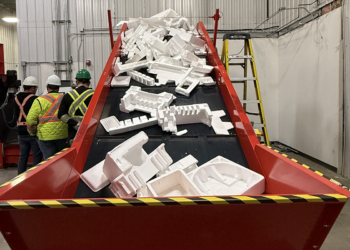
Transporting rigid packaging foams is challenging due to being lightweight and bulky, but the new densifier compacts the material at...

Hitachi Energy partner turns spools into PVC pipe feed

Hitachi Energy partner turns spools into PVC pipe feed

byAntoinette Smith
October 22, 2026

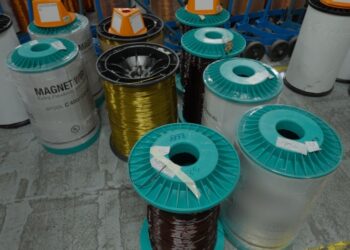
A grant-funded granulator at J. Carter Enterprises has recovered about 250,000 pounds of plastic from Hitachi Energy’s oversized wire spools...

Triton to make rail ties from artificial turf

Triton to make rail ties from artificial turf

byAntoinette Smith
October 20, 2026

The Missouri-based company is adding capacity to recover HDPE from retired TenCate turf, providing demand for the hard-to-recycle material.

SC Johnson CEO: Recycling needs policy fix

byStefanie Valentic
October 5, 2026

Decades of voluntary packaging work have hit an economic wall. EPR and stronger regulation are what will move the needle.

Trash Panda collab with Crocs supports recycled plastic

Trash Panda collab with Crocs supports recycled plastic

byWillona Sloan
September 10, 2026

Trash Panda Disc Golf is working with Crocs to turn old shoes into new disc products.

SB 54 Unpacked: Can film catch up to cartons?

byStefanie Valentic
September 4, 2026

Flexible film, generating 550,000 tons/year of waste, has end markets for only about 10% of it, panelists said at a...

Load More
Next Post

Casella joins other haulers in feeling China's pinch

2026 Buyers’ Guide

Equipment, services and technology suppliers serving the recycling industry.

Browse the Guide

More Posts

NexPoint Materials to shutter Alabama plastics plant

NexPoint Materials to shutter Alabama plastics plant

November 4, 2026
PureCycle sees easing headwinds to R-PP adoption

PureCycle shifts focus, secures feedstock

November 5, 2026
Inside the Circle: Will we lose our shirts over CA textile EPR?

Inside the Circle: Will we lose our shirts over CA textile EPR?

November 9, 2026
Artificial intelligence is altering the marketplace for ITAD providers in numerous ways. | Shutterstock

AI alters ITAD economics

November 3, 2026
Textile EPR needs end markets, not just collection

Textile EPR needs end markets, not just collection

November 10, 2026
PET bottles for recycling

PET imports reshape US markets as demand grows

November 11, 2026
The missing link in e-plastic recycling

The missing link in e-plastic recycling

October 28, 2026
UC Riverside expands reusable takeout program

UC Riverside expands reusable takeout program

November 6, 2026
New CAA chief talks markets, industry support

New CAA chief talks markets, industry support

November 4, 2026

Produce packers face narrow exits under SB 54

November 11, 2026
Load More

About & Publications

About Us

Staff
Job Listings

Archive

Magazines

Work With Us

Advertise
Contact
Terms and Privacy

Newsletters

Get the latest recycling news and analysis delivered to your inbox every week. Stay ahead on industry trends, policy updates, and insights from programs, processors, and innovators.

Subscribe

Welcome Back!

Login to your account below

Forgotten Password?

Retrieve your password

Please enter your username or email address to reset your password.

Log In

Add New Playlist

No Result
View All Result
  • The Latest
  • Podcast
  • Analysis
  • Recycling
  • E-Scrap
  • Plastics
  • Policy Now
  • Conferences
    • E-Scrap Conference
    • Plastics Recycling Conference
    • Resource Recycling Conference
    • Textiles Recovery Summit
  • Magazines – Old
  • About Us
  • Advertise
  • Archive
  • Job Listings
  • Staff
Subscribe
This website uses cookies. By continuing to use this website you are giving consent to cookies being used. Visit our Privacy and Cookie Policy.