











This article appeared in the April 2025 issue of Resource Recycling. Subscribe today for access to all print content.
Resource Recycling’s annual plastics-focused edition, the Spring 2025 Plastics Recycling Update, published in March to coincide with our own Plastics Recycling Conference in National Harbor, Maryland. This year’s magazine shone a spotlight on some of the sector’s hottest topics: chemical recycling, textiles and designing for recyclability.
Below we’re republishing snippets of the edition’s feature stories; you can also find the full versions here.
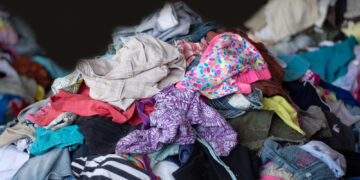
The new age of textile recycling
A few generations ago, the fate of end-of-life clothing would have been an unlikely subject in a plastics recycling trade journal.
In 1960, natural fibers dominated global production, with cotton making up half of all textile fibers produced that year, according to data from textile analysis firm The Fiber Year, with other natural or cellulose-based fibers like linen, rayon and wool rounding out the mix. Synthetic fibers made up just 3% of global textile fiber produced that year.
The percentages have flipped dramatically since. In 2023, synthetic materials including polyester, which is made from PET, and polyamide — nylon — made up a whopping 68% of global textile fiber production, while cotton had fallen to 21%.
Besides the material shift, the sheer growth of clothing production is staggering: Global textile manufacturing increased nearly sevenfold from an estimated 20 million metric tons annually in 1960 to 130 million metric tons in 2023.
With the increases come a host of new considerations. End-of-life textile management is far from a new concept, spanning a long history of secondhand clothing use, repurposing and mechanical recycling. And even in the synthetic space, recycled polyester clothing has been produced — typically using mechanically recycled PET bottles — for decades. Its share of overall polyester fabric grew from 4% in 2010 to 14% in 2020, according to the nonprofit Textile Exchange, which publishes annual textile data.
But the growth in new polyester production is eclipsing the increase in mechanically recycled polyester use: After recycled polyester production’s share of overall polyester use peaked at close to 15% in 2021, it fell back to 12.5% in 2023.
Consumers have frequently followed the materials management hierarchy, which prioritizes reuse and repurposing above recycling, when faced with textile management.
“First they would wear, wear, wear, until it literally couldn’t be worn anymore,” said Marisa Adler, a senior consultant at Resource Recycling Systems and founder of the firm’s Textile Circularity Practice. “Then they would rip it up and just use it as cleaning rags in their home. And then they would finally throw it away.”
Mechanical recycling, which RRS defines as the physical form of recycling textiles in which fiber is cut, shredded, garnetted (pulled apart), melted or extruded for new manufacturing, also has a long global history. The Italian city of Prato is renowned for generations of wool recycling expertise, for example. The process involves pulling apart used wool clothing and re-spinning the wool back into a usable yarn. It uses textiles as feedstock and produces yarn for new textiles at the end. There are similar processes for cotton as well.
“There is just a maximum number of cycles you can go through, because the natural cellulosic fibers become shorter and shorter and they’re harder to spin, so it’s lower quality,” Adler said. “So you need a really good, pure, high, high-quality input in order to do a mechanical yarn-to-yarn recycling process, which is why it is not more common now.”
Mechanical recycling is more complicated for synthetic and blended fabrics. As the Textile Exchange noted in a report last year, “mechanical recycling requires clean textile inputs free from contaminants, and it is difficult to process textiles containing more than one material type.” Pulling apart and separating fabrics by their component material is costly and labor-intensive, the group added.
That’s partially why nearly all of the mechanically recycled polyester used in new textiles comes from PET bottles rather than textiles, and it’s also contributing to industry interest in chemical recycling.
The Textile Exchange, in a comprehensive report on synthetic textile recycling issued last year, cautioned that short of a dramatic reduction in production and consumer buying trends, moving away from polyester would be virtually impossible.
Amid these challenges and others, chemical recycling, the group of technologies that process a plastic down to its basic components, has emerged as what industry stakeholders say is a promising tool to cut down on one of the fastest-growing waste streams in the world.
–by Colin Staub
Breaking down chemical recycling
Chemical recycling, the umbrella term for a wide array of processes that break down the molecular chains of plastic polymers, has been a contentious topic for years, drawing debate over its role, how to regulate it and where it fits into the larger picture of resource circularity.
But even stakeholders on opposite sides of the debate found common ground in recent interviews, sharing concerns that the technology has been overpromised on one hand as well as ideas for how it can complement, rather than replace, conventional mechanical recycling on the other.
“We now have routinely seen facilities operating at reduced capacity, delays getting online, things like that,” said Anja Brandon, director of plastics policy at the Ocean Conservancy, a Washington, D.C.-based nonprofit that doesn’t support chemical recycling. Brandon cited the April 2024 closure of Agylix’s joint PS recycling venture, Regenyx, in Oregon, among other facility closures and disruptions, as evidence that the technologies aren’t the “get-out-of-jail-free card they were promised to be.”
“I think the false promises that were made of ‘we can accept all of your plastics, and it’s really cost-efficient, and you’ll get plastics back immediately’ — folks are starting to see through those lies, and because of that, some of the smart chemical recycling companies are now changing their language,” Brandon said. Now she’s hearing chemical recycling advertised as “just a part of the puzzle.”
Brian Bauer, CEO of California-based chemical recycling company Resynergi, agreed that early claims that pyrolysis could handle anything weren’t helpful. The company uses microwave energy to break down HDPE, LDPE, PP and PS and announced in February that it had raised $18 million toward commissioning its first commercial-scale chemical recycling plant.
“Some players said, ‘We can take everything,’ and it’s like — come on, guys,” Bauer said, adding that the industry needs to show people that chemical recycling works.
“Otherwise they’re feeling lied to,” he said. “We’re not making the claim we’re going to do all plastic for everyone. We’re doing our part.”
Brandon and others also agreed that chemical recycling could play a beneficial role in managing end-of-life plastics, though Brandon said that role is limited and even shrinking, while industry players took a much more ambitious view.
“A robust chemical recycling industry is essential to achieve significantly greater recycling rate targets, such as the Environmental Protection Agency’s 50% by 2030 National Recycling Goal,” Ross Eisenberg, president of American Chemistry Council’s plastics division, wrote in an email. “While mechanical recycling should be prioritized for the plastics it is suited to recycle, chemical recycling is needed for the many types of plastics that can’t enter the mechanical recycling stream.”
Chemical recycling includes processes that use heat, pressure and solvents to break polymers into liquids or gasses that can then be processed into fuels, oils, waxes, new plastics or other chemical products. It’s also commonly referred to as advanced recycling, non-mechanical recycling and molecular recycling. Whatever the term, it’s typically used to describe three main technologies: purification, depolymerization and conversion.
Purification covers technologies that use solvents to dissolve plastic and separate it out from additives. The plastic can be recovered without changing the basic molecular structure, but the process requires highly pure feed stocks and can only be used for certain types of plastic.
Depolymerization is a broad category that uses solvents, heat, catalysts or a combination thereof. It also requires pure feed stocks and is also limited to very specific types of plastics called condensation polymers, such as nylon and PET. Methanolysis, using methanol, is one of the most common types.
Conversion technology has been around for decades for turning plastic into fuel. Two types of technologies are widespread today: pyrolysis and gasification. Pyrolysis uses high heat and pressure to break apart chemical bonds in plastic to create what’s called pyrolysis oil, which can be used as fuel, to create new plastic and in other applications. Gasification uses heat and pressure to break chemical bonds to produce mainly synthetic natural gas.
Many chemical recycling companies have started up over the past five years, with companies like Cyclyx, Brightmark and PureCycle building or planning more than 1 billion pounds of processing capacity in the U.S. and other countries. There are also some oil heavyweights in the ring, such as ExxonMobil, and chemical companies such as Eastman.
Alterra, a chemical recycling company with a plant in Akron, Ohio, that has been operating since 2013, highlighted how chemical recycling could support extended producer responsibility programs by bringing less commonly recycled materials, such as multi-layer packaging and contaminated plastics, into the system.
“One of the greatest strengths of chemical recycling lies in its diversity. No single technology can process all types of discarded plastics, but collectively, chemical recycling solutions can address a wide range of materials that would otherwise go to landfill or incineration,” the company said in a written statement.
On the other hand, Brandon with the Ocean Conservancy argued that it could be beneficial to shift the focus of the chemical recycling conversation — for example, even though most of the conversation in the U.S. is about packaging, which is nearly 40% of the plastics used globally and a high contributor to marine pollution, “there are other plastics out there that we’re not talking about that will be really challenging to mechanical recycling.”
–by Marissa Heffernan
The Design Guide turns 30
In the three decades since its first printing, the Association of Plastic Recyclers Design Guide, an instruction manual for calibrating plastic packaging to best suit reclaimers’ needs, has evolved from a basic list of dos and don’ts, patched together by a handful of PET companies, to an internationally cited online litmus test of PET, HDPE, polyethylene and polypropylene recyclability.
APR, the owner of this magazine’s publisher, marked the guide’s 30th anniversary at the 2025 Plastics Recycling Conference. The inaugural APR Recycling Leadership Awards recognized packaging designers, manufacturers, researchers and innovators who have made significant contributions to the guide’s mission.
The recognition caps off years of both tinkering and overhauling, said APR Chief Operating Officer Curt Cozart, who has led those efforts for about a decade with continuous guidance from APR’s many technical committees of industry scientists and other experts.
One of the overarching goals when Cozart began was to make the guide simple and consistent. The APR team also worked to expand the guide’s scope to account for the capabilities of materials recovery facilities, covering every step of the recycling process from sorting to remanufacture.
The guide’s latest online version, unveiled last fall, allows users to search among several varieties of PET, HDPE, PE and PP and hone in on aspects of a package that range from the mundane, such as color and labeling, to the technical, including resin melt flows and densities. It then provides acceptable baselines for each as well as testing protocols and referrals to testing laboratories. In March, APR announced the guide was also translated into French, with Quebecois users in mind.
Taken together, the guide gives a packaging maker the tools to either tweak an existing product or craft an ideal one from the ground up.
“We’ve really come a long way,” Cozart said.
–by Dan Holtmeyer