











This article appeared in the September 2023 issue of Resource Recycling. Subscribe today for access to all print content.
Although state and municipal programs are happy to allocate significant resources and efforts to increase and improve recycling and organics separation at home and work, public space recycling is usually not a major focus. Since public space recycling often entails contamination rates of 30% or higher, this is not entirely surprising. Moreover, public space waste represents only a small, albeit conspicuous portion of MSW. At the same time, public spaces can be significant sources of litter, and they provide educational spillover benefits. In other words, better recycling in public can translate to better recycling at home or work.
What is public space collection?
Public space collection includes containers in uncontrolled outdoor areas such as parks, beaches, college campuses and sidewalks; controlled outdoor/indoor areas such as sports facilities, concert venues and rest areas; and controlled indoor areas such as malls, building lobbies, libraries, airports and train stations. Finally, special events, such as fairs and festivals, are also a venue for public space collection.
With public space recycling, can there be a return on investment? Contamination will always be an issue, but having a better understanding of the multiple factors that affect proper material sorting at the point of discard can help with strategies and designs. Although there are numerous published strategies on, for example, optimal locations for public space containers and co-locating trash with recycling containers (“bin twinning”), this article discusses additional strategies and design considerations.
Traditionally, public space collection has focused only on trash, primarily to prevent litter. This has evolved with the subsequent addition of recycling, and in some cases, organics. Adding more containers to collect different streams in the absence of an intentionally designed system can be problematic, especially in terms of contamination and litter. Additionally, public space containers have numerous challenges that give rise to the high contamination rate, which include the following.
Sorting confusion
To improve public space recycling, it is important to understand the motivations and barriers to recycling. First, what is waste? By definition, waste has no value to its owner. Therefore, the owner of the waste will seek to discard it as easily and cheaply as possible. Because time expended is a cost (time opportunity cost), the waste owner will limit the time involved in discarding waste.
In the context of public space recycling, this gives rise to what I call the “one-second rule.” Based on numerous direct observations in a variety of controlled and uncontrolled spaces, owners will spend an average of one second deciding whether and how to sort their waste at public space containers. Human attention is a scarce commodity. In a previous Resource Recycling article (“Outreach Optimization,” March 2023), I outlined the “20-60-20 framework,” which identifies three broad categories of recyclers and their relative proportions: True Greens (20%), Sometimes and Maybe Recyclers (60%) and Never Recyclers (20%). In public spaces, true greens will likely spend more than one second trying to decipher the sorting requirements specific to a public space container, Sometimes and Maybe Recyclers will spend a maximum of one second, and the Never Recyclers will take the quickest and easiest action.
Researchers have found that clear visual prompts can increase recycling, but in practice, use of such prompts is inconsistent and can be confusing. Public space container users are generally transient, such as occasional shoppers or visitors, tourists, and passersby. They may come from other cities, regions, states and countries where they may recycle different materials, use different color schemes for containers, and different labels and signage, causing visual prompt confusion.
The lack of uniformity in the color of our recycling containers undermines the power of visual prompts by creating an unfamiliar procedure. For example, in the August 2012 Resource Recycling article “Calling All Containers,” we found that slightly more than half of all jurisdictions (51.9%) use various shades of blue for their recycling containers, followed by green (25.5%), gray (8.4%), yellow (2.9%), black (2.3%), and other colors (8.4%). As a side note, California, with its 2020 landmark SB 1383 law, mandated a uniform color scheme for containers (blue for recycling, green for organics and black/gray for trash), which will harness the power of visual prompts.
The one-second rule highlights the importance of clear and consistent visual prompts. An effective prompt can reduce the amount of time an individual needs to expend in deciding what, where and how to sort.
Form over function
There has been a long-running debate over the design of public space collection containers – or more accurately, over the aesthetics of public space stations. Solid waste professionals prefer function over form, whereas businesses and public officials may prefer the opposite. Public space containers that focus on aesthetics and contextual attractiveness (e.g., history, architecture and advertising) contribute to non-uniformity in color, shape, signage and openings, which reduces the efficacy of visual and functional prompts. Applying the one-second rule, when people are faced with beautiful but confusing options, the closest and quickest container will serve as the catch-all.
Restricted education
Education about proper sorting and/or using the proper container in public spaces is generally restricted to the point of discard. Some supplemental education can occur if, for example, single-use food service waste is distributed nearby. But, with only one second spent at the collection point, education has very limited efficacy.
Education is becoming more challenging with the constant changes in the waste stream (a shift toward plastics and lightweighting) and what is recyclable and/or compostable locally. In the absence of local ordinances restricting the sale or use of to-go food service ware, there is generally a resulting mix of recyclable versus non-recyclable items and compostable versus non-compostable items. This further exacerbates the loss of recyclables and the contamination problem because users may “wishcycle” or discard commingled materials into a single container, which will not always be the correct container.
Structural considerations
Within the confines of the one second rule, there are structural improvements and strategies that can address the challenges of sorting confusion, form over function, and restricted education.
The first approach is to restrict openings. In a compelling 2009 study, researchers found that by using specialized recycling lids, recycling increased by 34% and contamination was reduced by 95%. With public space recycling, they found that the only clear difference between recycling and trash containers is often a label or symbol, neither of which is sufficient. They theorize that by using a special lid (one with flaps, a door or a unique opening shape, e.g.), users must pause slightly to make a cognizant decision regarding proper placement. The researchers did not find that a specific design was influential, only that having a different opening for recycling than for trash was effective. However, the design must ensure that a sorting decision is simple and somewhat obvious. Avoiding the need to touch a dirty receptacle (e.g., having to push a door or flap) is critical. Instead, providing an optional foot pedal to open a door will increase use, provided such action is in compliance with the Americans with Disabilities Act.
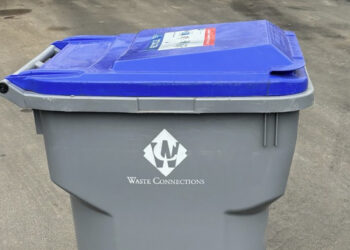
Next, we must re-establish that the function of a container is more important than its form. A recycling container needs to look like a recycling container and not like part of the environment. More importantly, recycling and organics containers must be clearly and easily distinguishable from each other and from the trash container. Consistency in color schemes, at least throughout the jurisdiction, is vitally important. Containers should at least match residential colors to harness the power of visual prompts. Easily identifiable and distinguishable containers reduce the need for a user to spend more than their allotted one second. While stylish, covering containers with advertising or art creates confusion for sorting.
Visual cues are crucial
In a similar vein, we should always be looking to use effective signage. Based on the one-second rule, detailed explanatory signs should be avoided because they will be ignored, thereby eliminating any educational value. At a minimum, the “chasing arrows” recycling icon and the word “recycling” should be used for recycling. The chasing arrows symbol should not be used for organics because it is the default recycling symbol.
For trash containers, there is a debate about using the negative term “landfill” instead of the neutral term “trash.” In a 2022 study, researchers found that using the term “landfill” on public space containers can lead to higher contamination rates in recycling containers because of wishcycling. This is a case for determining what works best locally. If problems arise, applying new labels can be relatively simple. In other words, try testing it.
Also, using simple, universal icons, such as a bottle for recycling or an apple core for organics, is important. Consider also the number of icons. Too many will lead to confusion, so always use the minimum number of icons that achieves the desired effect.
Another consideration is the placement of signage; container signage should always be located at strategic locations. For example, a simple “recycling” sign on the container should be clearly readable from a distance of at least 10 feet away. However, you need to assume that users are not looking down at the middle or lower part of a container but are making a beeline toward the opening. Thus, an additional “recycling” sign should be placed adjacent to the sightline of the opening.
For special events and food service areas, organics are also often collected. The term organics, however, is an industry term. If you surveyed the public for their definition of organics, there likely would be confusion between organics and organic. Common responses would include “all natural”, “chemical free”, “environmentally friendly”, and other irrelevant terms. Applying the one-second rule using labels or signage with the confusing term organics is problematic. Trying to educate users at the point of discard as to what constitutes organics within one second is unlikely to be successful resulting in high levels of contamination. An effective solution is to instead use a label and signage that denotes the two primary constituents of organics: Food Waste + Compostables. Using graphic symbols for compostables (paper plates, napkins, pizza boxes, etc.) and food waste (an apple core) are simpler than trying to describe organics.
Finally, an often overlooked but important consideration is that containers need to be clean, because dirty containers will repel users. Public space containers are especially susceptible because there is a high proportion of leftover food and beverages being discarded in addition to residue on food service items, which can attract ants, flies, bees and rodents. Moreover, users in public areas are not always conscientious about or accurate with their toss into a container, so it is common for food and beverage residues and stains around openings, which can deter users.
Travis Wagner is a professor emeritus at the University of Southern Maine and a solid waste consultant based in Sonoma, Calif. He can be contacted at [email protected].
This article appeared in the September 2023 issue of Resource Recycling. Subscribe today for access to all print content.