






This article appeared in the August 2023 issue of Resource Recycling. Subscribe today for access to all print content.
Municipal solid waste is an often-ignored source of greenhouse gas emissions, air/water pollution, habitat destruction and public health risks. As consumption and the human population continue to grow, the burden of waste grows too.
Here in the United States, we have just 5% of the global population yet we create 30% of all waste. That outsized output means improving waste reduction and waste management practices is extremely important.
Understanding what motivates the general public to reduce waste can help waste management professionals identify the most effective messaging and images to use in education campaigns. Understanding the perception and comprehension of waste reduction policy can help waste management professionals determine where further engagement and education is needed.
With that in mind, in 2019 the Center for Biological Diversity held focus groups with around 30 waste management professionals from government agencies, universities, NGOs, consulting firms and for-profit companies to learn more about their thoughts on zero waste, extended producer responsibility, conscious consumption and the experiential economy.
The center’s mission is to fight biodiversity loss, and it conducted these focus groups because consumption has an enormous effect on wildlife and ecosystems. The center supports waste prevention efforts because they have the most potential to fix upstream harm to habitats, the climate and imperiled species.
Gathering feedback
The focus groups discussed the full cycle of consumption from production to consumer choices, exploring a variety of concepts with implications for both policy and cultural norms.
During these sessions, participants expressed concerns about the feasibility of current waste reduction strategies and the words used to describe them. Terms such as “zero waste” were perceived as perfectionist, costly or unattainable.
Participants saw them as representing unrealistic goals for waste reduction.
Some focus group participants also worried about our economic structures and the driving forces of endless growth and profit as barriers to improved models of waste management.
Feedback from the focus groups made it clear that more information was needed to understand the effectiveness of existing policies and current waste reduction messaging strategies.
So in 2021, the center conducted research via a combination of nationwide and targeted online surveys to learn more about the public’s perceptions of effective waste prevention language, policies that help prevent the creation of waste in the first place, and people’s motivations and support for these topics.
The survey was distributed to the U.S. public through an online marketplace called MTurk, which compensates people for participating in surveys. The results from the survey of the general public are referred to in this article as “the public.” The survey was also distributed to employees, partners and members of the center. This version was unpaid and responses to it are referred to as the “convenience sample.”
Our hope is that the survey results can serve as the first step in a larger process of identifying the most effective way to communicate to the public about waste prevention actions and policies, particularly those that show the greatest environmental benefits by preventing waste upstream.
Aggregating results
Understanding the general public’s existing waste reduction knowledge and motivations is key to achieving long-term and systemic change. The survey results re-emphasized the need for accessible, familiar and appropriate communication strategies that speak to the public’s existing waste reduction motivations. Below are some of the most notable results.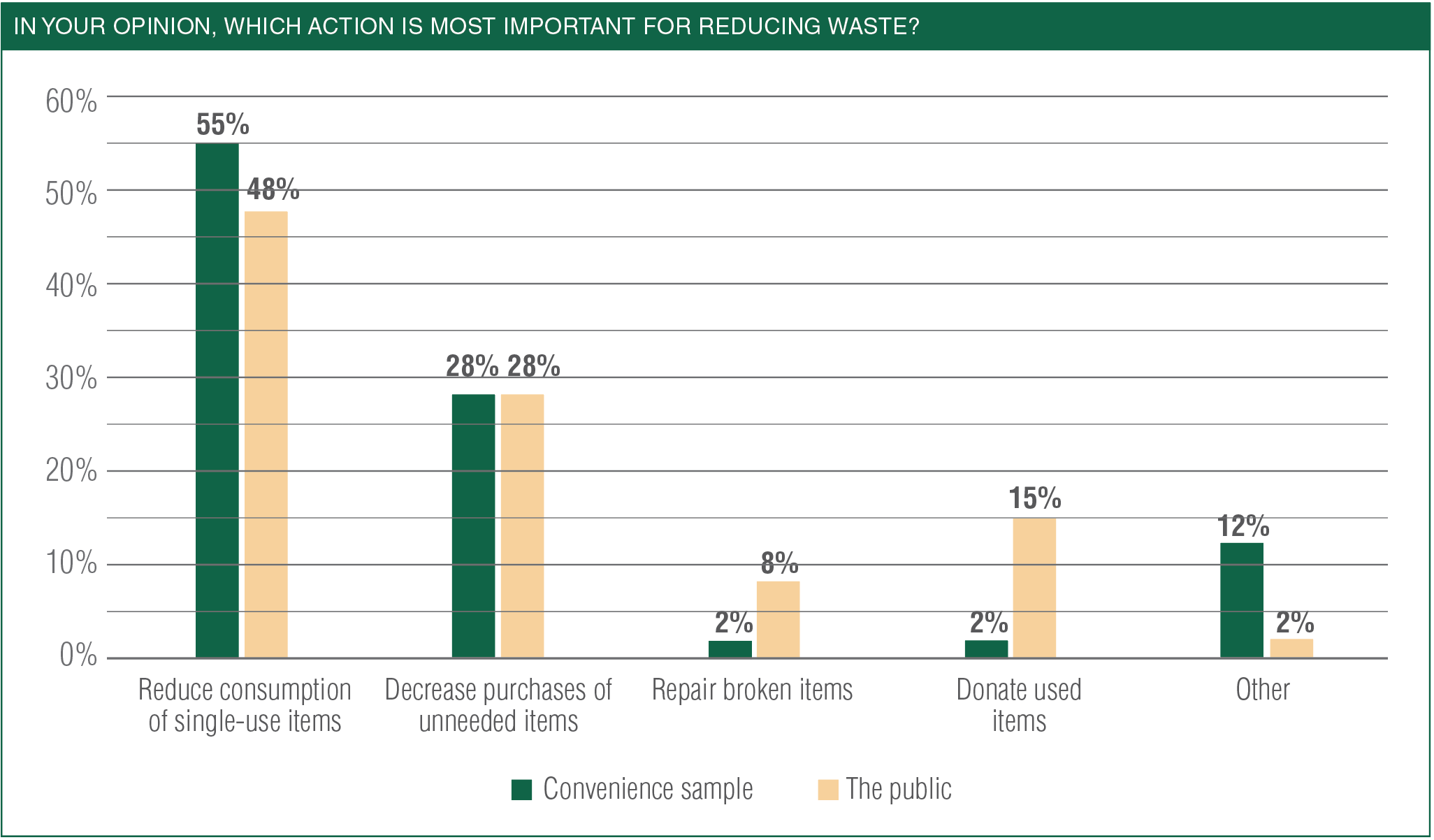
1. Most people prefer simple and familiar waste reduction terms and images.
When asked about the best term to describe generating and disposing of less waste, “waste reduction” was preferred by both the public and the convenience sample. The term “single-use” was selected by both groups as the best phrase to describe something that is used only once and then put in the trash.
Although “single-use” was favored in both samples, some respondents suggested shifting the focus to present reuse as the default, favoring the term “non-reusable” to describe these items.
Future campaigns should work toward increasing public education on the options for reuse in retail establishments and advocating for the expansion of reuse models through policy and corporate change.
When it comes to images that best represent waste prevention, a picture of a reusable water bottle resonated with both groups. Images of electronics and appliances were chosen as most accurately representing products with artificially limited useful lives.
2. Saving money and simplifying people’s lives are strong incentives to reduce waste. More than 75% of all survey respondents believed reducing their consumption of unneeded or single-use items was effective at eliminating waste. Both groups also said they’d be more likely to decrease their purchases of single-use items than their purchases of unneeded items.
More than 50% of all respondents said protecting nature motivates them to reduce waste. However, the general public was more likely to say they reduce waste to save money and simplify their lives.
The takeaway is that the most effective way to encourage the public to reduce waste is to build a communication strategy that focuses on both saving money and simplifying.
3. While the public is motivated by financial savings and simplicity, they’re undecided on the terms associated with environmentally friendly lifestyle changes.
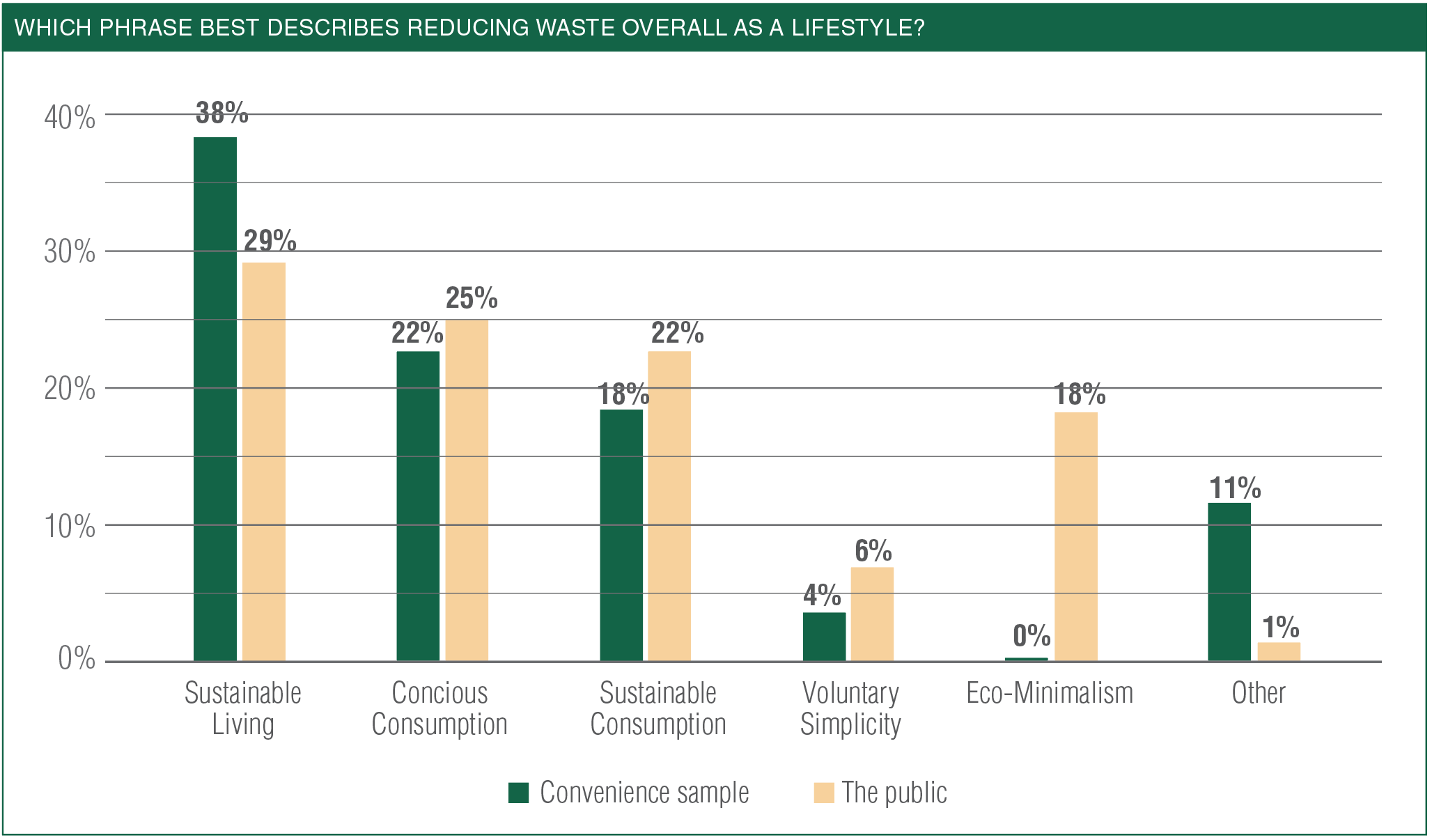
Respondents were asked to select which phrase represents a lifestyle of reducing waste. Although “sustainable living” was the most-selected response in both samples, respondents in the public sample were significantly more likely to select “eco-minimalism,” and respondents in the convenience sample were more likely to write in their own answers. When asked why they chose their answers, respondents who favored “sustainable living” wrote that it was easy to understand.
Similarly to the focus group results, survey respondents also noted that they see the framing of these lifestyles as “elitist” and inaccessible. These results suggest that future campaigns must highlight accessibility, inclusivity and specific actions to motivate behavior change. As noted above, effective messaging should point out that these actions actually simplify one’s life and can save people money.
4. When it comes to upstream waste reduction policy, the public isn’t very knowledgeable.
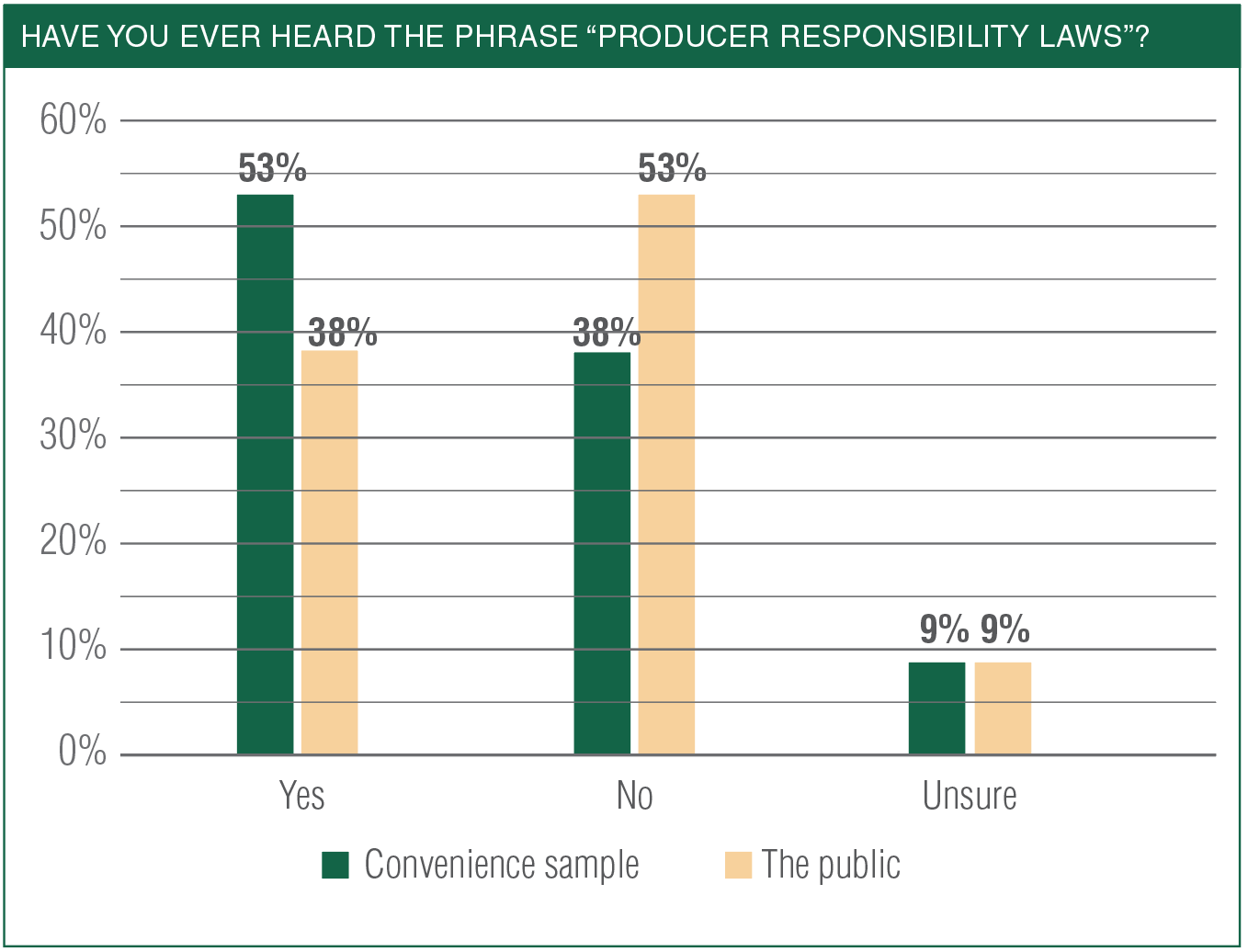
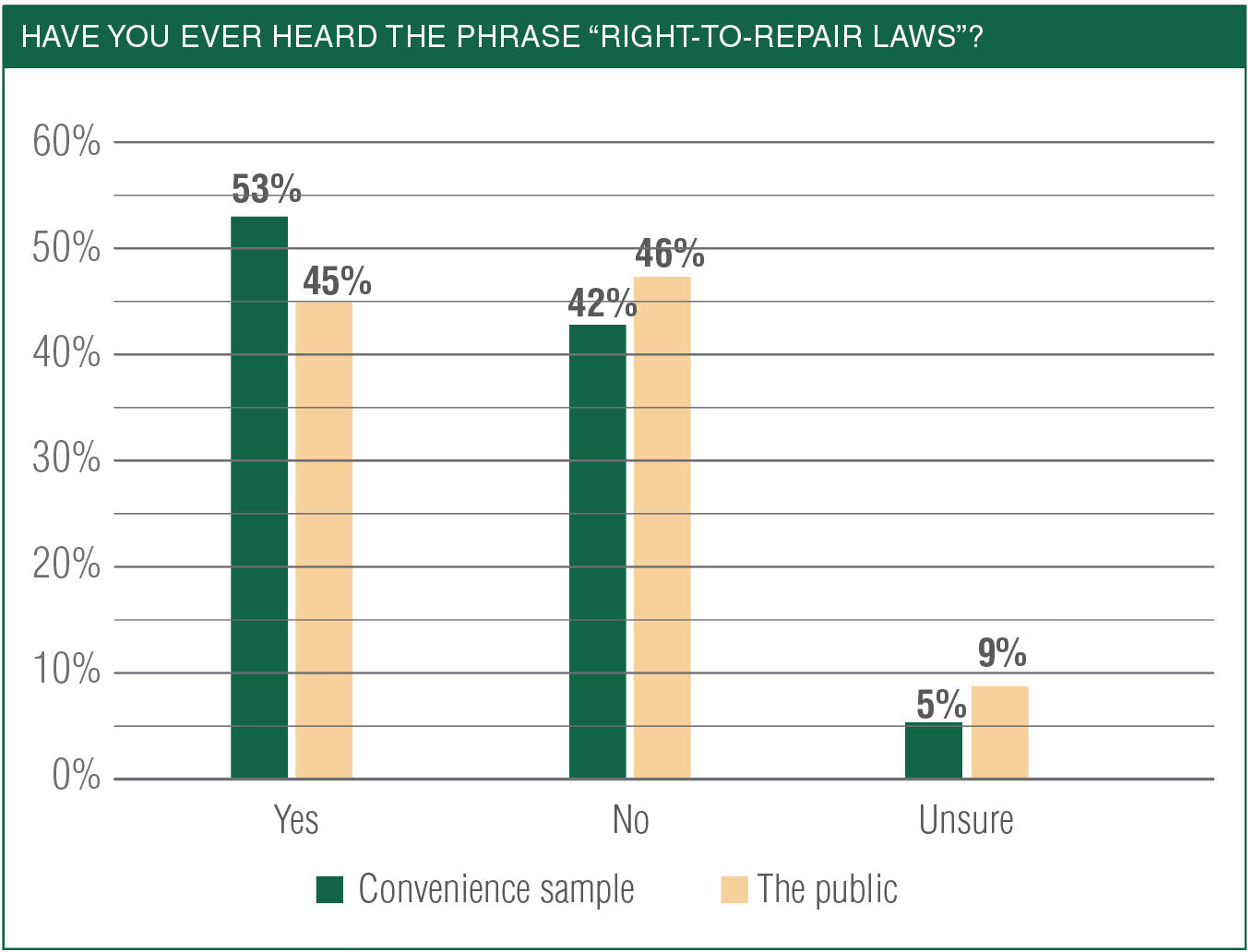
Only 38% of the general public had heard the phrase “producer responsibility laws” – of that, only 36% could accurately describe what a producer responsibility law is. Forty-five percent of the general public had heard the phrase “right-to-repair laws,” but only 62% of that chunk could accurately describe what a right-to-repair law is.
Knowledge and accuracy in the descriptions of both laws were higher in the convenience sample (53% had knowledge of both laws, and accuracy in describing producer responsibility and right to repair laws was 88% and 90%, respectively).
Additionally, 43% of respondents in the general public believed a policy that ensures recycling is actually happening correctly would be the most effective for reducing waste. However, in the convenience sample, 60% of respondents believed a policy that makes the manufacturers pay for the impacts of their products (e.g. extended producer responsibility or product stewardship) would be the most effective for reducing waste.
It’s clear that waste management professionals have some work to do on educating the public about policies and laws that they can support to encourage waste reduction upstream.
5. Downstream waste reduction efforts such as recycling are well known, and policies to improve these efforts are seen as highly effective by the general public.
The general public’s knowledge of existing waste reduction policy was limited, but many respondents in both surveys demonstrated high levels of knowledge of and appreciation for downstream waste reduction efforts, especially recycling.
As noted earlier, when asked which policy would be most effective for reducing waste, almost half of the public selected “a policy that ensures recycling is actually happening correctly.” This shows that the public is concerned about the transparency of how and where recyclables are processed once collected.
While the results showed that the public considers recycling a more feasible solution than policies that are aimed at changing manufacturer procedures upstream, the Center for Biological Diversity is working to change that sentiment by focusing its work higher up on the waste hierarchy.
While we support mechanical recycling for certain products, such as paper and metal, we cannot ultimately rely only on recycling to address the larger consumption and waste issues we face. We implore others in the waste management field to join us in highlighting successful upstream waste reduction strategies.
How we can reduce waste
The results of our survey show that efforts to reduce waste require a combination of individual behavior change and incentivizing policies aimed at both manufacturers and the general public.
It took a long-term coordinated effort to get recycling to become as popular as it is with the public today. With similar dedication and clear, easy-to-understand campaigns, waste reduction can also be elevated to the same level of familiarity.
Our findings suggest that people are willing to get involved in reducing waste for personal benefit, though they may overestimate the impact of their downstream actions. The public’s lack of understanding about personal waste prevention behaviors and potential waste prevention policies limit the effectiveness of individual efforts. But waste management professionals can use clear, familiar language to design outreach initiatives to overcome these barriers while highlighting how waste prevention can be a win-win for people and the planet.
Adoma Addo is an associate at the Center for Biological Diversity, where she supports campaigns that address human impacts on the environment. Her work focuses on waste prevention and the systemic injustices associated with unequal environmental burdens. She can be reached at [email protected].
Kelley Dennings develops and executes the center’s advocacy and outreach initiatives. She can be reached at [email protected]. For more information on the survey data above, please visit biologicaldiversity.org.
This article appeared in the August 2023 issue of Resource Recycling. Subscribe today for access to all print content.