












This article originally appeared in the February 2018 issue of Resource Recycling magazine. Subscribe today for access to all print content.
Chances are, you’ve heard of the concept of a “life hack.” The term, made popular online over the last decade, describes simple strategies and techniques that a person can use to manage time and daily activities in a more efficient way.
It might now be time for materials recovery stakeholders to borrow the linguistic concept and start talking in terms of “recycling hacks.” After all, every local program leader probably has a few hacks they’ve developed over the years – small, simple activities that improve a recycling program at little or no cost.
When The Recycling Partnership, with our funding partners, brought more than 50 recycling professionals to the 2017 Resource Recycling Conference, we wanted to gather all of them and other conference attendees to share ideas.
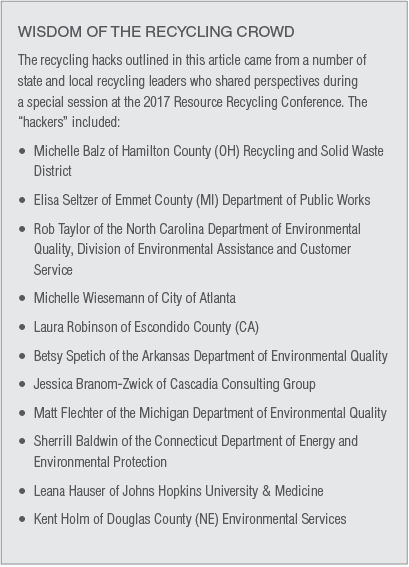 And share they did. In the conference session, more than 200 recycling professionals reported out the tips and tricks that work in their respective jurisdictions. Here, we offer a list of some of the most compelling approaches discussed during the gathering.
Come Together
Regularly convening stakeholders is on oft-repeated suggestion. On the local level, connect your recycling coordinator with your haulers and your materials recovery facility (MRF). Have everyone give an update and share concerns, talking over strategies to combat issues such as contamination (this is a great way to establish or revisit a community’s accepted materials list). On the state level, go to different regions and bring together officials to share state priorities and answer questions. Create a community listserv for municipal coordinators. Many states also have strong state recycling organizations (SROs) that can help organize such meetings.
Pick Up the Phone
It’s also good to remember you don’t always need formal meetings to maintain connections. Set a monthly or quarterly calendar reminder for yourself with a list of key stakeholder contacts. Give these people a call when schedules allow – Friday afternoons can be a great time to catch folks and catch up. Also, hold a quarterly conference call with your MRF and haulers and other stakeholders.
Sing Outreach in Harmony
Your regular communication with partners can translate to better communication with residents. Work with surrounding communities and your MRF to make sure your messaging – and accepted materials lists – are coordinated. Your MRF knows the markets and you know your residents. Work together to make the lists match up so residents know how to recycle wherever they are in your region. If a community is looking to undertake an activity and they don’t know where to start, contact The Recycling Partnership. Chances are, we can connect you with a community that has experience in outreach issues and can offer some advice.
Take a Tour
One surefire way to get local stakeholders or elected officials excited about materials diversion is to show them the realities of recycling infrastructure and facilities. Whether they’re held at a MRF, a plastics reclaimer or something like a volunteer-run mattress recycling center, tours are a way to connect officials with the circular economy unfolding in their own communities.
Identify Your Champions
Whether it’s trained citizen recyclers, dedicated local businesses or members of a local “green team,” every community has recycling champions sprinkled across it. These are individuals who may be able to help your community with tasks, such as cart tagging or door-to-door education, that might not be covered in a program’s budget. Take advantage of these folks if they are willing to help out. Also, if you are looking to train an army to help with a cart tagging project, take a look at a video put together by The Recycling Partnership, available at bit.ly/TRPRouteTips.
Stop By the Statehouse
Don’t ever assume an elected official knows all the details and benefits tied to recycling. Some recycling professionals have held special Recycling Days at their state legislatures, convening local recycling business leaders to illustrate how recycling can fuel job growth and bring other benefits to the economy. Stay in regular contact with elected officials and apprise them of successes and challenges that recycling faces.
Teach the Children
We’ve all heard that a key to recycling’s future is reaching and influencing the next generation. Get creative in how you do this. During the “Hacking Recycling” session at the 2017 Resource Recycling Conference, one attendee noted a recycling participation poster campaign that was held in local schools. This initiative allowed the recycling program to effectively reach low-income families and ultimately included a celebration of the posters at City Hall.
Leverage Your Website
Your budget may only allow you to mail one or two educational resources to residents each year. If that’s the case, make sure those pieces drive residents to your website, where they can learn all the important points about your program. Several recent studies focused on Internet research show that a majority of residents rely on websites (especially those run by the city, county or local recycling company) for answers to their materials diversion questions.
Connect with Campuses
Institutions of higher learning are resources just waiting to be tapped for recycling-related research projects and program assistance. Does your program want to do a robust cart-tagging campaign? Do you want to learn about toward about your city’s recycling program? Reach out to your local university’s environmental sciences or sociology department and see if professors and students have interest in designing their own research project around actionable ideas in waste recovery.
Connect the Dots
Local market development for recyclables has long been a major industry talking point, but the importance of this issue has grown since China announced new policies on imports last year. You can play a role by talking to your MRFs and your local manufacturing businesses to see if you can make a market match. Convening manufacturers with recyclers and the business community is an excellent way to build environmental resilience into your community.
Pair Up
In parks, city centers and other public spaces, always pair trash receptacles with recycling receptacles and make sure residents can tell what is supposed to go where. Using simple, wayfinding imagery allows folks to determine from a distance the intended use of a container. Also, only use icons or images of the specific materials likely to be generated in a given public space.
Take Advantage of App-ortunities
Mobile apps are available to perform all manner of helpful recycling management tasks – such as program scheduling and resident feedback tools. In a presentation during the “Hacking” session, a representative from Atlanta described how that program used apps from waste-oriented technology company Rubicon to improve route optimization and the dissemination of general information. City officials also worked with the company to build a customized app for an on-the-ground tagging campaign to help curb contamination.
Dylan de Thomas is vice president of industry collaboration for The Recycling Partnership. He can be reached at [email protected].
Best management practices and free graphics and tools from the organization can be found at tools.recyclingpartnership.org.
The list in this article represents just a sampling of all the low-cost ideas to boost local programs. Know of another hack that you’d like The Recycling Partnership to know about? Drop us a line and let us know.