Resource Recycling
  • The Latest
  • Analysis
    • All
    • Certification Scorecard
    • Industry Announcements
    • Opinion
    Our top stories from April 2022

    Peters-Michaud named CEO, Houghton chair of Sage Sustainable Electronics

    Closeup of a printed circuitboard

    Can modular metals recovery challenge the smelter model?

    Intel sign outside of company building.

    What Intel’s blockbuster quarter means for ITAD

    Feds to develop repairable computer donation program

    The whitebox blind spot in PC recycling

    Analysis: circular design still elusive in laptops

    PC shipments grew in Q1, but questions remain

    The independent ITAD at a crossroads

    The independent ITAD at a crossroads

    Certification Scorecard — Week of April 20, 2026

    Apple Watch on product box.

    Wearables are coming and ITAD isn’t ready

    Certification Scorecard — Week of April 13, 2026

  • Conferences
  • Publications

    Other Topics

    Textiles
    Organics
    Packaging
    Glass
    Brand Owners

    Metals
    Technology
    Research
    Markets
    Grant Watch

    All Topics

Subscribe
No Result
View All Result
Resource Recycling
  • The Latest
  • Analysis
    • All
    • Certification Scorecard
    • Industry Announcements
    • Opinion
    Our top stories from April 2022

    Peters-Michaud named CEO, Houghton chair of Sage Sustainable Electronics

    Closeup of a printed circuitboard

    Can modular metals recovery challenge the smelter model?

    Intel sign outside of company building.

    What Intel’s blockbuster quarter means for ITAD

    Feds to develop repairable computer donation program

    The whitebox blind spot in PC recycling

    Analysis: circular design still elusive in laptops

    PC shipments grew in Q1, but questions remain

    The independent ITAD at a crossroads

    The independent ITAD at a crossroads

    Certification Scorecard — Week of April 20, 2026

    Apple Watch on product box.

    Wearables are coming and ITAD isn’t ready

    Certification Scorecard — Week of April 13, 2026

  • Conferences
  • Publications

    Other Topics

    Textiles
    Organics
    Packaging
    Glass
    Brand Owners

    Metals
    Technology
    Research
    Markets
    Grant Watch

    All Topics

Subscribe
No Result
View All Result
Resource Recycling
No Result
View All Result
Home Resource Recycling Magazine

Community Spotlight: Recycling ambition in the nation’s capital

Colin StaubbyColin Staub
April 6, 2017
in Resource Recycling Magazine
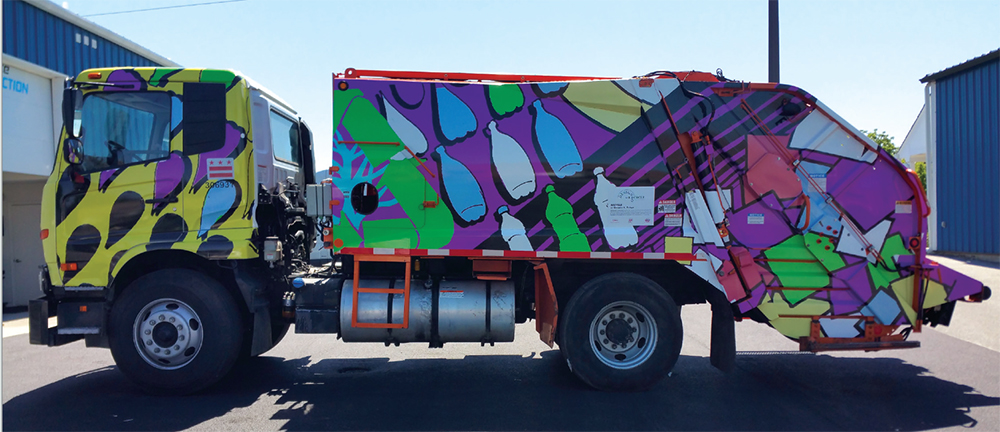
Washington, D.C.’s recycling collection trucks were recently decorated with recycling-related motifs painted by local artists and students.

Although changes at the White House have grabbed much attention recently, there are plenty of other developments taking place in the District of Columbia.

Take Washington D.C.’s recycling program, for instance, which is on the cusp of big changes nearly 30 years after it first started. The District is pushing to become a leader in the recycling world, and will soon accept hard-to-recycle materials currently collected curbside by a select few cities across the country.

The new initiatives have been ushered in through a recent goal-setting process and ambitious legislation that solidified those goals into legal requirements.

Bottle battle spurs recycling

The U.S. capital’s materials recovery program dates back to the late 1980s when a proposed bottle deposit was defeated after a contentious battle. After the bill was voted down, proponents in the District began looking for other ways to increase diversion in the municipality.

“When the bottle bill got defeated, that’s when the recycling legislation came out,” said Bill Easley, recycling program officer with the District’s Department of Public Works (DPW). The first law requiring recycling of certain materials was passed in 1989.
Community spotlight, March 2017
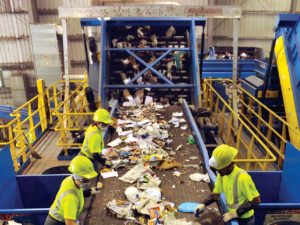
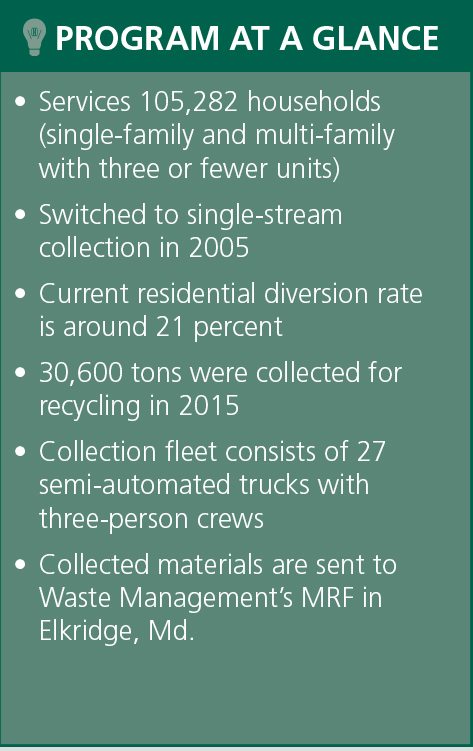
The Waste Management MRF in Eldridge, Md. handles the materials from Washington, D.C.’s residential program.

The program began as essentially a paper recycling effort and evolved to accept all the standard materials. Diversion has increased, albeit fairly slowly. In 2002, the first year of available data, the District diverted 13 percent of its solid waste. By 2004 that number had increased only marginally, but after the program went to single-stream collection in 2005, diversion rose to 17 percent during the following two years.

Using the measurement system in place since the start of the program, the District’s diversion rate reached higher than 28 percent in 2015, but DPW has also begun using a different metric that takes stock of a wider range of public recycling and composting programs. By the latter metric, the District currently holds a roughly 21 percent diversion rate.

The residential recycling program has always been run by DPW. City crews service single-family homes and multi-family buildings with fewer than three units, which together make up 105,000 households. Collection is funded through the city’s general fund rather than utility bills.

Commercial and large multi-family recycling is separate. Those properties contract with private haulers for their recycling collection, and under District law, commercial properties must provide recycling services.

Aiming to lead

In 2013, a non-binding “Sustainable DC” plan was crafted and introduced by Mayor Vincent Gray. It identified some ambitious goals, including reaching 80 percent diversion by 2032. The following year, local lawmakers passed the Sustainable Solid Waste Management Amendment Act of 2014, which updated the District’s original recycling legislation. It also codified the goals from the non-binding plan and in some cases took them a step further.

For example, the Sustainable DC plan allowed disposal by waste-to-energy to count toward its 2032 diversion goal, but the legislation bars waste-to-energy figures. In addition, the non-binding plan targeted primarily residential recycling, but the legislation expands that to include commercial and industrial as well.

“This is the District making its commitment that we want to lead, and have a strong waste portfolio as part of our broader sustainability goals,” said Annie White, manager of the office of waste diversion at DPW.

In order to get to the diversion goal, the 2014 Act revises the list of materials legally required to be recycled, as well as those that are accepted through the residential program. One of the more innovative moves will take effect in 2018, when single-use coffee cups and an array of other food-service packaging will be accepted for recycling.

Besides paper cups with polyethylene coating, the District will begin collecting paper plates and other paperboard food containers, non-bottle rigid plastics, and non-single-use products like Tupperware storage containers.
Community Spotlight, March 2017Inclusion of those products will begin next January.

“Some of these materials are accepted by less than 20 percent of communities in the U.S.,” White said, adding that the District is “looking to take more of a leadership role in some of these areas.”

In accepting coffee cups, D.C. will join some leading recycling municipalities such as Seattle and San Francisco. Coffee cups are often non-recyclable due to the plastic or wax coating that fortifies the paper against liquid penetration.

However, two large coffee companies, Starbucks and Pret A Manger, began collecting single-use coffee cups at their D.C. locations recently. That spurred the push for wider acceptance of food-service packaging material.

Using a survey model from The Recycling Partnership, solid waste officials queried MRFs in the area to gauge the materials they could accept, and made a plan to adjust the city’s list accordingly. In the responses from MRFs, the solid waste department determined a wide range of food-service packaging was accepted by the majority of MRFs in the area.

White explained that through independent but related efforts, the District and the Foodservice Packaging Institute will work to educate MRFs and their haulers about this shift as well as to help develop end markets for the newly accepted materials.

“I am optimistic about our program,” White said. “I look forward to sharing our experience and results so that other communities can learn from us.”


This article originally appeared in the March 2017 issue of Resource Recycling. Subscribe today for access to all print content.

Tags: Local Programs
TweetShare
Colin Staub

Colin Staub

Colin Staub was a reporter and associate editor at Resource Recycling until August 2025.

Related Posts

Bill to update New Jersey e-scrap program heads to governor

New Jersey recyclers talk EPR

byBrian Clark Howard
April 9, 2026

At the Association of New Jersey Recyclers’ spring meeting industry representatives discussed the state and future of the sector.

Wineries help create model for film recycling

Wineries help create model for film recycling

byAntoinette Smith
April 7, 2026

A collaboration between California wineries and the recycling value chain has provided a closed-loop model the partners aim to see...

Waste Connection recycling cart in The Dalles, Oregon

First Oregon community expands curbside recycling with EPR funding

byBrian Clark Howard
April 1, 2026

The City of The Dalles in northern Oregon is now rolling out nearly 5,000 new 90-gallon recycling carts to customers...

Rural effort targets vapes as battery fire risk grows

byScott Snowden
March 24, 2026

A Wisconsin firefighter is building a rural vape collection service as discarded devices with lithium-ion batteries continue to raise fire...

New Providence carts underpin recycling campaign

New Providence carts underpin recycling campaign

byBrian Clark Howard
March 23, 2026

With grant assistance, the Rhode Island capital is providing about 55,000 new collection carts to help boost its recycling rate,...

Recycling education needs consistency, simplicity 

byBrian Clark Howard
February 25, 2026

Several members of Circular Action Alliance team shared insights during a workshop at the 2026 Resource Recycling Conference in San...

Load More
Next Post

Southern collaboration

More Posts

Birch Plastics gets FDA green-light for post-industrial PP

LyondellBasell upgrade to PreZero assets on hold

April 23, 2026
The independent ITAD at a crossroads

The independent ITAD at a crossroads

April 22, 2026
EPR fees are a market signal. Here’s what they’re telling you.

Oregon DEQ flags 250 producers for RMA noncompliance

April 21, 2026

What Netflix’s ‘Plastic Detox’ gets wrong – and right

April 23, 2026

Google pilots reuse kits to extend device life

April 21, 2026
What is EPR and why it matters

What is EPR and why it matters

April 22, 2026

PCA keeping focus on virgin fiber products

April 27, 2026
Prescription drug bottles

National Prescription Drug Take Back Day is Saturday

April 24, 2026
AT&T, Compudopt expand e-recycling program

AT&T, Compudopt expand e-recycling program

April 23, 2026

Industrial sources drive rise in PVC recycling

April 13, 2026
Load More

About & Publications

About Us

Staff

Archive

Magazine

Work With Us

Advertise
Jobs
Contact
Terms and Privacy

Newsletter

Get the latest recycling news and analysis delivered to your inbox every week. Stay ahead on industry trends, policy updates, and insights from programs, processors, and innovators.

Subscribe

Welcome Back!

Login to your account below

Forgotten Password?

Retrieve your password

Please enter your username or email address to reset your password.

Log In

Add New Playlist

No Result
View All Result
  • The Latest
  • Analysis
  • Recycling
  • E-Scrap
  • Plastics
  • Policy Now
  • Conferences
    • E-Scrap Conference
    • Plastics Recycling Conference
    • Resource Recycling Conference
    • Textiles Recovery Summit
  • Magazine
  • About Us
  • Advertise
  • Archive
  • Jobs
  • Staff
Subscribe
This website uses cookies. By continuing to use this website you are giving consent to cookies being used. Visit our Privacy and Cookie Policy.