








Fourth-quarter MRF commodity values in the Northeast reached five-year lows, as they continued to drop but at a decelerating pace, according to Northeast Recycling Council survey data released this week.
The average value for all commodities fell to $68.41/ton without residuals, lower by 8.96% on the quarter. This level marks the lowest point since Q4 2020, when the grade hit $60.46.
The report includes responses from 18 MRFs representing 12 states: Connecticut, Delaware, Maine, Maryland, Massachusetts, New Hampshire, New Jersey, New York, Pennsylvania, Rhode Island, Vermont and Virginia.
With residuals, average values were at $52.49/ton with residuals, lower by 12.75% – the lowest point since Q3 2020, when the grade reached $40.19.
The report also detailed the change in Q4 average values, with
For PET, PP and mixed plastics (#3-7), as well as steel cans, the rate of decrease slowed in the quarter, while OCC, aluminum cans and mixed paper continued falling at the same pace as the previous quarter.
Average pricing for both natural and color HDPE bales, brown glass containers and all other paper rose in Q4. However, clear glass, green glass and 3-mix glass containers, along with bulky rigids, fell during the period, after rising in Q3. The report points out that recovered glass often is marketed but at a negative value, meaning recipients are paid to take it away.
| Commodity | Avg. $/ton in Q4 2025 | Change from Q3 2025 |
|---|---|---|
| OCC | 78.85 | -9% |
| Mixed paper #54 | 41.18 | -12% |
| Aluminum cans (UBCs) | 1,724.72 | -6% |
| PET | 111.57 | -11% |
| Natural HDPE | 1,030.33 | +8% |
| Color HDPE | 84.33 | +10% |
| Mixed plastics 3-7 | 86.41 | -12% |
| Polypropylene | 144.55 | -12% |
Single stream decreased by 7.87% without residuals and by 9.82% with residuals, while dual stream/source separated materials fell by 10.57% without residuals, and by 18.98% with residuals.
Although dual-stream MRFs did not decelerate as much as their single-stream counterparts, they did see a higher average commodity price compared to single stream for both with and without residuals. Residual material cannot be sold and is landfilled.
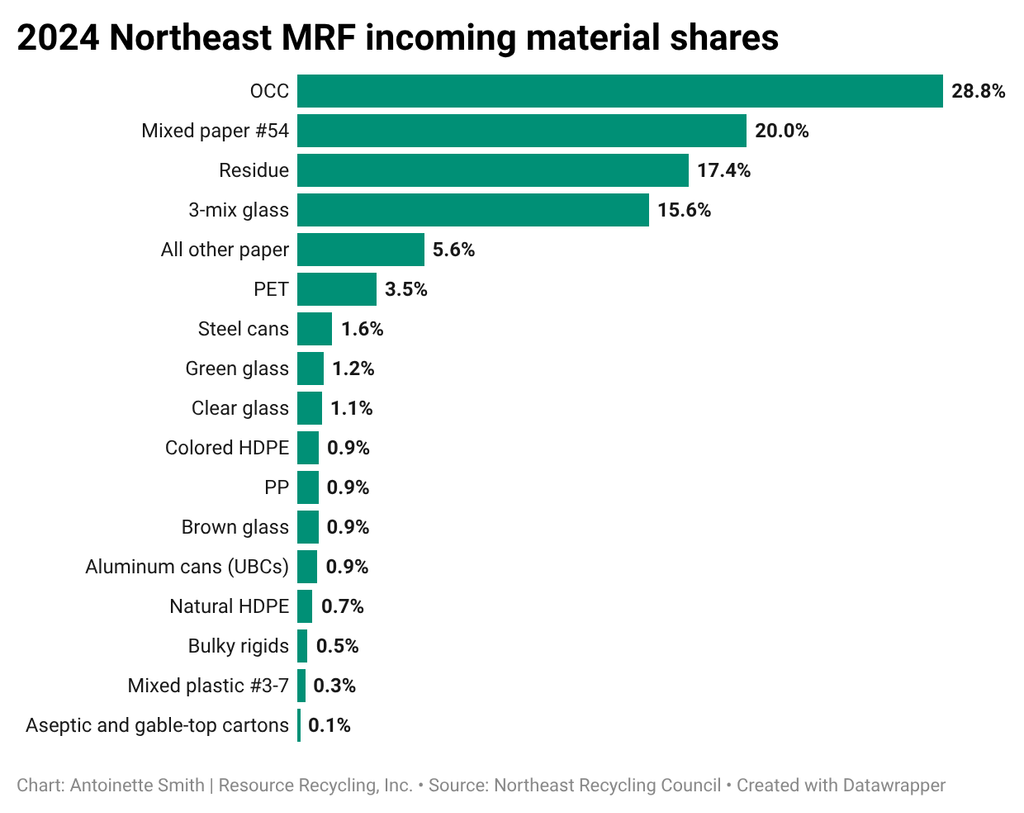
The report also showed the 2024 share of each material at 18 MRFs, with OCC and mixed paper representing nearly one half of incoming volumes. Of the included states, five have deposit return systems for beverage containers, which results in fewer glass bottles, PET bottles and aluminum cans winding up in MRFs there. In addition, MRFs in those states typically generate less revenue from those recyclables, the report said.
The report also showed the 2024 share of each material at 18 MRFs, with OCC and mixed paper representing nearly one half of incoming volumes. Of the included states, five have deposit return systems for beverage containers, which results in fewer glass bottles, PET bottles and aluminum cans winding up in MRFs there. In addition, MRFs in those states typically generate less revenue from those recyclables, the report said.
Of the three approaches reflected in the report – single stream, dual stream and source separation – single stream is the most common.