





Negotiations for a global, legally-binding treaty to address plastic pollution will spill over into another meeting, but participants noted the need for a seismic shift to reach the finish line after a fifth round of United Nations negotiations splintered along similar lines as the last four.
Those on the ground in Busan, South Korea, reported that familiar disagreements around plastic production caps, funding and the treaty’s proper reach stymied progress at what was supposed to be the final round of negotiations.
However, a majority of countries signaled willingness to support binding measures around product design, a global list of chemicals and products of concern to eliminate, and a global target on production reduction. At least 126 countries also support an independent, dedicated fund to support the goals laid out in the treaty.
The U.S. was not among the more than 100 countries that called for legally binding measures. With the next round of negotiations happening under a new U.S. president, Ocean Conservancy’s Director of Plastics Policy Anja Brandon said in an emailed statement that “addressing plastic pollution is not a partisan issue,” and she hopes “that any administration will respect the will of the people and recognize the responsibility and opportunity for the U.S. to be part of the solution.”
Overall, the U.S. stuck by its preference for each country to make a national action plan and keep commitments voluntary. Many countries, including Canada, China and Russia, also called for action “based on national circumstances and capabilities” at certain points.
NGOs, industry come away with divergent views
The Center for International Environmental Law said that without change, the treaty “will not be worth the paper it will be written on.”
“Negotiators are sticking with business as usual at such a crucial stage, abandoning their commitments, ignoring their principles, neglecting the science and economics in front of them, and failing those most impacted,” the group said in a mid-week statement.
By the end of the week, CIEL said that while “fossil-fuel producers once again succeeded in stalling progress, global momentum for a robust plastics treaty has only intensified.”
“In a remarkable show of strength, we saw more than 100 Member States unite in insisting the treaty include concrete measures to cut plastic production and ban the toxic chemical building blocks that fuel this crisis,” said Daniela Duran Gonzalez, senior campaigner at CIEL.
However, “opportunities for observer participation – a critical component of transparency and accountability – all but vanished at INC-5,” CIEL added, referring to the closed-door sessions held Nov. 29, Nov. 30 and Dec. 1.
Industry reactions were more positive but also emphasized the need for action. Rob Opsomer, executive lead on plastics and finance at the Ellen MacArthur Foundation, said in an emailed statement that pressure was on to make a “decisive choice” at the next negotiating session.
“It’s encouraging to see such a strong majority of countries supporting global rules across the plastics lifecycle,” Opsomer added. “We urge them to hold on to their ambition and agree to an impactful treaty that sets the global rules that business needs to unlock solutions at scale to end plastic pollution.”
The Business Coalition for a Global Plastics Treaty, a group largely composed of business interests and trade associations, also said it was encouraged by the increased alignment on “global phase-outs and sustainable levels of plastic production.”
“At the resumed INC5.2 session, governments must make a choice,” the coalition said in a written statement. “They can continue negotiating a treaty with universal support but little impact. Or they can agree on a treaty based on strong global rules across the full lifecycle of plastics and with a comprehensive financing mechanism, confident in knowing that this is what the majority of governments, business and citizens want.”
The Global Partners for Plastics Circularity, which is made up of the World Plastics Council, the International Council of Chemical Associations, and the American Chemistry Council, said in a statement that the treaty should stay focused on “addressing the primary cause of plastic pollution – mismanaged waste” instead of production caps or chemical bans.
New draft text to inform next negotiations
Closed-door meetings on the morning of Nov. 29 covered products and chemicals of concern, supply and finance. Afterwards, INC Chair Luis Vayas Valdivieso released an updated non-paper, so named because it’s a working suggestion.
It provided language for the preamble and the objectives and options for principles, definitions and health. The revised non-paper called for countries to take measures to address certain plastic products, including potentially banning their manufacture, export or import. A range of options were provided for production caps, one of which was a global target to reduce the production of primary plastic polymers to “sustainable levels.”
However, it didn’t address scope. Delegates agreed to use the revised text as a basis for negotiations at the resumed fifth session, INC-5.2, but with reservations.
Arpita Bhagat, plastics lead at Global Alliance for Incinerator Alternatives Asia Pacific, said in a statement that the text was “not a reflection of the will of the vast majority of Member States, who support ambitious measures in a legally-binding, global instrument.”
“Once again, as throughout this process, the Chair has bent to the will of the petrochemical states while dismissing the demands of the majority, in a completely non-transparent, exclusionary process,” Bhagat said. “This is a matter of life and death, especially for Global South communities. Member States will not roll over and play dead.”
Countries sound off on lack of progress
During the final INC-5 plenary, Rwanda called on countries to symbolically show their support for a globally binding and ambitious plastic pollution treaty that extends over plastics’ entire lifecycle, and 84 countries did so. Mexico, together with a majority group of 95 countries from various regions, officially stated that they will not accept a treaty without binding global bans and phaseouts on harmful plastic products and chemicals of concern.
However, several countries consider chemicals of concern a red line, according to a Nov. 27 report from Earth Negotiations Bulletin, a division of the International Institute for Sustainable Development.
GAIA noted that during the third day’s “stocktaking” plenary, there was a “flare-up of tensions that had been simmering for days.”
“Countries lamented how talks have stalled in contact groups, and the more ambitious countries openly stated their frustrations at the small number of Member States who they claim are negotiating in bad faith,” according to the group’s press release. “From previous plenaries and INC’s, it is safe to assume that they are referring to the petro-states.”
Panama representative Juan Carlos Monterrey called out “colleagues that argue that production is not part of the mandate.”
“Let me correct the record. Production is part of the full life cycle of plastic,” he said, adding that “every time that we hesitate in these negotiations, every time that we soften our ambition, more plastic seeps into earth, and into us.”
Proposals on the table to address production included one from Rwanda on behalf of 45 African countries that would set a global target to reduce the production and consumption of primary plastic polymers “to sustainable levels and promote circular economy,” and from the Cook Islands, on behalf of Pacific Small Island Developing States, that suggested a global target of 40% reduction by 2040, compared to 2025 levels.
Saudi Arabia proposed deleting altogether the article that addresses production.
Meeting criticized for lacking access, representation
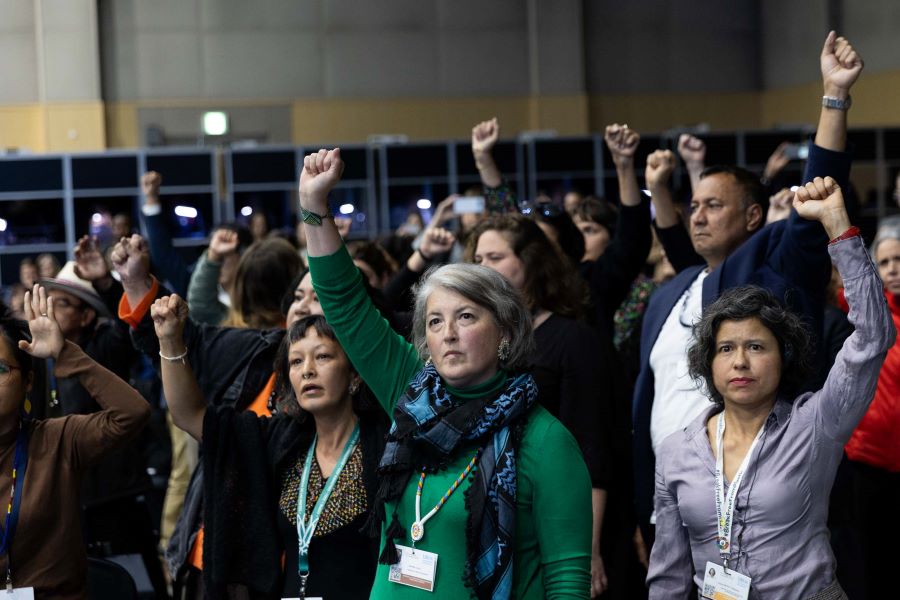
Complaints around limited observer and civil society group participation continued to plague negotiations. GAIA noted that in a break from past INC sessions, civil society members were not given time to speak during plenaries – until Nov. 27, when the Indigenous Peoples’ Forum on Plastics forced the issue.
“The group rose to their feet with their fists in the air, demanding to the Chair that they be heard, and soon a crowd of civil society members gathered around them in solidarity,” the press release noted. “Instead of acknowledging the unique and important perspectives that rightsholders have in negotiations and allowing them to speak, the Chair invited Russia, Saudi Arabia and other like-minded countries to quibble about when text is delivered to the legal drafting group.”
Eventually, the Indigenous Peoples Forum was given “just a few minutes to speak,” according to the release.
Representative Lisa Bellanger used the time to emphasize that the treaty “must recognize our rights and prioritize our voices and solutions to this crisis.”
“The treaty must actively promote Indigenous People’s contributions, providing a platform for our full and effective participation in decision making and implementation of the treaty as rightsholders, not stakeholders,” Bellanger said.
Stonewalled by a few
CIEL reported that there were 220 fossil fuel and chemical industry lobbyists present, the largest number at any plastics treaty negotiation so far analyzed by CIEL, a press release noted, surpassing the previous high of 196 lobbyists identified at INC-4. If counted together as a delegation, that would make fossil fuel and chemical industry lobbyists the largest single delegation at INC-5.
Of the 220 industry lobbyists, 16 were part of the national delegations sent by governments. Those countries were China, the Dominican Republic, Egypt, Finland, Iran, Kazakhstan and Malaysia.
During the week of negotiations, environmental groups repeatedly highlighted the consensus among a majority of countries for a strong treaty and criticized the “vocal minority” that were stonewalling talks, including Russia and Saudi Arabia.
Christina Dixon, ocean campaign lead at the Environmental Investigation Agency, called for moving forward without full consensus, and said “we would like to state loud and clear that the capture of these negotiations by the interests of the plastics and petrochemicals industries is holding us back from genuine solutions.”
“Busan laid bare that fossil economies like Russia and Saudi Arabia have no intention of addressing plastic pollution or letting other countries do so,” Dixon said. “Consensus has become another way to bludgeon progress, to hold back countries with a sincere interest in working to end plastic pollution.”
The World Wildlife Fund’s Erin Simon, vice president and head of plastic waste and business, said partway through the week in an emailed statement that “what was suspected over the last two-year treaty process became crystal clear today.”
“Not all countries are going to have the courage to finish this deal, but that can’t stop us from delivering a treaty that will finally meet the scale of this crisis head on,” Simon added. “The progressive majority now has a mandate: leave the laggards behind, speed up the development of the text, and utilize every tool available to get this job done.”