











Several recently published reports from the Ellen MacArthur Foundation and Oceana explored how to scale reusable packaging, while a Canadian company took another step toward establishing one such system.
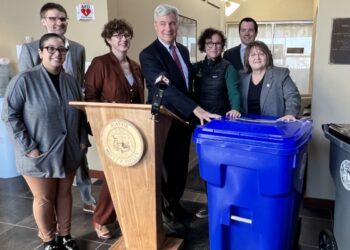
Canadian circular economy technology company Reusables.com is working to reduce single-use plastic foodware at universities.
So far, the Tap to Reuse and Smart Return Bin technology has been rolled out at Simon Fraser University in Vancouver, British Columbia in September, after a pilot project last year resulted in the elimination of 125 kg of single-use packaging over six months.
To expand its reach, Reusables partnered with Compass Group Canada’s educational food service division, Chartwells.
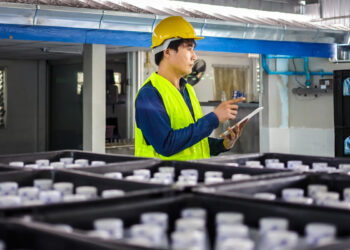
Students at the university can now get stainless steel reusable containers that are linked with Reusables’ RFID technology. That lets them return the containers without an app or a deposit, “making it the most convenient and scalable platform for sustainable packaging,” a press release noted.
The company’s RFID tags and automated return system has a 99% overall return rate, the press release added.
Jason Hawkins, Reusables CEO and co-founder, said the company vision is “to make reusable packaging the default for food services globally.”
Sid Mehta, the senior director of ancillary services at Simon Fraser University, said the program “aligns with our single-use product reduction goals.”
The state of reusables
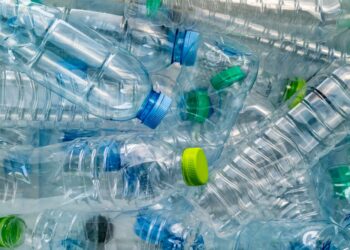
Oceana released a report detailing the potential impact of a 10% increase in the use of reusable beverage packaging, and the current state of reusable and refillable packaging around the world.
According to the report, a 10% rise in reusable beverage packaging by 2030 could replace more than one trillion single-use plastic bottles and cups and prevent up to 153 billion single-use containers from entering oceans and waterways.
In 2022, the global population used 1.5 trillion single-use plastic bottles and cups, the report noted, and up to 168 billion of them became pollution in aquatic systems. Of single-use cups, 59% by weight were polystyrene. The U.S. and China are the top consumers of non-alcoholic ready-to-drink individually packaged beverages, according to the report.
Some countries are well ahead of others when it comes to reusable infrastructure. Ethiopia, the Philippines, Germany and Nicaragua all have a market share of refillables greater than 30%, followed by Paraguay, Kenya, Sri Lanka, Chile, Mexico and Zambia with shares of over 20%.
Major markets lacking strong refillable footprints are the U.S., Canada, Indonesia, the United Kingdom, China and Poland, where less than 1% of non-alcoholic beverages are sold in refillable bottles, the report found.
Also emerging are reusable cup systems, which are currently in use in the U.S. and Europe, and have been adopted by some major companies and organizations.
Matt Littlejohn, Oceana’s senior vice president for strategic initiatives, said in a press release that “we’ve spent too much time chasing circular fantasies while huge amounts of plastic continue to flood into our oceans.”
“Adding recycled content to bottles and cups won’t topple this single-use plastic tower,” he said. “The way to really make a difference is to replace single-use plastic with reusable packaging. We need companies and governments to stop betting on the wrong horse with recycling and to prioritize the expansion and re-establishment of reusable packaging systems instead.”
Oceana is calling for global beverage and bottling companies to increase reusable packaging and to reduce the production and use of single-use plastic.
“All beverage and bottling companies should set targets to increase reusable packaging by at least 10 percentage points (and hopefully beyond) and to allocate appropriate investment and marketing resources to ensure growth goals are achieved,” the press release said.
That kind of increase “is clearly possible,” the press release added, because “the world’s leading soft drink companies, The Coca-Cola Company and PepsiCo, have large existing reusable packaging systems and have already pledged to increase the volume of beverages they sell in reusable packaging by 10 percentage points.”
“It is imperative for both companies, which have a history of not meeting commitments, to follow through and for other beverage companies to step up,” the press release stated.
While most of the report focused on non-alcoholic beverages, it noted that beer is another product area that can easily be transitioned to refillables. Anheuser-Busch InBev sells 35% of its volume in returnable glass bottles already, and Heineken in 2022 estimated that 38% of its packaging in a returnable format, the report said.
There has been some movement toward refillable legislation in Chile, Austria, France, Germany, Portugal, Romania, Sweden and Spain, the report added.
“The global transition to efficiently designed reusable beverage systems will require investment,” the report noted. “Luckily, reusable beverage packaging is not only good for the environment, but it’s good for business, too.”
A different system of reuse
The Ellen MacArthur Foundation also shared a new report focused on business-to-consumer reusable packaging. Developed with more than 60 organizations and brands, as well as consulting firms Systemiq and Eunomia, it models four different returnable packaging applications at three different levels of change.
The four returnable packaging applications are beverages, personal care, fresh food and food that is in a cupboard, while the three levels of change are a system level of change, where the model assumed that 40% of the market would shift to reusable packaging; a collaborative level, where about 10% of the market would shift; and a “fragmented effort” level, where only about 2% of the market changes.
“The scenarios keep all variables constant across applications to aid comparison, but its likely that any system would have a blend of bespoke and pooled packaging, and high return rates may be easier or harder to reach depending on the application,” the report noted, adding that the outcomes presented are based on French data and geography.
Overall, a successful return system has three key things, the report added: scale and shared infrastructure; packaging standardization and pooling; and high return rates.
“As the need for action becomes evermore urgent, and in anticipation of increased regulation, now is the time to come together to make this reuse revolution a reality,” the report stated.