



Resource Recycling
  • The Latest
  • Analysis
    • All
    • Certification Scorecard
    • Industry Announcements
    • Opinion
    The electronics recycling industry is undergoing a transformation from labor-intensive manual operations to highly automated, AI-driven facilities that use advanced robotics, cleaner chemistry and digital tracking systems to extract critical materials.

    The cyber-physical MRF: AI and robotics reshape e-waste recovery

    Certification scorecard for the week of Feb. 9, 2026

    Meta-Corning deal signals IT hardware retirement wave

    Meta-Corning deal signals IT hardware retirement wave

    Malaysia clamps down on illegal e-waste imports amid probes

    Malaysia clamps down on illegal e-waste imports amid probes

    URT builds alliance to remake electronics plastics at scale

    ICYMI: Top 5 e-scrap stories from January 2026

    The electronics recycling industry is undergoing a transformation from labor-intensive manual operations to highly automated, AI-driven facilities that use advanced robotics, cleaner chemistry and digital tracking systems to extract critical materials.

    Certification scorecard for the week of Feb. 2, 2026

    Auditors warn EU may fall short on critical metals

    Auditors warn EU may fall short on critical metals

    Industry announcements for January 2026

    Industry announcements for February 2026

    ICYMI: Top 5 recycling stories from January 2026

  • Conferences
  • Publications

    Other Topics

    Textiles
    Organics
    Packaging
    Glass
    Brand Owners

    Metals
    Technology
    Research
    Markets
    Grant Watch

    All Topics

Subscribe
No Result
View All Result
Resource Recycling
  • The Latest
  • Analysis
    • All
    • Certification Scorecard
    • Industry Announcements
    • Opinion
    The electronics recycling industry is undergoing a transformation from labor-intensive manual operations to highly automated, AI-driven facilities that use advanced robotics, cleaner chemistry and digital tracking systems to extract critical materials.

    The cyber-physical MRF: AI and robotics reshape e-waste recovery

    Certification scorecard for the week of Feb. 9, 2026

    Meta-Corning deal signals IT hardware retirement wave

    Meta-Corning deal signals IT hardware retirement wave

    Malaysia clamps down on illegal e-waste imports amid probes

    Malaysia clamps down on illegal e-waste imports amid probes

    URT builds alliance to remake electronics plastics at scale

    ICYMI: Top 5 e-scrap stories from January 2026

    The electronics recycling industry is undergoing a transformation from labor-intensive manual operations to highly automated, AI-driven facilities that use advanced robotics, cleaner chemistry and digital tracking systems to extract critical materials.

    Certification scorecard for the week of Feb. 2, 2026

    Auditors warn EU may fall short on critical metals

    Auditors warn EU may fall short on critical metals

    Industry announcements for January 2026

    Industry announcements for February 2026

    ICYMI: Top 5 recycling stories from January 2026

  • Conferences
  • Publications

    Other Topics

    Textiles
    Organics
    Packaging
    Glass
    Brand Owners

    Metals
    Technology
    Research
    Markets
    Grant Watch

    All Topics

Subscribe
No Result
View All Result
Resource Recycling
No Result
View All Result
Home Recycling

US eyes ‘holistic approach’ in global plastic talks

byJared Paben
March 20, 2023
in Recycling
Steve Alexander of APR and Monica Medina of the U.S. State Department at the 2023 Plastics Recycling Conference. | Big Wave Productions and Resource Recycling, Inc.

The Biden administration envisions a global plastics agreement that requires each country to take steps to boost demand for recycled resin, including through use of public procurement policies and packaging standardization.

Although any global deal with specific plastic waste reduction requirements is likely years away, U.S. State Department officials recently provided a sense of which direction they’d like negotiations to take. 

In a written submission to the United Nations, the U.S. government suggested an agreement that requires countries to create their own national action plans to reduce plastic waste in a variety of ways.

A top State Department official elaborated on the U.S. position at the 2023 Plastics Recycling Conference outside Washington, D.C. earlier this month.

“Recycling is a huge part of that, but we also need reuse and reduction,” said Monica Medina, an assistant secretary at the U.S. State Department. 

She added the recent train derailment in Ohio, which released chemicals that are made to manufacture plastic, put renewed focus on the issue of materials management. “I think that was another wake-up call to the U.S.,” Medina said, “that we need a more holistic approach that includes all of the above: reduce, reuse and recycling.”

Seeking an agreement, not a treaty

Medina, who is the State Department’s assistant secretary for oceans and international environmental and scientific affairs, oversees officials speaking on behalf of the U.S. government at the Intergovernmental Negotiating Committee (INC).

The process of creating the global agreement under the U.N. was kickstarted by a resolution approved by 175 nations in Nairobi, Kenya a year ago. The goal is a legally binding agreement by the end of 2024 that seeks to end the leakage of plastic waste into the environment by 2040. The next meeting is set for May 29 to June 2 in Paris. 

The U.S. proposal, which was dated Feb. 13 and was posted online by the United Nations Environment Program, largely deals with how an international body and agreement – called an instrument – could be structured. 

The Biden administration is not calling for a formal “treaty” that would change U.S. law and thus require the consent of the U.S. Senate. Instead, the administration is pursuing an “executive agreement” that President Biden or a future president could agree to, although a future president could also unilaterally withdraw from it.

The U.S. proposal is just one of dozens posted online, and it focuses on the process and structure of negotiating a plastics agreement. But it does hint at some obligations the administration would be open to seeing in a final document, even though many are vaguely worded. 

For example, the U.S. submission points to the need for plastics reuse as well as the importance of working with stakeholders to tackle product design and ensure transparent reuse and recycling labeling.

Further, the document outlines the potential to change government buying policies to avoid single-use plastic waste and the value of taking steps “to strengthen demand for secondary plastics to facilitate environmentally sound plastic scrap recycling, including by using public procurement to drive demand for plastic products containing higher recycled content levels.” 

The U.S. also points to “measures to strengthen environmentally sound management of plastic waste, including actions to prevent and reduce the generation of plastic waste.” 
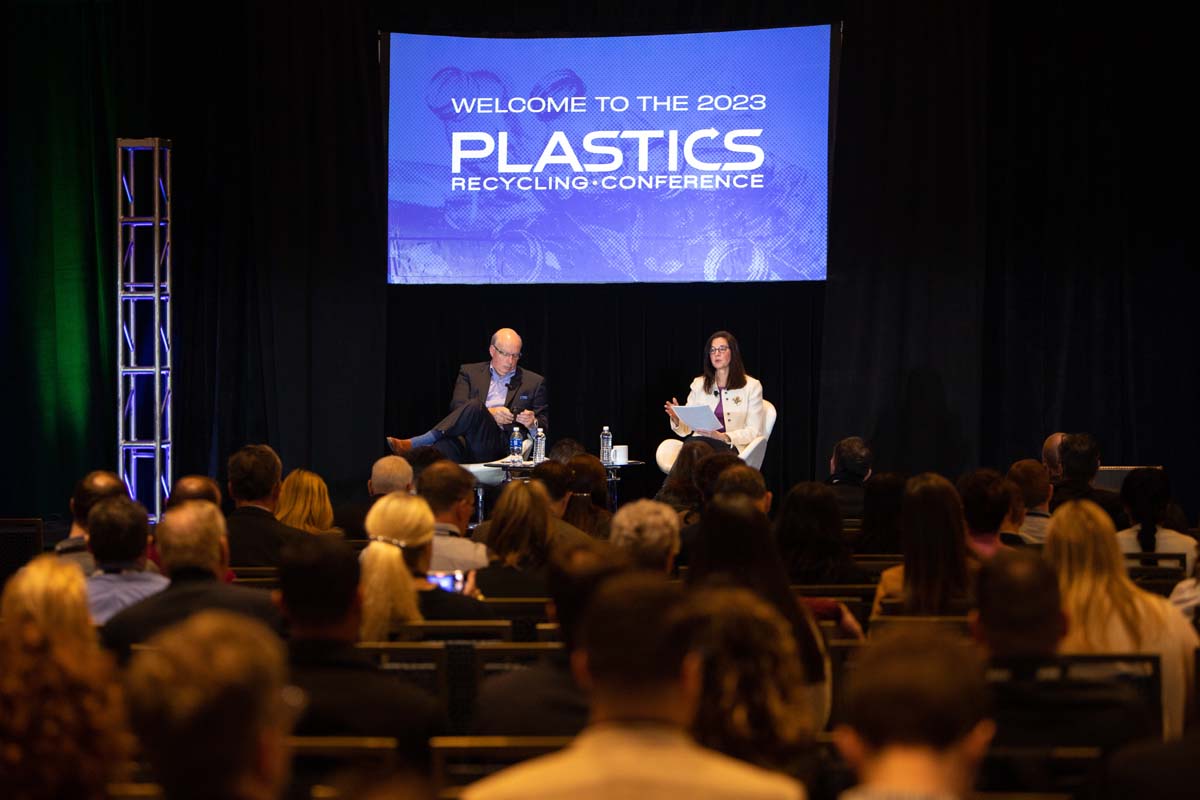
Courtesy of Big Wave Productions and Resource Recycling, Inc.

‘A huge step forward’ in California

In her remarks at the Plastics Recycling Conference, Medina noted that the U.S. EPA will contribute heavily to a national plastic waste plan, “but really it’s going to come down to state and local governments and our ability to leverage changes in state and local government law that will help us to sort of flip the paradigm here in the U.S.” 

She pointed to California’s laws aimed at reducing plastic waste as “a huge step forward” and emphasized the U.S. needs other large states to follow suit to usher in a “sea change, if you will, within the U.S.”

She said she could imagine a national action plan that results in a smaller variety of polymers and colors used in packaging paired with a comprehensive and consistent recycling system “that allows your businesses to grow.” 

Steve Alexander, president of the Association of Plastic Recyclers (APR), served as moderator of the conference session and told Medina she touched on a central concern for plastics reclaimers: the lack of consistency across the U.S. in terms of recycling program acceptance and packaging labeling regulations. APR was recently accredited by the U.N Environment Program as an official delegate. (APR owns Resource Recycling, Inc., publisher of Plastics Recycling Update.)

Alexander also asked Medina whether a national action plan would be more prescriptive in terms of federal guidelines to provide standardization across the U.S.  

Medina said a federal regulatory approach to require consistency is hampered by a lack of statutory authority in the U.S. In the absence of a national law on plastic and recycling, “we’re going to have to try to find a way from the bottom up and the top down to get to that kind of standardization that will make everyone’s lives easier.”

“We need your help figuring out how to find that right balance between top-down prescription and standardization and bottom-up innovation and flexibility,” she added.

Countries stake out early position

The U.S. is proposing to require countries to develop their own plastic waste action plans, as opposed to meeting specific requirements that apply to all parties to the agreement. 

That position has drawn criticism from environmental activists who fear it will allow the U.S. to water down its actions, because the country won’t be held to strict requirements that apply to all countries across the board.

A large group of countries calling itself the High Ambition Coalition to End Plastic Pollution has staked out an aggressive position, calling for mandated constraints on plastic production and consumption, among other measures. That group wants a treaty that would “include control measures that will minimize demand of plastics and increase the supply of recycled plastics for use in new plastic products.” The group includes Canada, Mexico, most of Europe, and several other countries around the world. 

Medina defended the “national action plan” approach, however, saying the U.S. wants “an ambitious, innovative and country-driven agreement.” 

“We don’t have a one-size-fits-all solution that we negotiate that’s supposed to fit every country in the world, ” she said. “They’re all different. They all have different problems with plastics. Some have problems with waste disposal, some have problems because they’re creating plastic.”

A version of this story appeared in Plastics Recycling Update on March 14. 

Tags: Industry GroupsPolicy Now

TweetShare
Jared Paben

Jared Paben

Related Posts

Focus on recycling film, flexibles takes shape in two reports

byAntoinette Smith
February 13, 2026

The US Plastics Pact and the Alliance to End Plastic Waste released reports outlining necessary steps to improving recycling outcomes...

Bipartisan reps introduce bill on recycling claims

Bipartisan reps introduce bill on recycling claims

byAntoinette Smith
February 12, 2026

Legislators introduced the Recycled Materials Attribution Act in the US House, drawing support from a new industry group and scrutiny...

APR, industry create proactive guidance for PET caps

byAntoinette Smith
February 12, 2026

The Association of Plastic Recyclers recognized that developing guidelines before PET caps were completely developed and commercialized was crucial, and...

APR expands recycling efforts in Mexico, Latin America

byAntoinette Smith
February 11, 2026

The organization aims to leverage Mexico's leadership in plastics recycling and vital role in North American markets.

Member states select new chair for global plastics treaty

Member states select new chair for global plastics treaty

byAntoinette Smith
February 10, 2026

During a short session, the Intergovernmental Negotiating Committee elected Chilean diplomat Julio Cordano to continue efforts toward an internationally binding...

SWANA hires new executive director

SWANA partners with Product Stewardship Institute

byStefanie Valentic
February 4, 2026

The Solid Waste Association of North America and the Product Stewardship Institute are formalizing their collaboration to address materials management...

Load More
Next Post

UBC stakeholders report on recycling progress

More Posts

Oregon’s Recycling Modernization Act faces injunction

Court partially blocks Oregon EPR law, dismisses bulk of lawsuit

February 10, 2026
Chinese processing group details goals for US visit

AMP lays out vision of next-generation, AI-driven MRFs

July 24, 2024
Malaysia clamps down on illegal e-waste imports amid probes

Malaysia clamps down on illegal e-waste imports amid probes

February 6, 2026

REUSE Act heads to US House for consideration

February 9, 2026
Meta-Corning deal signals IT hardware retirement wave

Meta-Corning deal signals IT hardware retirement wave

February 9, 2026

ecoATM recycled 7.5M phones in 2025 as payouts hit $1.5B

February 10, 2026
Texas sues over dumped wind turbine blades

Texas sues over dumped wind turbine blades

February 10, 2026

APR, industry create proactive guidance for PET caps

February 12, 2026

Alpek talks PET overcapacity, soft demand

February 11, 2026
The electronics recycling industry is undergoing a transformation from labor-intensive manual operations to highly automated, AI-driven facilities that use advanced robotics, cleaner chemistry and digital tracking systems to extract critical materials.

The cyber-physical MRF: AI and robotics reshape e-waste recovery

February 12, 2026
Load More

About & Publications

About Us

Staff

Archive

Magazine

Work With Us

Advertise
Jobs
Contact
Terms and Privacy

Newsletter

Get the latest recycling news and analysis delivered to your inbox every week. Stay ahead on industry trends, policy updates, and insights from programs, processors, and innovators.

Subscribe

Welcome Back!

Login to your account below

Forgotten Password?

Retrieve your password

Please enter your username or email address to reset your password.

Log In

Add New Playlist

No Result
View All Result
  • The Latest
  • Analysis
  • Recycling
  • E-Scrap
  • Plastics
  • Policy Now
  • Conferences
    • E-Scrap Conference
    • Plastics Recycling Conference
    • Resource Recycling Conference
    • Textiles Recovery Summit
  • Magazine
  • About Us
  • Advertise
  • Archive
  • Jobs
  • Staff
Subscribe
This website uses cookies. By continuing to use this website you are giving consent to cookies being used. Visit our Privacy and Cookie Policy.