











This story originally appeared in the December 2016 issue of Resource Recycling.
Subscribe today for access to all print content.
When it comes to U.S. paper recycling, Pratt Industries is typically at the center of the conversation.
The Conyers, Ga.-based company now operates four 100 percent recycled paper mills and touts itself as the nation’s fifth-largest manufacturer of corrugated packaging. But perhaps more important to the materials recovery industry is the fact that Pratt uses only recovered fiber as feedstock for its mills.
That dependency on old corrugated containers (OCC) and other forms of recovered fiber has pushed Pratt deep into the materials processing segment of the recycling industry. Last September the company opened its 17th material recovery facility (MRF) – a decade ago, the company operated just one.
As the recycling stream continues to evolve and boxes used in e-commerce rapidly replace newspaper and other fiber streams, Resource Recycling was interested to know the effects on Pratt and other paper recycling stakeholders.


We talked with Shawn State, senior vice president southern region for Pratt’s Recycling Division. He discussed the company’s dedication to recycled material, and he also answered questions about MRF profitability and the effects of curbside contamination on paper-making operations.
State leads a team that is responsible for operations and procurement at 14 recycling facilities from North Carolina to Texas as well as procurement into Pratt’s containerboard mills in Shreveport, La. and Conyers, Ga. Together, those two mills consume over 900,000 tons of recovered fiber annually.
Your company operates MRFs and acts as a huge consumer of recycled fiber. How do those two sides of the business inform one another?
Pratt Recycling’s MRFs exist to supply Pratt’s 100 percent recycled mills with fiber. When it comes to growing our MRF business, we continue to look at different markets strategically, and if it makes sense to put a MRF in to support a mill, we will do that.
Regarding the operation of our MRFs, what we are seeing in the incoming single-stream material is less and less of the news and mixed [paper] and more of that percentage being OCC. That’s being supported by what we are seeing on the corrugated box side of our business. We see the recovered corrugated material we’re bringing in – either through one of our MRFs or an industrial account – as being critical to our long-term supply for our mill group.
What has the jump in e-commerce over the last decade meant to Pratt? How is it affecting the business of paper recycling?
Since we are a privately held company, we do not reveal sales numbers. However, we can state that our sales to companies who operate in the e-commerce space have experienced a massive increase, and we expect that to continue.
And what about the recycling side? I imagine you’re seeing more small boxes coming into your MRFs from curbside programs as opposed to a lot of the larger packages that might come in off the back dock of retailers and other commercial entities.
There are two ways to look at it. On one hand, these large distribution centers that are popping up all over country have large amounts of corrugated available. As we partner with these distribution centers (corrugated box customers) on the corrugated box supply side, in many cases we are also being asked to partner with the corrugated box customers to handle their recycling at these million-square-foot distribution centers. That part is easy. We deliver the new boxes that they will pack merchandise in, to ship to their individual customers, one item at a time, and then that e-commerce company loads all of their bales of empty boxes onto that same truck, and it gets shipped to our paper mill. And once there, these old boxes get pulped and eventually get made into new corrugated boxes. This is really closing the loop.
However, collecting these boxes from the residential curbside stream is a bit more challenging. If a city has single-stream carts, it is typically the policy that only what gets put inside the cart gets picked up and recycled. More often than not, if you drive through a neighborhood, you see the OCC either in the trash bin, because the trash bin is historically bigger, or you see it knocked down and lying next to the recycling bin because the resident wants to recycle it but can’t fit it in the bin. If it is outside the recycling cart, tough luck – it is probably ending up in the landfill.
This is one of the flaws that no one ever anticipated with single-stream recycling that is collected with “automated” trucks. There is a big opportunity to try to figure out how to recycle these boxes at the curb. But there is not an easy answer on how to do that. There might be multiple solutions including educating the consumer about collapsing their cardboard boxes, getting larger carts, or moving away from carted single-stream altogether.
On the materials processing front, is it difficult to capture smaller boxes used in e-commerce since OCC screens have traditionally been geared toward larger items? And if the material isn’t picked up by the screens and goes along the line with mixed paper, is it going to be worth it for MRF operators to pull out the OCC later in the process?
From our perspective, the brown boxes being in the mixed paper is not a problem. We would actually prefer to have the brown fiber in the mixed paper. Pratt is the largest domestic consumer of residential mixed paper and when corrugated is mixed in that bale of fiber, that only helps us. We’ve talked to our suppliers about this as well. If it doesn’t make sense for them to pull corrugated boxes out of the mixed paper bale, then we tell the suppliers to feel free to leave it in. On the MRF side, the boxes coming in are not so small that they are not getting caught by the OCC screens and the optics we have in our MRFs. Generally speaking, the MRF equipment is still doing a good job separating out the OCC.
What’s driven the growth in the number of MRFs you run? Has that been pushed by cost efficiencies in vertical integration? Or was it more a question of quality, where maybe you weren’t getting the level of feedstock you wanted from other processors?
 For Pratt, the decision to have a MRF in a market is as much about the security of supply of fiber as it is about financial stability or quality. The voracious appetite of our paper mills for quality feedstock requires that we have a secure supply of recovered fiber. Some of this comes from many other recycling companies. We want to have diversification in our incoming fiber streams. This means we will have some fiber being bought from a third-party recycler, and some being from “close the loop” accounts, those accounts where we also perform the recycling piece in addition to selling the account boxes.
However, in addition to other recyclers and commercial/industrial accounts, a certain portion of this comes from Pratt Recycling’s own MRFs. As we have expanded our paper mills in the U.S., we have also improved our MRF infrastructure. The factors that come into consideration as to where to site a MRF are as follows: 1) proximity to one of our paper mills; 2) opportunity to improve recycling rates in that geography; 3) ability to execute a long-term contract with a municipality and commercial accounts; and 4) backhaul opportunities where we can use our trucks to deliver corrugated boxes to our customers or internal plants, and then backhaul recovered fiber from MRFs in that same area to our paper mill. This can significantly reduce the cost of freight by not dead-heading empty trailers back to our box plants and paper mills.
So the fiber-supply considerations are more important than whether a facility is actually profitable on its own?
The plant managers in the Pratt MRFs are tasked with running profitable facilities regardless of market conditions. That task can be challenging when the recovered fiber prices have been at historic lows. If we were looking at it only from a financial standpoint, when the recovered fiber market is down, it would be difficult to justify operating MRFs.
But we are looking long term. We are a sustainability company, and just as important, we need the fiber to run our mills. We believe operating MRFs is the best way to control the fiber supply coming into a mill. If we operate the facility, we know we can bank on our own fiber supply being available day in and day out. But, as mentioned earlier, we need that fiber supply portfolio to be diversified so we are not impacted as much by the recovered fiber market swings. Regarding how we view the MRFs, we want to run every MRF as a profit center and that will always be the goal regardless of market conditions.
We often hear about the lightweighting of materials when it comes to plastics, but the trend has extended to corrugated boxes as well. Is it concerning to you that the boxes that get recycled are smaller and thinner than in the past? It seems like it would be challenging to maintain constant tonnages of recovered material as lightweighting evolves.
Actually for Pratt, we consider it an opportunity. Because our paper mills are some of the newest, high-tech containerboard mills in North America, we have been very focused on producing 100 percent recycled containerboard, much of it lightweight. Through this technology, we have also developed lighter, thinner boxes, that are as strong and sturdy as thicker and heavier boxes manufactured 20 years ago. Therefore, this has provided an opportunity for us to sell boxes to many new customers. As we acquire new box business, we often get the opportunity to be the primary recycler for that account. This has provided us with a new source of fiber for our mills.
I’m curious to know how Pratt views the trend toward sustainable materials management (SMM). There are some products that traditionally used cardboard for packaging but now are coming in flexible film or other materials. Is that phenomenon detrimental to your business?
SMM is still in its infancy, although some states, like Oregon, seem to be taking the lead and are ahead of the curve. Generally speaking, when it comes to the recycling side of the equation for SMM, paper scores well. For instance, when it comes to curbside recyclables, recycling aluminum has significant energy savings per ton, but the tonnages of aluminum, in comparison to other recyclable materials, in the curbside bin, are very low. At the other end of the spectrum, recycled glass has very low energy savings per ton recycled. Paper is somewhere in the middle, in terms of energy savings per ton recycled, but the tonnage of paper that is contained in the curbside bin is huge, both in terms of total tonnage, and as a percent of all commodities recycled. Therefore, since SMM will take focus off of weight-based recycling, and instead use life-cycle assessment, paper will continue to be a preferred packaging material.
What can the larger recycling industry do to help your company and others continue to thrive by prioritizing recycled material?
The industry needs to continue to educate the leaders that serve in municipalities on what can and cannot be recycled. The industry also needs to do everything it can to keep contamination out of the recycling bin. Contamination is the biggest issue we are seeing out of single-stream programs. In addition, many recyclers are struggling with the recyclability of glass. When it breaks in the collection and processing of single-stream recycling, it contaminates other materials. In addition, other small materials such as bottle caps and shredded paper contaminate the glass stream. So it is a lose-lose situation. We are working with other recyclers who seem to have promising solutions for glass recycling.
When you get contaminated loads,how exactly is your process affected?
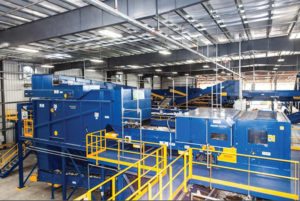
When operating a MRF, contamination is a problem because we have to send the contaminated material to landfill and that costs the MRF money. If we don’t get that contamination separated from the paper and we ship that product to the mill baled, then the contamination ultimately ends up in the pulper at the mill. This becomes a problem, because the pulper is only so big and can only handle so much volume.
We need that volume in the pulper to be paper and water only. We don’t want contaminants, trash and other non-recyclables to make it all the way to the pupler. We run our mills to full capacity, maximizing the volume of usable fiber that can be made into new paper. Whether it is Pratt’s mills, or anyone else’s, the entire industry is focused on reducing contamination, which has gotten much worse since the introduction of single-stream recycling. At the end of the day, contamination only adds costs to the entire system – the contaminated material that gets removed at the MRF, or the paper mill, ultimately goes to the landfill. Only the trip for that trash took much longer, and was much more expensive, due to the non-recyclable material being placed in the wrong bin to begin with.
Dan Leif is the managing editor of Resource Recycling. He can be contacted at [email protected].