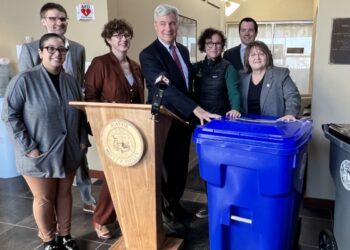













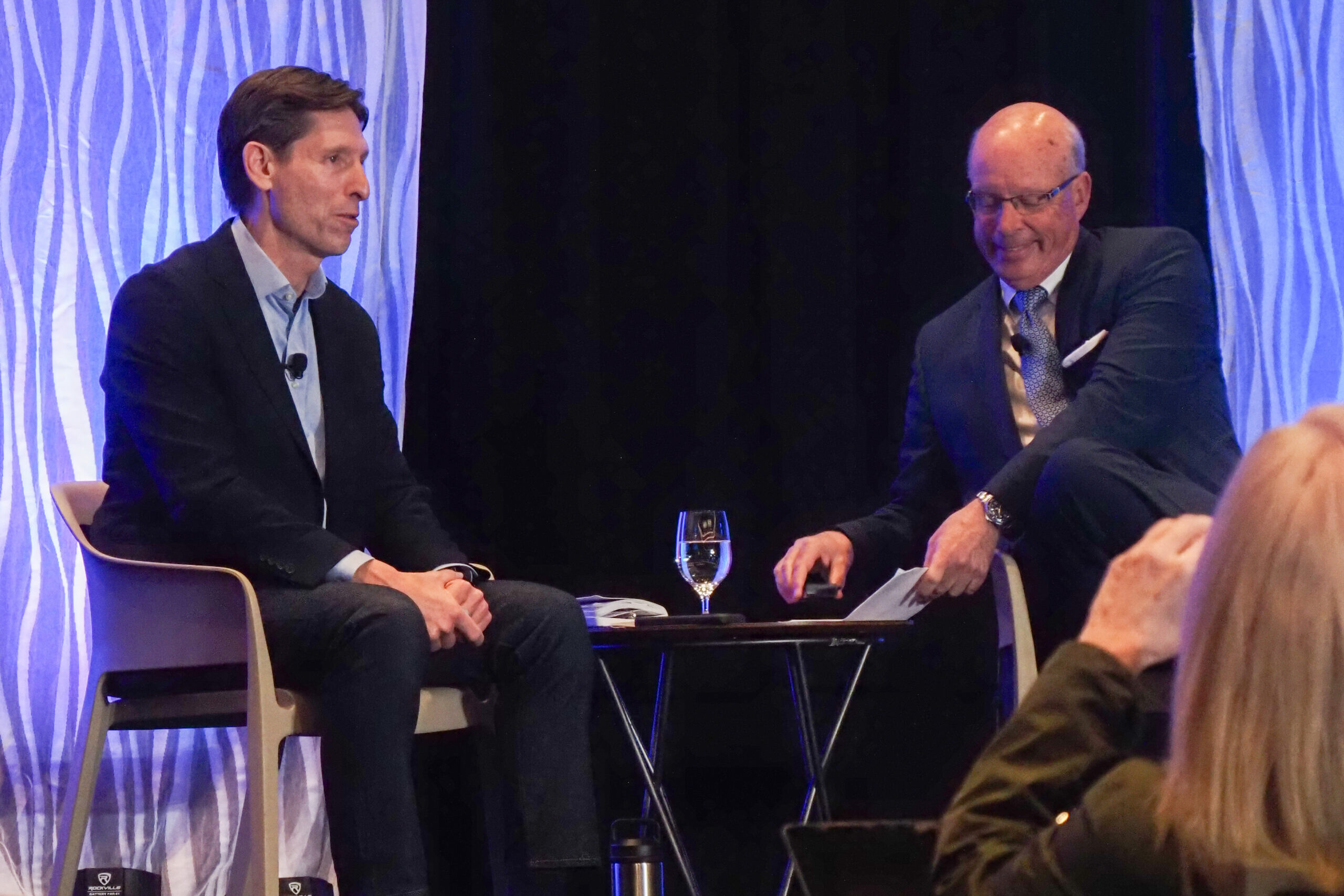
Steve Alexander, CEO of the Association of Plastic Recyclers (APR), kicked off the 2026 Plastics Recycling Conference with a candid discussion of extended producer responsibility (EPR) laws and the role of the producer responsibility organization (PRO), with Jeff Fielkow, CEO of Circular Action Alliance, the group that administers most of the current US packaging EPR programs.
“For those of you who don’t know APR, we’re the only organization in North America that does one thing. We work on plastics recycling,” Alexander said during the opening plenary on Feb. 23 in San Diego. “We don’t have competing interests. We’re here for you. And sometimes that puts us in a position of being, I wouldn’t say adversarial, but we say things that are real. People sometimes don’t like to hear reality. That’s who we are, and that’s what you’re going to hear today.”
APR owns Resource Recycling, Inc., publisher of Plastics Recycling Update and organizer of the conference.
Fielkow started the chat by explaining in simple terms, a PRO’s place in EPR programs: “We’re like Bob the Builder. We don’t make the law. What we do is we interpret the law and put it into an implementable program plan that ensures producers, since that’s who we represent, are compliant with the law.”
The following highlights of the conversation were condensed and edited for brevity and clarity:
Alexander: I’m going off script.
Fielkow: There is no script.
One of the things that burns my toast is this: Can you define what the term “producer” is, please? Because we’re really talking about brands. So why isn’t it the extended brand responsibility law?
Can we go back to the script? No. So that is actually one of the roles that we play, is really helping states that are thinking about passing laws in the future or ones that have laws already in the books, it’s to harmonize the definitions. I don’t think I can give you a full definition of what a producer is because it varies in each state.
We help producers or brands determine if they are considered a producer in a given state. Producers tend to be brand owners, but not always.
There’s a perception out there that you’re a brand organization or you’re a brand protector organization. Can you address how that all fits into what you’re trying to do?
To simplify it the best I can, the producers, who tend to be brands, are obligated to pay into the system to cover costs either that the state, the ratepayers were paying, or to invest in new infrastructure to actually ensure that the mandates of the EPR law actually come to fruition.
We are producer-led because that is who is paying the fees in. So we can work with the recyclers, the haulers, the collectors, the end markets to actually make the positive change happen. We represent the producers or the brands because that is who we are obligated to keep compliant with the laws.
But I think the best way that one should think of it is the way the US programs are really structured, we’re conveners. We are not the ones that have all the answers. Our role is to ensure that we’re getting all the people that do have the answers on how to actually make a better recycling system, composting system, better design.
One of the things in EPR law that infuriates me is that a responsible end market has somehow been defined as not the customer, and the recycler is defined in certain state regulations as the end market. Why in God’s name are recyclers made the customer? Because if they can’t sell it, will EPR just become a supply stream versus becoming a driver of material?
Really, what we are obligated to do is ensure that whatever is collected and processed for recycling goes to an end market that can be verified and meets certain standards. It doesn’t do environmental harm, and can actually assess what the yield is to create more trust and transparency.
We’re building the REM standard with a collaborative effort hosted by SCS, and I know APR is helping as well. We’re creating that transparency on what an end market looks like so there’s more trust in what gets recycled. That’s part of the answer.
The second is we need to make sure that what goes into the end market has high quality, to hopefully improve the economics for the full supply chain. But each program has their own rules, so the end market can also vary state by state.
I noticed that in other countries, the PROs have gotten together and there’s a standardized design platform and PCR platform. Not all the states require PCR, am I correct on that? So what are some of the other things that we can do?
Within the programs that we currently have, you are correct that not all programs have a PCR mandate, but there are tools that a PRO can use to incentivize or disincentivize behavior. For example, there’s something called eco-modulation. But basically there’s a tool that lets the PRO incentivize behaviors that will drive performance results that build a better recycling system or drive design behaviors that we’re looking to see.
What we need to drive — when I say we, it’s not CAA, it’s everybody in this room and all the interested parties — we need to drive better education. We need to drive getting collection right, right-sizing the bin and the frequency of collection so we’re capturing the material. We need more investments in the MRFs.
We also know there’s a bigger need for secondary sortation, especially for films and some plastics, so we can then present to converters or recyclers a better quality stream, which again I believe will improve the economics for everybody.
Obviously one of the biggest issues, the elephant in the room, is the price of imported material and how it’s completely undermining the domestic market. Do you foresee a time when you would be able to incentivize your members to utilize material that’s produced and collected in North America versus external markets?
We need ultra-healthy markets. And what the PRO needs to see happen is whatever is collected actually gets recycled responsibly. And part of that is that it has to be sold. And it’s highly complicated.
I do know there are external factors of pricing from outside the US. I’m not sure I should probably discuss it in a forum like this. But we know we need to have markets that have circularity built in and where there’s demand pull for the material. If it doesn’t happen, we cannot be successful. That’s just the bottom line. So we will have to use whatever tools are available within our program plan to ensure that we’re getting a healthy, robust pull of material.
So we’re going to get to the fun part, where I get to put you on the hot seat. An issue with end-market certification is the burden associated with the process. The market should be encouraged and the process appears to be counter to that objective. What can be done to redistribute that burden?
The end-market verification, the REMs standard is something we’re obligated to build as part of the program plans, and we’re building that now. We’re trying to get this just right for everybody, and that’s the only way that it will work.
It might not be perfect for everybody, but it has to be just right for everybody. And we’ve started working on what those standards look like. Part of it is balancing information with the administrative burden of providing that information.
So we’re in the early stages. Feedback is really important. And we’ve already received hundreds of comments.
People tend to think about EPR applied to a primary package, but there are a lot of secondary materials in some packaging. How do you handle complex materials and secondary material across multiple states?
That’s one of the areas where we would like to see more harmonization. And we will say that’s covered material. A covered material in a program is what has set targets and what’s obligated to pay into the system.
We help producers understand what materials would be considered covered. For example, in California, I think there’s 94 different classifications for covered material. So if it’s a secondary or tertiary package, it would be listed. And then we have a team that works with producers to help them ensure that their reports to us are complete.
Do you look to other PROs in other countries and see how they operate? How do you interact with them?
In fact, there are a few other PROs in this room today from Canada. Several of our staff on our executive team have come from previous PROs as well.
We do talk to the other producer responsibility organizations, not only in paper and packaging, but there’s other EPR laws in the US. And it’s helpful, because at the end of the day, how do you build a really good system that ensures the producers are meeting the obligations of those laws? So it’s really important that we share best practices and also avoid pitfalls.
What do you think about mass balance?
You leave me a minute and 29 seconds to answer that question. Since we’re talking about driving a better recycling system, all technologies need to be available. Mass balance is not a new topic. It’s worked in coffee, beans, cotton, wood, pulp, paper, in many different industries.
I think that for the recycling industry to be healthy, mechanical recycling is a priority and should always be a priority. But in order for us to get total recycling, I think all technologies need to be proven. And if they can prove themselves as a responsible end market and meet the definitions, they should be allowed because we’ll need all tools at our disposal, and we’ll need to pull all the end market levers to actually make this really work for everybody.
Okay. In the last 30 seconds, then, define recycling. Let me make it easier. Does plastics recycling include transition to fuel?
No, fuel does not count. When we’re talking about recycling, it’s fuel exempt. So when we’re talking about mass balance, fuel is not part of the equation and would not be factored in the way we would envision it.