












Resource Recycling
  • The Latest
  • Analysis
    • All
    • Certification Scorecard
    • Industry Announcements
    • Opinion
    Industry announcements for January 2026

    Industry Announcements for March 2026

    HP receives ocean plastics certification

    HP Inc. earnings point to memory inflation challenge

    Certification scorecard for the week of Feb. 23, 2026

    Umicore highlights strength in recycling, catalysis

    Apto, Tusaar partner on rare earths recovery

    Apto, Tusaar partner on rare earths recovery

    Certification scorecard for the week of Feb. 16, 2026

    Sims Lifecycle leverages hyperscale decommissioning

    Sims Lifecycle leverages hyperscale decommissioning

    The electronics recycling industry is undergoing a transformation from labor-intensive manual operations to highly automated, AI-driven facilities that use advanced robotics, cleaner chemistry and digital tracking systems to extract critical materials.

    The cyber-physical MRF: AI and robotics reshape e-waste recovery

    Certification scorecard for the week of Feb. 9, 2026

  • Conferences
  • Publications

    Other Topics

    Textiles
    Organics
    Packaging
    Glass
    Brand Owners

    Metals
    Technology
    Research
    Markets
    Grant Watch

    All Topics

Subscribe
No Result
View All Result
Resource Recycling
  • The Latest
  • Analysis
    • All
    • Certification Scorecard
    • Industry Announcements
    • Opinion
    Industry announcements for January 2026

    Industry Announcements for March 2026

    HP receives ocean plastics certification

    HP Inc. earnings point to memory inflation challenge

    Certification scorecard for the week of Feb. 23, 2026

    Umicore highlights strength in recycling, catalysis

    Apto, Tusaar partner on rare earths recovery

    Apto, Tusaar partner on rare earths recovery

    Certification scorecard for the week of Feb. 16, 2026

    Sims Lifecycle leverages hyperscale decommissioning

    Sims Lifecycle leverages hyperscale decommissioning

    The electronics recycling industry is undergoing a transformation from labor-intensive manual operations to highly automated, AI-driven facilities that use advanced robotics, cleaner chemistry and digital tracking systems to extract critical materials.

    The cyber-physical MRF: AI and robotics reshape e-waste recovery

    Certification scorecard for the week of Feb. 9, 2026

  • Conferences
  • Publications

    Other Topics

    Textiles
    Organics
    Packaging
    Glass
    Brand Owners

    Metals
    Technology
    Research
    Markets
    Grant Watch

    All Topics

Subscribe
No Result
View All Result
Resource Recycling
No Result
View All Result
Home E-Scrap

Scientists explore radical changes in electronics materials

Colin StaubbyColin Staub
May 10, 2017
in E-Scrap
Scientists explore radical changes in electronics materials

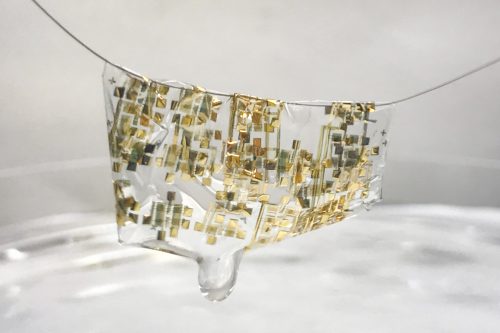
Photo by Bao lab, via Stanford University

Photo by Bao lab, via Stanford University

Researchers have developed a biodegradable polymer for electronics, which could complicate e-scrap recycling if it were ever adopted for widespread use.

Conducted by researchers from Stanford University, the University of California, Santa Barbara and Hewlett-Packard Enterprise, the study aimed to cut down on mounting volumes of e-scrap. The team approached that goal by developing a semiconductive polymer that would decompose, which the researchers said has not been produced before.

They also looked at the use of iron rather than gold as an electronic component. The study further explored a cellulose substrate material on which to mount the components.

“Using an ultrathin biodegradable substrate, we successfully fabricated polymer transistors and logic circuits that show high performance and are ultralightweight, but they can be fully disintegrable,” the team wrote in a paper on its findings. “Our work significantly advances organic materials to enable environmentally friendly and biointegrated electronic applications.”

The resulting electronic device was flexible and degradable using a weak acid such as vinegar, according to a Stanford news release.

The researchers noted their findings’ significance for certain electronics, including wearable technology and implants inside humans, as well as electronic monitoring devices that are dropped into remote areas.




Tags: Research
TweetShare
Colin Staub

Colin Staub

Colin Staub was a reporter and associate editor at Resource Recycling until August 2025.

Related Posts

UT Austin spinout Supra launches to recover rare earths

byScott Snowden
February 3, 2026

Supra Elemental Recovery launched today, aiming to recover gallium and scandium from US waste streams to help reduce import dependence...

Leveraging materials testing for procurement efficiency

byDr. Pradyumna Gupta
January 23, 2026

In real-world application, variations in resin properties translate into budget risk, from increased scrap rates and production downtime to premature...

Robot pilot targets legacy parts to help supply defense

Robot pilot targets legacy parts to help supply defense

byScott Snowden
December 29, 2025

Although chip availability has improved since the worst shortages earlier in the decade, Tuurny says demand for legacy electronics remains...

Chemical bonds

Alberta catalyst discovery targets hydrogen and plastics

byScott Snowden
December 10, 2025

A chance discovery inside a University of Alberta laboratory has developed into a Canadian cleantech project that aims to reshape...

Global recycling patent trends may reflect legislative push

Global recycling patent trends may reflect legislative push

byAntoinette Smith
November 25, 2025

Patent applications for chemical recycling technologies have reached a record high globally with government initiatives among the factors driving innovation,...

Study maps barriers to firms’ supply chain climate goals

byAntoinette Smith
October 14, 2025

Publicly articulating clear sustainability goals helps ensure company follow-through, according to an annual supply chain study from the Massachusetts Institute...

Load More
Next Post
No-landfill pledges collide with CRT realities in California

No-landfill pledges collide with CRT realities in California

More Posts

Rising containerboard demand comes as OCC prices taper

November 5, 2024
PET bales stacked for recycling.

Evergreen closing RPET plants in Ohio, New York

February 24, 2026

Paper giants foresee continuing rise in OCC prices

August 28, 2023

North American paper mills discuss demand, OCC pricing

May 15, 2023
Recycled plastic lumber firms report diverging results

Trex CEO to retire after 23-year run

February 25, 2026
Battery fire risk isn’t going away. Insurance is responding

Battery fire risk isn’t going away. Insurance is responding

February 24, 2026
Chinese processing group details goals for US visit

AMP lays out vision of next-generation, AI-driven MRFs

July 24, 2024
How will 2026 unfold for plastics recycling?

How will 2026 unfold for plastics recycling?

February 19, 2026

California selects Landbell USA as PRO for textile EPR

March 2, 2026

Recycling education needs consistency, simplicity 

February 25, 2026
Load More

About & Publications

About Us

Staff

Archive

Magazine

Work With Us

Advertise
Jobs
Contact
Terms and Privacy

Newsletter

Get the latest recycling news and analysis delivered to your inbox every week. Stay ahead on industry trends, policy updates, and insights from programs, processors, and innovators.

Subscribe

Welcome Back!

Login to your account below

Forgotten Password?

Retrieve your password

Please enter your username or email address to reset your password.

Log In

Add New Playlist

No Result
View All Result
  • The Latest
  • Analysis
  • Recycling
  • E-Scrap
  • Plastics
  • Policy Now
  • Conferences
    • E-Scrap Conference
    • Plastics Recycling Conference
    • Resource Recycling Conference
    • Textiles Recovery Summit
  • Magazine
  • About Us
  • Advertise
  • Archive
  • Jobs
  • Staff
Subscribe
This website uses cookies. By continuing to use this website you are giving consent to cookies being used. Visit our Privacy and Cookie Policy.