









This article originally appeared in the Winter 2021 issue of E-Scrap News. Subscribe today for access to all print content.
The first thing that might come to mind when you hear the term blockchain is Bitcoin, a cryptocurrency whose underlying platform is blockchain technology.
However, as more business leaders are coming to understand, blockchain technology is not limited to just the realm of digital money. It can serve multiple purposes in a variety of sectors, providing a platform to increase transparency, traceability and security in supply chain management and beyond.
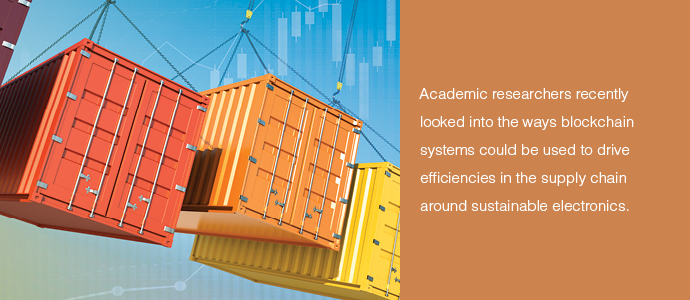
We recently undertook academic research focused on the potential use of blockchain in the supply chain related to electronics, specifically how the technology might aid stakeholders in efforts to meet requirements of the Electronic Product Environmental Assessment Tool (EPEAT) sustainability standard. The findings help underscore the ways in which blockchain could be leveraged in the electronics recycling and reuse ecosystem moving forward.
Already in use across the globe
The utilization of blockchain to enhance supply chain management has been evolving rapidly. For instance, projects such as VeChain have been used to track food safety. The TradeLens blockchain tool developed by Maersk and IBM is helping to build efficiencies in transportation networks.
Some recycling and waste management businesses have begun leveraging the concept as well. For instance, Agora Tech Lab, based in the Netherlands, initiated a blockchain pilot study with the municipality of Rotterdam, using the internet of things (IoT) for monitoring waste management details. A startup called Empower is using blockchain to try to bring more value to plastic waste at risk of becoming pollution across the globe.
Within the electronics recovery sector, HashCash Consultants has proposed a blockchain-based system in which governments, organizations and manufacturers would be able to track recycled assets. At the same time, stakeholders in North America recently formed the Open Blockchain for Asset Disposition Alliance (OBADA), a nonprofit organization with the goal of building the protocol blockchain best suited to the industry.
Potential benefits are not limited to supply chain issues. For example, blockchain has been used in Italy to encourage individuals to recycle their waste in exchange of digital tokens. These digital tokens in turn can be used for food and communication purchases. This program more than paid for itself, having saved nearly 21% of collection costs, according to media reports.
While the COVID-19 crisis has certainly forced new priorities to the fore for business and government leaders, excitement about the future of blockchain remains in various sectors. This is based on the technology’s potential to drive improved information sharing across supply chains and between organizations, better materials traceability, transparency into the supply chain, efficiencies in transactions between stakeholders, secure information, and overall improved governance. Cost savings, reputational benefits and additional revenue are all possibilities for organizations able to leverage blockchain effectively.
EPEAT-focused research
Still, although potential exists, broad-based adoption has yet to occur, especially among recycling stakeholders. We launched our research to try to better understand why that’s the case.
In our study, funded by the Alfred P. Sloan Foundation, we considered the barriers and potential for blockchain adoption in green and sustainable supply chains (some of our findings have been published in the International Journal of Production Research and the International Journal of Production Economics).
We looked at one specific application of blockchain technology: managing processes and information related to the EPEAT standard. Much of the work done by stakeholders in this realm is tied to the management of used electronic material.
The EPEAT standard is a hybrid governance system where specific governmental (public) standards are incorporated alongside private standards. We investigated how blockchain plays a role in the relationships of hybrid governance mechanisms and the adoption of sustainable supply chains using the electronics supply chain and EPEAT standards as a case study.
We sought to know: (i) how blockchain decentralization, security, transparency, traceability, and smart contracts influence the adoption of sustainability practices in supply chain networks; (ii) whether blockchain integration into governance mechanisms enables efforts to meet EPEAT standards or hinders them; and (iii) what external factors, such as regulations, could potentially influence a blockchain-based supply chain and its connection to sustainability practices.
We spoke with a variety of global electronics industry stakeholders to learn how they think blockchain technology can support various elements of EPEAT standards. These standards include corporate life-cycle assessment, end-of-life management and environmental management systems practices. EPEAT also includes meeting governmental regulatory standards such as the waste electrical and electronic equipment (WEEE) and restriction of hazardous substances (RoHS) directives in the European Union.
Our study included corporate managers, technology developers, standards developers, consultants and academics.
The various perspectives together paint a picture of possibilities, but we also believe that for blockchain to gain acceptance, its integration with emergent and existing technologies is needed.
Hesitancy and uncertainties
One major finding from our research is that stakeholders have some significant doubts about the overall efficacy of using blockchain to manage supply chain materials flow within electronics recycling.
In large part, the general skepticism about the technology is tied to the fact that most current blockchain implementations are immature and typically at just the proof-of-concept stage.
“Current use of blockchain is not fully understood and adopted,” one IT manager noted. “There are not many production systems out there actually fully using blockchain yet.”
In addition, companies are wary of the technology and want to keep a control of any blockchain validation process. To avoid having wrong information, companies need to have a good process in place to audit the information input to the blockchain and this auditing can be costly.
There is also a concern that technology platforms already in wide use, such as enterprise resource planning (ERP) systems, can perform the same functions as blockchain systems. Respondents also pointed out that blockchain is not foolproof when it comes to data accuracy.
“The blockchain might be a solution for aggregating some information, but you need to be willing to reveal information,” said one supply chain expert. “Whatever you enter into the blockchain can also be wrong. You cannot check this information either. So the credibility of the information is not getting better because we saw it on the blockchain.”
Blockchain has also been criticized because of its environmental issues surrounding its energy resources consumption. These negative environmental characteristics lead to circumspect evaluation and lack of trust associated with technology sustainability.
One respondent expressed belief new distributed ledger technologies are coming, and these will be more advanced, faster, cheaper, use less energy and have a smaller environmental footprint.
Multiple efficiency benefits
Nevertheless, it is clear to many within the electronics supply chain that blockchain can be a very important technology for standards verification.
Representatives from companies that must follow RoHS guidelines said that applying a blockchain system in their frameworks could make the compliance process faster, easier and more efficient overall. Blockchain records can show compliance, and deviations from the standard can be easily identified, they noted.
In general, respondents identified traceability and transparency as the most effective blockchain technology capabilities for end-of-life electronics management. End-of-life materials traceability is necessary not only for the source of these materials, but also for pinpointing their location at any given moment. One of the most difficult aspects of material and product stewardship is knowing the exact location of products and materials, respondents indicated.
Further, blockchain could lead to better efficiency for the administrative side of compliance activities. The application of standards can be very labor intensive or expensive to manage, and blockchain can reduce the need for human involvement while offering an integrative information tool. This could all lead to much-needed harmonization within the standards and regulatory ecosystems.
“I think blockchain will be fundamental to transforming the standards world, which will then be very helpful in advancing sustainability solutions,” noted one respondent “Right now, the sustainability standards are a patchwork across various parts of the value chain. They don’t work together; they’re not very interoperable.”
Transparency. meanwhile, includes knowing the origination, composition and state of materials within a supply chain. Offering more transparent information opens the opportunity to widen the supplier network, especially for organizations seeking suppliers who are compliant to end-of-life and processing rules and regulations.
Transparent information from blockchain data can also work for managing resources within returns and reverse supply chains, once again aiding in end-of-life resources management.
In some ways, blockchain technology can be likened to a magic wand for data control and management. With the swipe of a finger, a manager might have access to loads of reliable data points coming in real-time through sensors.
We believe that to make the magic happen, it is necessary to have well-constructed systems of interconnected electronic devices capable of sharing information with each other in a strategic way. This will require collaboration between various players in supply chains.
In some projects, developers have in fact linked mobile technology to blockchain technology to support broad-based materials tracing. For instance, a Kansas-based business called Farmobile helps farmers to improve the efficiency and profitability of their farms by integrating IOT with blockchain technology. Another example can be seen in ePac Flexible Packaging’s move to partner with RePurpose for plastic recycling using joint IOT-blockchain technology.
The complete package
We found in our research that although some blockchain characteristics can be replicated separately – and sometimes even more effectively – by other information systems, the complete blockchain capability package is where the value lies.
Blockchain, as a whole, is considered a new technology with the potential to revolutionize the current audit process, aid in tracing materials, tokenize and incentivize resource management practices, increase transparency, and centralize data pertaining to end-of-life materials management.
Its use in efforts geared toward electronics sustainability remains uncertain, but it’s clear that practices in this realm will continue to evolve, holding significant potential for more efficient ways of doing business.
Sara Saberi and Joseph Sarkis are faculty members at Worcester Polytechnic Institute’s Foisie Business School. Luis Kleinknecht is a Ph.D. candidate in business administration (entrepreneurship) who is working with Saberi and Sarkis. They can be contacted at [email protected], [email protected] and [email protected].