




Resource Recycling
  • The Latest
  • Analysis
    • All
    • Certification Scorecard
    • Industry Announcements
    • Opinion
    SK Tes on track to meet 2030 ITAD goal

    SK tes’ sustainability report offers window into ITAD

    Our top stories from February 2023

    ADS flexes new recycling capacity against resin spikes

    SCS launches chem recycling standard

    Certification scorecard — week of Sept. 28

    NJ’s PCR delay risks making its own excuse permanently true

    NJ’s PCR delay risks making its own excuse permanently true

    E-scrap magnet recycling company scales up

    Why only some rare-earth sources are economically viable

    e-Stewards to develop an ITAD-specific standard

    Certification scorecard — week of Sept. 21

  • Conferences
    • Resource Recycling Conference
    • Plastics Recycling Conference
    • E-Scrap: The Longevity Conference
    • Textiles Recovery Summit
  • Publications
    • E-Scrap News
    • Plastics Recycling Update
    • Policy Now
    • Resource Recycling
    • Other Topics
      • All Topics
      • Brand Owners
      • Critical Minerals
      • Glass
      • Grant Watch / RFPs
      • Markets
      • Organics
      • Packaging
      • Research
      • Technology
      • Textiles
Subscribe
No Result
View All Result
Resource Recycling
  • The Latest
  • Analysis
    • All
    • Certification Scorecard
    • Industry Announcements
    • Opinion
    SK Tes on track to meet 2030 ITAD goal

    SK tes’ sustainability report offers window into ITAD

    Our top stories from February 2023

    ADS flexes new recycling capacity against resin spikes

    SCS launches chem recycling standard

    Certification scorecard — week of Sept. 28

    NJ’s PCR delay risks making its own excuse permanently true

    NJ’s PCR delay risks making its own excuse permanently true

    E-scrap magnet recycling company scales up

    Why only some rare-earth sources are economically viable

    e-Stewards to develop an ITAD-specific standard

    Certification scorecard — week of Sept. 21

  • Conferences
    • Resource Recycling Conference
    • Plastics Recycling Conference
    • E-Scrap: The Longevity Conference
    • Textiles Recovery Summit
  • Publications
    • E-Scrap News
    • Plastics Recycling Update
    • Policy Now
    • Resource Recycling
    • Other Topics
      • All Topics
      • Brand Owners
      • Critical Minerals
      • Glass
      • Grant Watch / RFPs
      • Markets
      • Organics
      • Packaging
      • Research
      • Technology
      • Textiles
Subscribe
No Result
View All Result
Resource Recycling
No Result
View All Result
Home Plastics

The view from a plastics recycling trailblazer in Kenya

byJared Paben
April 18, 2023
in Plastics
The view from a plastics recycling trailblazer in Kenya
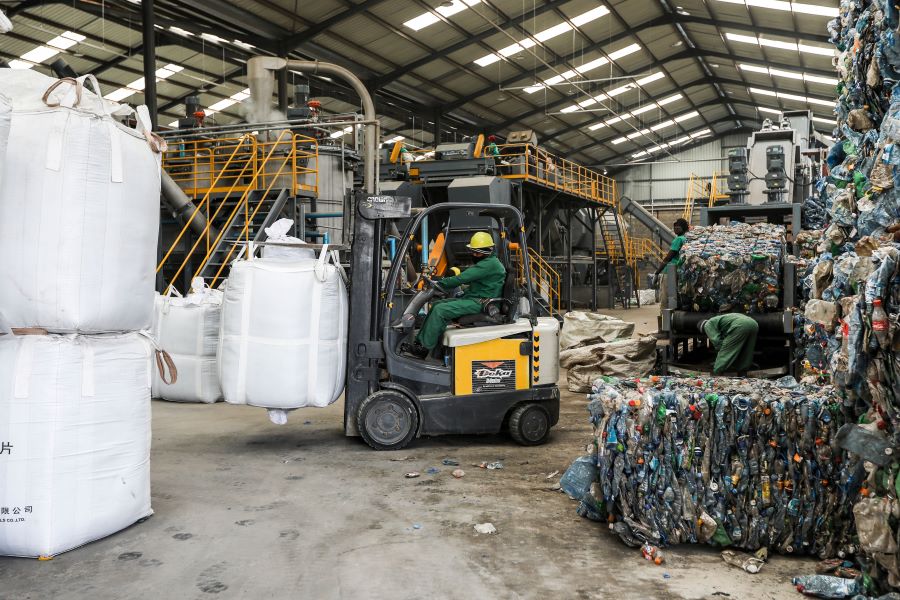
A view inside T3’s PET recycling facility, which produces hot washed flakes, in Athi River, Kenya. | Courtesy of T3 Limited

When it comes to PET bottle recycling in Kenya, a lot will sound familiar to North American audiences: demand for food-grade RPET outpaces supply, collection remains a challenge, and companies want to shorten supply chains. 

But other factors are unique, including the fact that the Kenyan government is still working on how it judges the safety of food-grade PCR. 

“It’s also very new territory for [regulators], and they’re just trying to find their way around it,” said Gurpreet Kaur Kenth, founder and chief operating officer of plastics reclaimer T3 Limited. 

In an interview with Plastics Recycling Update, she talked about recycling realities on the ground in the East African country.

In addition, she outlined her company’s move to purchase a Starlinger recoSTAR PET recycling and extrusion line for its plant in Athi River, which is about a half-hour drive from Nairobi, Kenya’s capital. It will be the first bottle-grade RPET production line in East Africa. 

The company’s operations

Owned by the Megh Group and founded in 2018, T3 (“Trash, Thread, Textile”) is already one of the largest PET reclaimers in the region. The company specializes in producing hot-washed PET flakes, Kenth said, with about 70% of the product going to food packaging and 30% to textiles – some flakes are fed to a sister company’s automotive upholstery business. 

For collection, the company relies on an expansive and varied network of informal sector suppliers, whom T3 pays for scrap. T3 also provides training for basic skills such as bookkeeping and money management. “Our primary goal is to formalize the informal sector by uplifting them,” she said. 

T3’s other goal is to achieve the environmental benefits of recycling, she said. With demand for RPET exceeding supply, it’s also good business. 

“As the recycling industry is growing globally, it’s also growing in Kenya,” she said. “Consumers are becoming more conscious and the demand for recycled material, it’s exponentially increasing right now.”

Currently, T3 primarily exports PET flakes to Europe, where converters produce bottle pre-forms for major beverage bottlers, including for Coca-Cola products. The Starlinger line, a nearly $7 million investment, will allow T3 to produce PCR locally for conversion into bottle pre-forms, said Kenth. 

Financing the system was challenging, especially in today’s uncertain finance environment in Kenya, where interest rates are rising three-quarters of a percentage point every few months, she explained. But along with debt financing, T3 received financing help from Swedish investor The World We Want Foundation (3W), she said. 

The system is scheduled to be installed and commissioned in the second quarter of 2024, she said. 

The need for regulations

Kenya currently has a voluntary producer responsibility organization framework through which some beverage companies, particularly international ones with sustainability commitments, pay to support PET recycling in the country. Founded in 2018, the Kenya PET Recycling Company is funded by voluntary contributions from retailers, packaging converters and beverage companies, including Coca-Cola. 

But Kenth estimated roughly one in five producers voluntarily contribute money to help finance PET recycling in the country.

Mandatory extended producer responsibility (EPR) regulations are on the way. National leaders have adopted the EPR policies, which should come into effect within weeks and will force producers to pay to help support PET collection and recycling, she said. 

It should help with collection, which Kenth said is “very erratic and the most challenging aspect of our business.” 

“We’re really hopeful that the EPR will and should change collection, because obviously you get to incentivize more, you get to buy the plastic at a higher price,” she said. “It becomes more attractive for them. They’ll get more plastic out of the environment.” 

Still, more regulations are needed, she said, particularly those requiring a minimum amount of recycled content in bottles. The multinational companies are interested in buying T3’s RPET to meet their internal targets, she said, adding that it will mean they don’t have to import material and can shorten supply chains. 

“A lot of people are preferring local supply chains and that will also be beneficial to us,” she said. 

But many local beverage producers aren’t interested, she said, pointing to a lack of awareness in the local beverage sector. Until the government mandates the use of RPET, she doesn’t see them purchasing PCR for bottles. 

In some ways, T3 is also ahead of government food safety regulations. Because Kenya hasn’t produced any of its own virgin or recycled plastic for food containers, it lacks food safety regulations and approvals akin to those from the U.S. FDA and the European Food Safety Authority (EFSA), both of which she called the “gold standard.” 

Leaders are working on those rules, but there’s no indication as to when they’ll finalize the draft standards, she explained. 

When asked how she can be confident investing $7 million when Kenya’s food safety RPET regulations haven’t been finalized yet, Kenth pointed to strong international demand for RPET – some driven by Europe’s recycled-content mandates – and T3’s good relationship with multinational companies. 

“At the end of the day, global demand versus supply will really be the reason why everyone is going to be investing in this industry,” she said. 
 

Tags: MarketsProcessorsTechnology
TweetShare
Jared Paben

Jared Paben

Related Posts

How to perform chip harvesting

How to perform chip harvesting

byDan Wang, Toyoshima Green Tech
October 1, 2026

Chip harvesting has grown from a Taiwanese factory-floor workaround into a global business, but the U.S. is barely in the...

Domestic e-plastics recovery picks up pace 

Domestic e-plastics recovery picks up pace 

byAntoinette Smith
September 30, 2026

Amid the current push to nearshore supply chains, e-plastics processors see opportunity – if handled correctly.

USFFI signs first film offtake deals

USFFI signs first film offtake deals

byAntoinette Smith
September 29, 2026

The brand-led group has moved more than 3 million pounds of flexible packaging from two California MRFs to reclaimers and...

Xscindo set to expand its data destruction tech

byPaul Lane
September 29, 2026

The company specializes in devices containing highly sensitive information, offering destruction combined with mineral recovery.

trash bags

Sorted: Should we use recycled trash bags?

byBrian Clark Howard
September 28, 2026

Manufacturers’ resistance is rooted in performance and cost, but the products may have an important role to play.

Cutting healthcare plastics could save $18B

Report provides path to reduce medical e-scrap

byPaul Lane
September 25, 2026

The European report found that circularity in medical devices is possible through several potential initiatives.

Load More
Next Post
Fire at Indiana plastics facility came after warnings

Fire at Indiana plastics facility came after warnings

2026 Buyers’ Guide

Equipment, services and technology suppliers serving the recycling industry.

Browse the Guide

More Posts

Newsom nixes recycled content claims bill

Newsom nixes recycled content claims bill

September 28, 2026
Analysis: Undersupply of PCR is ‘stifling’ brand goals

US lawmakers urge protection of domestic RPET

September 25, 2026
trash bags

Sorted: Should we use recycled trash bags?

September 28, 2026
Oregon state capitol building with state flag and blue sky.

NAW appeals Oregon EPR ruling

September 25, 2026
Recyclers reeling from NJ PCR extension

Recyclers reeling from NJ PCR extension

September 23, 2026
Domestic e-plastics recovery picks up pace 

Domestic e-plastics recovery picks up pace 

September 30, 2026
Diversion Dynamics: Policy needed to reach full charge for vape recycling

Disposable vapes banned in California

September 28, 2026
USFFI signs first film offtake deals

USFFI signs first film offtake deals

September 29, 2026
NJ’s PCR delay risks making its own excuse permanently true

NJ’s PCR delay risks making its own excuse permanently true

September 28, 2026
Cyclic launches commercial test of rare earth recycling tech

ERI investment to help fund Cyclic Materials expansion

September 29, 2026
Load More

About & Publications

About Us

Staff

Archive

Magazines

Work With Us

Advertise
Jobs
Contact
Terms and Privacy

Newsletters

Get the latest recycling news and analysis delivered to your inbox every week. Stay ahead on industry trends, policy updates, and insights from programs, processors, and innovators.

Subscribe

Welcome Back!

Login to your account below

Forgotten Password?

Retrieve your password

Please enter your username or email address to reset your password.

Log In

Add New Playlist

No Result
View All Result
  • The Latest
  • Analysis
  • Recycling
  • E-Scrap
  • Plastics
  • Policy Now
  • Conferences
    • E-Scrap Conference
    • Plastics Recycling Conference
    • Resource Recycling Conference
    • Textiles Recovery Summit
  • Magazines
  • About Us
  • Advertise
  • Archive
  • Jobs
  • Staff
Subscribe
This website uses cookies. By continuing to use this website you are giving consent to cookies being used. Visit our Privacy and Cookie Policy.