












Resource Recycling
  • The Latest
  • Analysis
    • All
    • Certification Scorecard
    • Industry Announcements
    • Opinion

    From CES to the shredder: What 2026 PCs mean for ITAD

    Certification scorecard for week of Jan. 12, 2026

    Industry announcements for January 2026

    Certification scorecard for Dec. 18-30, 2025

    Certification scorecard for Dec. 18, 2025

    Industry announcements for the week of Dec. 15

    Certification scorecard for December 10, 2025

    Industry Announcements for Week of December 8

    Certification Scorecard for December 3, 2025

  • Conferences
  • Publications

    Other Topics

    Textiles
    Organics
    Packaging
    Glass
    Brand Owners

    Metals
    Technology
    Research
    Markets
    Grant Watch

    All Topics

Subscribe
No Result
View All Result
Resource Recycling
  • The Latest
  • Analysis
    • All
    • Certification Scorecard
    • Industry Announcements
    • Opinion

    From CES to the shredder: What 2026 PCs mean for ITAD

    Certification scorecard for week of Jan. 12, 2026

    Industry announcements for January 2026

    Certification scorecard for Dec. 18-30, 2025

    Certification scorecard for Dec. 18, 2025

    Industry announcements for the week of Dec. 15

    Certification scorecard for December 10, 2025

    Industry Announcements for Week of December 8

    Certification Scorecard for December 3, 2025

  • Conferences
  • Publications

    Other Topics

    Textiles
    Organics
    Packaging
    Glass
    Brand Owners

    Metals
    Technology
    Research
    Markets
    Grant Watch

    All Topics

Subscribe
No Result
View All Result
Resource Recycling
No Result
View All Result
Home Resource Recycling Magazine

After the MRF: How batteries can come back to life

byRaghav Mecheri
October 18, 2023
in Resource Recycling Magazine

This article appeared in the September 2023 issue of Resource Recycling. Subscribe today for access to all print content.
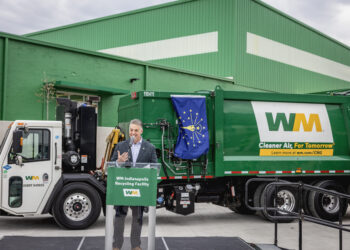
As record-high numbers of batteries enter the solid waste stream, they have increasingly become associated with facility fires, safety issues and danger to workers. Last year saw more than 2,000 fire incidents in the recycled materials industry in the U.S. and Canada alone. With global demand for lithium-ion batteries projected to increase 500% by 2030, our industry has moved rapidly to head off the growing crisis.

Battery retrieval

Because detecting and removing batteries has been impractical given their size and the burden depth of incoming material, we have until now dealt with battery fires by using flame-suppression systems. New AI-powered systems such as BinIt Hazard are changing that by using automated monitoring of feed lines to enable the preventative removal of batteries and other hazards from our waste streams. BinIt uses X-ray imaging to identify common battery types as well as other dangers such as gas tanks with almost 100% consistency.
The transition from a reactive approach to the new proactive, extraction-based model offers a new opportunity and presents the industry with a new question: “What do we do with all the batteries we’re removing from waste streams?” For at least two reasons, the answer lies in recycling. First, batteries are difficult to dispose of safely. And second, we need the raw materials.

Lithium already plays a crucial role in the battle against climate change thanks to its capacity for powering electric vehicles, but less than 5% of all batteries are ever recycled. The rapidly emerging battery recycling industry aims to move the needle on that statistic. Its first challenge is procuring feedstock in large enough volumes to generate short-term scale as we work toward establishing longer-term battery pipelines.

Where are all the batteries?

Most batteries end up in everyday household waste streams. That means consumer education is a top priority, and the good news is that Congress has allocated $10 million toward battery recycling best practices and $15 million for battery labeling guidelines, both to be enacted through the EPA.

In the meantime, a parallel course of action will focus on better detection and removal. Early field data from BinIt Hazard suggests that between 15 and 30 lithium-ion batteries are passing undetected through each recycling facility on a daily basis. Common lithium-ion batteries can weigh anywhere from 10 to 50 pounds, but conservatively, we estimate that at least 150,000 pounds of lithium-ion batteries are moving through North America’s 1,000 or so materials recycling facilities every 24 hours. Even at the modest buyback rate of 25 cents per pound, that’s a staggering $15 million revenue opportunity.

The EPA is currently in the second year of the Solid Waste Infrastructure for Recycling grant program, which allocates $55 million annually to improve recycling processes across the country. Our low-end estimate for revenue from recaptured lithium is equivalent to more than a quarter (27%) of that annual grant from the EPA – and unlike government grant funding, battery retrieval revenue will increase exponentially as EV adoption increases.

What next?

Right now, we can reliably identify and remove batteries from waste streams, and we have a rough sense of the size of the potential market for recovered materials. The next steps will bring new challenges, from understanding the demand for this newly precious commodity to devising a method to safely pack and transport batteries from our facilities to the appropriate recyclers.
One thing is certain, however. As materials like lithium, cobalt, and nickel become increasingly important to global supply chains, including them in the circular economy is becoming exponentially more valuable in both ecological and economic terms. The White House has declared that securing a made-in-America supply chain for critical minerals is a matter of national security. And while community education will remain a vital priority, it is essential that we also have reliable workflows to handle the 68% of material that is not correctly recycled.

Today, building technology that empowers recyclers to detect and remove materials such as lithium-ion batteries is predominantly a safety issue. Over the coming decade, however, it may well become a foundational responsibility for our industry – one demanding that we rise to the occasion with innovative new technologies, strong industrial processes and bold visions for the future.

Raghav Mecheri is the CEO of BinIt, a company that builds AI-powered recycling infrastructure. He can be contacted at [email protected].

This article appeared in the September 2023 issue of Resource Recycling. Subscribe today for access to all print content.

TweetShare
Raghav Mecheri

Raghav Mecheri

Related Posts

Aduro reports losses, will pick site for demo plant by end Jan

byAntoinette Smith
January 16, 2026

Canada-based Aduro Clean Technologies plans to finalize site selection, with options including a Dutch site, amid higher quarterly revenue but...

EU contributes €6 million toward textile DRS pilot

byAntoinette Smith
January 16, 2026

The TexMat pilot project will test a deposit return system featuring automated textile collection bins to accompany the rollout of...

Houston, MRF operator sign chemical recycling MOU

CompuCycle CEO: Transparency drives electronics diversion

byStefanie Valentic
January 16, 2026

As Houston's role as a major port city raises concerns about electronics being exported overseas for processing, CompuCycle CEO Kelly...

From CES to the shredder: What 2026 PCs mean for ITAD

byDavid Daoud
January 15, 2026

Some of the most operationally relevant CES 2026 announcements for the e-scrap sector focused less on peak performance and more...

Emerald joins effort to boost film, flexibles recycling

byAntoinette Smith
January 15, 2026

In an interview, Emerald's CEO said the company became the first packaging manufacturer to join the US Flexible Film Initiative,...

Certification scorecard for week of Jan. 12, 2026

byEditorial Staff
January 14, 2026

These facilities have achieved, renewed or otherwise regained certification recently.

Load More
Next Post

Data Corner: US fiber, plastic exports decrease

More Posts

paint cans recycling

PaintCare brings stewardship to Illinois, Maryland on deck

December 19, 2025
Mitsubishi Materials buys into Elemental e-scrap pact in US

Mitsubishi Materials buys into Elemental e-scrap pact in US

December 19, 2025
#PRC2026 Speaker Spotlight: Joel Morales

#PRC2026 Speaker Spotlight: Joel Morales

December 22, 2025
Panel tracks shifts in e-scrap as policy, AI reshape

Panel tracks shifts in e-scrap as policy, AI reshape

December 22, 2025
Robot pilot targets legacy parts to help supply defense

Robot pilot targets legacy parts to help supply defense

December 29, 2025
Solar recycling ramps up in NY with new pickup service

Solar recycling ramps up in NY with new pickup service

December 23, 2025
State policy drives tire recycling investment in Southeast

State policy drives tire recycling investment in Southeast

December 23, 2025
New Hampshire makes progress on waste goals

New Hampshire makes progress on waste goals

December 22, 2025
Federal PACK Act aims to preempt ‘patchwork’ of state laws

Federal PACK Act aims to preempt ‘patchwork’ of state laws

December 23, 2025
APR year in review

APR year in review

December 30, 2025
Load More

About & Publications

About Us

Staff

Archive

Magazine

Work With Us

Advertise
Jobs
Contact
Terms and Privacy

Newsletter

Get the latest recycling news and analysis delivered to your inbox every week. Stay ahead on industry trends, policy updates, and insights from programs, processors, and innovators.

Subscribe

Welcome Back!

Login to your account below

Forgotten Password?

Retrieve your password

Please enter your username or email address to reset your password.

Log In

Add New Playlist

No Result
View All Result
  • The Latest
  • Analysis
  • Recycling
  • E-Scrap
  • Plastics
  • Policy Now
  • Conferences
    • E-Scrap Conference
    • Plastics Recycling Conference
    • Resource Recycling Conference
    • Textiles Recovery Summit
  • Magazine
  • About Us
  • Advertise
  • Archive
  • Jobs
  • Staff
Subscribe
This website uses cookies. By continuing to use this website you are giving consent to cookies being used. Visit our Privacy and Cookie Policy.