



This article appeared in the April 2022 issue of Resource Recycling. Subscribe today for access to all print content.
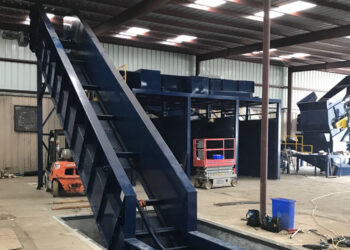
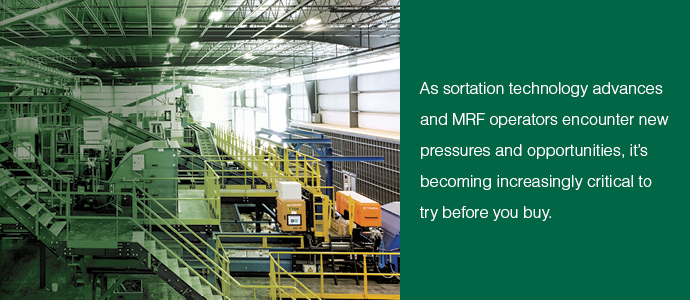
Sorting technology plays an integral role in the efficient capture of recyclable material. It helps increase both the quantity and quality of material moving through a materials recovery facility (MRF) while at the same time reducing the amount of manual intervention.
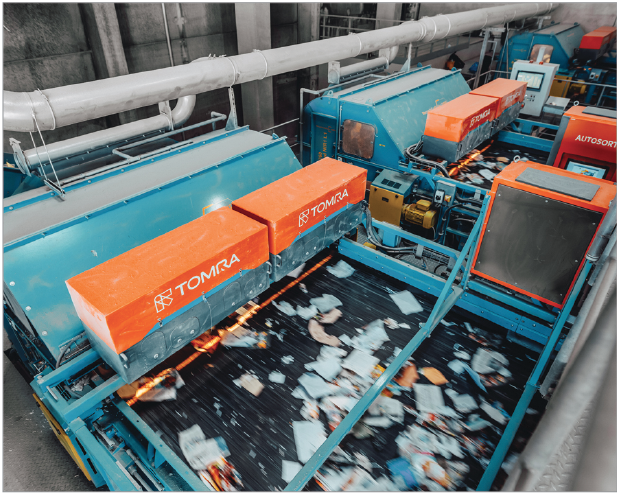
Today, plant builders are moving optical sorting equipment further upstream to help sort fiber materials. At the same time, higher resolution cameras, artificial intelligence (AI) and data harvesting can all be integrated into a single unit to maximize sorting flexibility and limit space requirements.
As sortation capabilities continue to evolve, equipment buyers are finding that testing plays a key role in selecting the right technology. TOMRA, for instance, now conducts roughly 600 tests annually at its test facility in Mülheim-Kärlich, Germany. And VAN DYK Recycling Solutions operates North America’s largest test center, which is located in Norwalk, Conn. and serves waste processors as well as industry stakeholders, including brand owners.

In this article, we’ll outline a handful of industry trends that are pushing forward the evolution of sortation machinery and adding to the importance of equipment testing.
Positive upstream sorting
Historically, fiber grades have accounted for most of the material volume at North American MRFs. While this continues to be the case, stream trends show less newspaper and more old corrugated containers (OCC) and smaller boxboard.
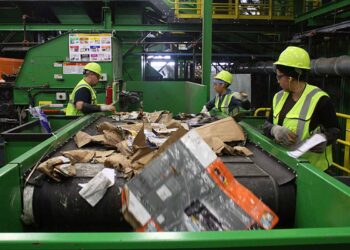
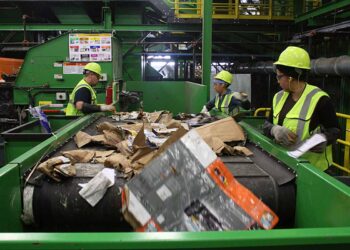
As most contaminants occur in the smaller material fractions, newer MRF designs place optical sorters further upstream to remove impurities from the fiber. This helps to reduce manual sortation and lower costs.
In many of these sort systems with an upstream fiber emphasis, material smaller than 6 inches is screened out and run through an optical sorter. Rather than a negative sort that ejects contaminants, the sorter is programmed to positively sort and eject the fiber, creating a much cleaner paper product.
Key to this trend is a breakthrough in air booster technology that allows higher conveyor speeds (at approximately 900 feet per minute). Air boosters – in both enclosed and open-conveyor designs – stabilize light materials on these high-speed conveyors.
For MRF systems configured in a more traditional layout, newer add-on optical sorter technology can help clear impurities from the fiber stream. For instance, laser detection removes glass and black plastic from paper that near-infrared technology cannot detect.
Not surprisingly, a number of different tools can be used to achieve these fiber objectives, and testing different options allows an operator to develop a customized sort strategy.
Wide use of artificial intelligence
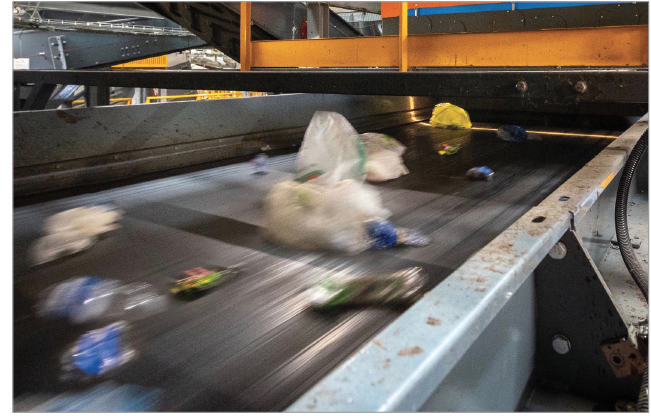
The use of artificial intelligence (AI) is rapidly evolving in the recycling industry, but there is a misperception among some recyclers that they must select a robotic arm sorter to leverage the benefits of AI. In actuality, optical sorters also incorporate AI functionality and offer the benefit of higher throughput rates.
Working with a technology supplier during testing can allow MRFs to gain AI advantages with optical sorters. All recycling AI solutions contain the same four components – a machine, a sensor for detecting different material fractions, a processing unit to identify what the sensor “sees,” and an ejection method.
The primary difference between robotic arm AI units and optical AI units lies in the means and speed of material separation.
While optical sorters have incorporated forms of AI for decades, newer optical sorter designs now use the deep learning subset of AI for classification in data processing. Massive data sets allow the sorters to “see” materials on the belt like a human with the added benefit of improving sort speeds. Today’s optical sorters with deep learning can complete more complex sorting tasks with higher purity rates.
MRFs looking to upgrade their systems and leverage the advantages offered by AI can often do so without adding to the facility’s footprint. Feeder belt sensor add-ons and software updates can upgrade existing optical sorters without changing the layout or significantly disrupting operations.
Data insight
MRF equipment suppliers now offer cloud-based platforms that harvest processing data from optical sorters, balers and many other plant components.
These programs allow recyclers to review critical operating data, including shift reports, amount and type of material processed, line stoppage, and shift production totals. All this provides managers the means to remotely analyze performance metrics and proactively manage machines for performance optimization.
Digitized material and production metrics also enable MRF operators to identify trends that can aid in planning and forecasting, including when different types of materials are typically received and in what quantities. This can further help to manage material flow, tipping floor practices and material loading to maximize efficiency.
Further, through customized reports and alerts, data systems help to proactively manage condition-based maintenance, parts ordering and servicing. Notifications can be enabled to alert service personnel when a component is at the end of its typical service life to avoid unexpected circuit downtime.
By testing before purchase, an operator can understand how different pieces of equipment can enhance data metrics and reporting. Processors can also gain a deeper understanding of the wider possibilities in this evolving segment of the industry.
partners to develop sortation systems capable of adapting to evolving legislation.
Advanced sorting of plastics
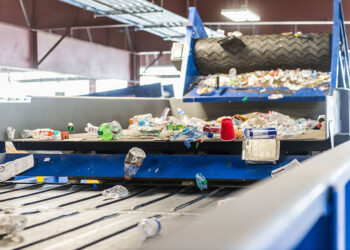
Pressure continues to mount on producers to use circular packaging. As a result, demand has been rising in North America for high-quality plastic flake, and testing facilities are installing flake sorting equipment to demonstrate developments in advanced sorting technology.
Increased demand in North America mirrors the global rise in flake sorting. In response to the trend toward quality systems that achieve high purity rates, TOMRA opened a new test center in Parma, Italy. It is dedicated to plastic flake sorting, specifically the development of new applications and solutions for polyolefin and polyethylene terephthalate (PET) flake sorting.
The facility tests recovery of PET and polyolefin plastic flake as small as 0.079 inches (2 millimeters) to help recycling plants successfully generate higher-quality plastic output. VAN DYK recently installed a plastic flake sortation unit to its testing line, and several companies have taken advantage of the opportunity to test their material.
EPR impacts
Legislation trends can have a considerable impact on the dynamics of recycling. When testing technologies, it’s now more important than ever to consider a system’s adaptability.
As has been discussed at length in this publication and elsewhere, several states are adopting an extended producer responsibility (EPR) framework for packaging to attempt to bring balance to a municipal system that has at times struggled from economic fluctuations.
EPR shifts the burden of covering the cost of recycling to producers, in theory incentivizing those with the most control over packaging design to select packaging that can effectively be recycled and to incorporate more recycled content into their packaging. Under EPR, producers manage the full life cycle of their packaging, including covering the costs for the collection, sorting, recycling and disposal of their products.
High-performing EPR systems typically include targets for collection, recycling and recycled content. Mandated targets are the critical driver for increasing both the quantity of material brought into the system, as well as for recycling facilities to produce a cleaner, more valuable product.
MRF operators should work closely with their associations, technology providers and plant building partners to move toward processing systems capable of adapting to the demands and opportunities tied to legislation.
Big brand attention
Heightened consumer awareness and pressure have retailers demanding more recycled packaging on their shelves. Meanwhile, brand owners are detailing higher recycled content targets for their packaging.
As a result, new packaging and label designs are regularly being run through test facilities. The trials ensure existing sorters will be able to detect the material and get it to the right place at the MRF (rather than treating it as a contaminant). This is one way brand owners are working to help improve sortation efficiency.
Confluence of forces
Changing legislation to improve fiber and plastic circularity. Advancements in sorting technologies and MRF designs. Emerging uses of AI.
As packaging formats and materials become increasingly complex and producers see pressure to meet higher standards over time, the case for testing becomes even more of a business imperative.
All segments of the value chain are working to push the needle on circularity. Testing with a trusted technology provider can help to prove out a concept, validate performance and maximize the return on investment.
Andre Lehmann, based in Germany, is the recycling test center manager for TOMRA Recycling. He can be contacted at [email protected]. Alex Wolf is the technical director for VAN DYK Recycling Solutions and can be contacted at [email protected].
This article appeared in the April 2022 issue of Resource Recycling. Subscribe today for access to all print content.