













This article appeared in the December 2020 issue of Resource Recycling. Subscribe today for access to all print content.
Now more than ever, individuals are looking to their city and state officials to provide leadership on critical issues. The growing amount of residential waste is certainly one of these important points of focus.
The past eight months have seen an incredible uptick in both the use and the disposal of packaging that is critical for us to function within our current socially distant way of life. Much of this packaging is made using material that is indeed recyclable, if it can be handled properly.
Cities and states should use the noted increase in plastic waste, triggered by the COVID-19 pandemic, as an opportunity to review their current policies, procedures and goals surrounding recycling. Implementing or upgrading recycling systems can be impactful to communities across the nation. These opportunities and solutions to increase recycling rates are truly more effective than simply banning valuable products that we rely on every day.
Evolving with waste stream realities
COVID-19 has changed consumer behaviors considerably. Americans are turning to delivery services more than ever before, with the U.S. Department of Commerce reporting that e-commerce sales grew more than 30% between the first and second quarter of 2020. With the push for online shopping comes a push for increased packaging.
Packaging also plays a vital role in keeping brick-and-mortar businesses open. For example, both restaurateurs and diners alike rely on curbside pickup and delivery services to support local establishments during pandemic-related restrictions to indoor services.
Demand has also surged for increasingly important applications within health care packaging and disposable products, as care facilities manage increased patient loads and virus transmission abatement.
Currently, curbside recycling programs are often limited in the materials that they can actually accept and recycle. This makes sense: Traditional recycling systems and methods can be hamstrung by contamination in both mixed and sorted material due to the resulting degradation of otherwise valuable commodities. This degradation often leads to “downcycling” and the added necessity of having to supplement with virgin materials.
Unfortunately, due to their inability to sort or clean some contaminants, traditional recycling methods of the past have not allowed for recycled material to be reused in food contact applications such as cups or food packaging. Traditional recycling methods are a good start, but they fail to accommodate the modern components of the growing waste stream. Luckily, there are ways in which we can drastically improve these existing systems.
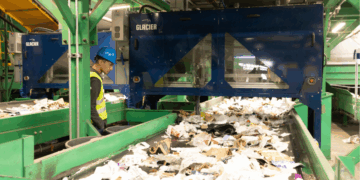
 Citizens rely on their community leaders for ensuring that proper recycling infrastructure is in place to process waste responsibly. Often, a productive first step is simply to conduct a waste audit to quantify the volume and content of both the waste and recycling streams. These audits establish baseline data and drive decision-making, ensuring cities are setting goals and promoting policies in areas with the greatest impact. According to The Recycling Partnership, 74.5% of Americans are willing to pay more taxes for better recycling. A proper waste audit ensures that these dollars are put to work on the most effective solutions.
An unparalleled option
While communities should certainly look to optimize existing systems, they should also be aware of the many innovative new technologies that have the potential to raise the recycling bar through a closed-loop system.
Using technologies classified as advanced plastics recycling (also sometimes called chemical recycling), plastic resins are converted back to their original raw material. Previously, the building blocks for polymers could come only from fossil fuels. But technological innovation has now created a new generation of circular pathways to the same high-quality material.
Since there is no degradation of the polymers in this process, the process can be infinitely repeated, keeping the same material in the loop for continuous reuse. Additionally, since this technology allows for purification of the raw material back to levels equal with fossil fuel-produced monomers, recycled content produced by these means can be safely used for food and medical applications.
As a result of this technology development, there could be a significant decrease in greenhouse gas emissions, pollution and overall waste associated with society’s use of plastics.
And this conversation is now more critical than ever. As the demand for affordable, high-performance materials and sustainable solutions continues to grow, closed-loop recycling solutions offer an unparalleled option for achieving a thriving economy as we continue to manage the realities of COVID-19.
Possibilities in polystyrene
To understand the implications of advancements in the advanced plastics recycling realm, we can look at one plastic type as an example: polystyrene, or PS.
The inherent properties of PS are so well suited for advanced recycling that it is leading the way in adoption of groundbreaking processing methods. Polystyrene’s unique chemical makeup allows it to be easily sorted from other polymers using infrared sorting technology. In addition, PS is made of only one monomer (or base raw material), which exists in liquid form at ambient conditions, making it easy and economical to transport and process.
Often, single-use and packaging plastics are contaminated with food or they require varying processing temperatures if they do get recycled, due to there being many differently shaped items in the stream. Such barriers prevent traditional methods of collection or recycling. However, PS advanced recycling facilities can accept increased contamination rates and can process many different PS items simultaneously, regardless of size or shape.
PS is commonly used in packaging and foodservice applications due to its strength, stability and other important properties. Think of coffee in a PS foam cup – it keeps the liquid inside hot while the hands of the drinker stay comfortably cool. This is often combined with a sturdy, rigid PS lid. All of this material can be thrown into a recycling bin together. Once collected and moved to a processing operation, the PS can be remade, via recycling technologies, into another cup and lid, over and over again.
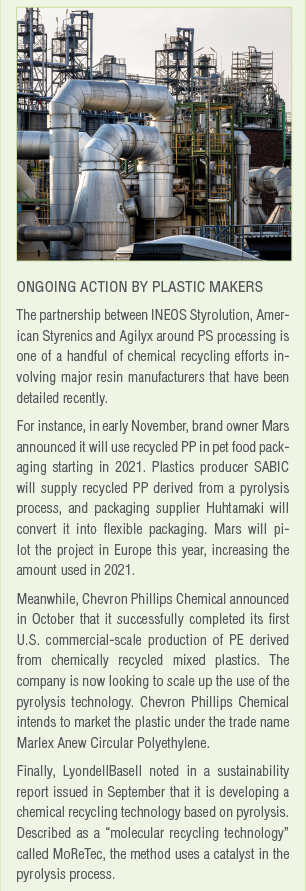
PS resin producers are leading the charge in development and adoption of PS advanced recycling technologies. For example, INEOS Styrolution, along with American Styrenics, has partnered with Agilyx to build a commercial scale advanced recycling PS facility on INEOS Styrolution’s existing production site in Channahon, Ill.
The new facility will be capable of turning up to 100 tons of polystyrene waste per day into new polystyrene. The operation will use pyrolysis technology developed by Agilyx to process polystyrene into virgin-equivalent styrene monomer. Tigard, Ore.-based Agilyx will also be responsible for sourcing and supplying plastic for the facility, through a new subsidiary called Cyclyx.
Innovation and implementation
Polystyrene is a great example of the opportunities available when we choose to invest in and improve our recycling infrastructures. While this material has not been widely adopted by existing programs, it offers exceptional polymer performance along with truly unrivaled recyclability and circularity.
The story of polystyrene also stands to model how an industry and its stakeholders can come together to develop real innovation and implement real solutions.
As we climb out from behind the shadow of COVID-19, Americans are more pragmatic and eager to collaborate on key issues threatening our environment and ourselves. Communities and their leaders who want to unify under reduced dependence on fossil fuels and landfills should focus on what the future has to offer.
Shattering outdated conceptions of what our recycling systems can do is imperative for truly reaching our common goal of a clean, healthy and thriving future.
Cassie Bradley is INEOS Styrolution’s sustainability and circular economy commercial manager, leading these initiatives for the company across North America. She can be contacted at [email protected].