










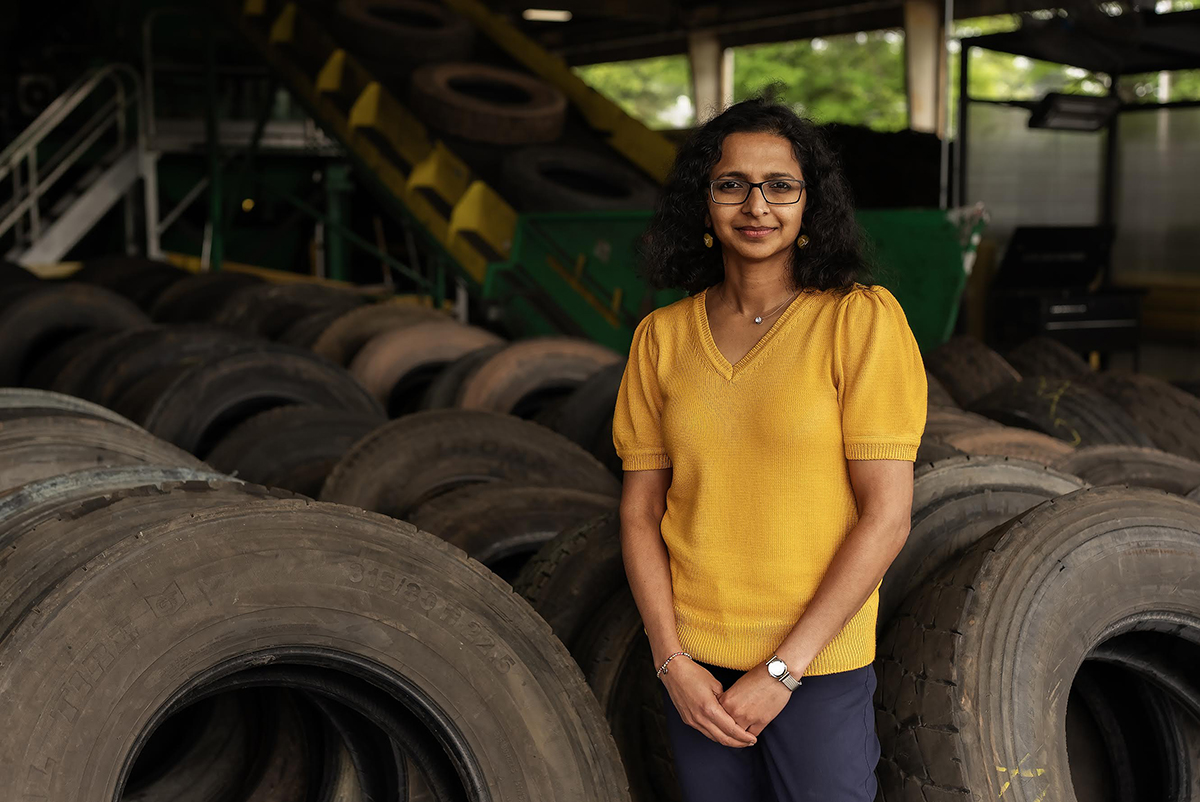
A warm welcome back to “Women in Circularity,” where we shine a light on women moving us toward a circular economy. This month, I was delighted to connect with Shweta Srikanth, a leader in sustainable materials innovation and circular design. Shweta is the chief circularity officer at Ecore International – a company known for transforming reclaimed materials into high-performance surfaces that support healthier, more sustainable built environments. With more than 15 years of experience in strategy, transformation and sustainability across industrial and healthcare sectors, Shweta brings a solutions-driven perspective to advancing circularity through science, innovation and practical implementation.
You’ve built a career at the crossroads of materials science and circular innovation. What first sparked your interest in this work and what keeps you engaged?
I often say I didn’t set out to build a career in circularity — circularity found me. Growing up, my upbringing and culture instilled a natural inclination toward minimizing waste and finding value in what others may overlook. Over time, these instincts became small personal experiments: writing a recycling blog, standing up recycling programs at previous employers, and constantly tinkering with ways to make systems more efficient. None of it was part of my “job description,” and sustainability certainly wasn’t a formal career path at the time, but it became a passion I gravitated toward.
When the opportunity at Ecore arose — a chance to align my professional background in innovation, materials science and business strategy with the impact I’d long cared about — I knew it was the moment to turn that passion into my life’s work. I’m genuinely fortunate to work at a company where “doing well by doing good” isn’t a slogan but a business model.
What keeps me engaged is the people and the purpose. My colleagues at Ecore are deeply committed to this journey. They’ve signed up for work that is often ambiguous, technically complex and still evolving as an industry. Yet they approach it with conviction and creativity because we all believe the outcome is worth it.
And the impact is real. Today at Ecore, we reclaim and transform hundreds of millions of pounds of rubber into high-performance surfaces each year — demonstrating that materials once dismissed as waste can become strategic assets. Knowing that our efforts keep material out of landfills, reduce emissions, and enhance the spaces where people live, learn, heal and play is incredibly motivating. It’s the rare kind of work where the business case and the environmental case strengthen each other and that alignment continues to inspire me every day.
Your work spans research, entrepreneurship and community engagement — what aspect of your impact are you most proud of, particularly when it comes to shifting mindsets or driving real-world change?
It’s difficult to single out one dimension of my work, because the real impact happens at the intersection of research, entrepreneurship, partnership and community engagement. Each reinforces the other. I am helping shift the conversation from “recycling is a nice-to-have strategy” to “circularity is the core business model.” For a long time, sustainability lived on the margins of organizations — important, but often disconnected from strategy, operations or product innovation. Much of my career has been about bringing it to the center.
At Ecore, that shift is fully realized. Circularity isn’t a side project, it’s embedded into how we design products, source materials and plan for end of life. Our TRUcircularity takeback program is a great example — working with schools, fitness centers, hospitals and other partners to demonstrate that closing the loop on rubber isn’t just technically feasible, it’s commercially compelling. When organizations see that they can meet regulatory requirements, strengthen their sustainability story, and keep materials in use through a single, streamlined program, their mindset moves from “Is this possible?” to “Why wouldn’t we do this?”
I’m also energized by how openly the industry now engages with these ideas. Sharing our work and progress with other practitioners sparks questions, critiques and creative ideas we may not have considered — pushing the whole sector forward. Ecore’s entrepreneurial, fail-fast model gives us the flexibility to test those ideas quickly and iterate in the problem-solution space. If I’m proud of anything, it’s helping build momentum for a new way of thinking — one where circularity is not an aspiration, but an operational reality.
Across your various initiatives, is there one project that truly showed you what’s possible when technology and circular thinking come together?
Ecore’s TRUcircularity takeback program is the strongest proof point of what becomes possible when strategy and circular design are fully aligned. By building a closed-loop system that allows us to reclaim rubber surfacing at the end of its life, process it in our US-based facilities and reintroduce it into high-performance products — often for the very same types of spaces where it began — we’ve demonstrated that circularity can be both operationally viable and commercially valuable.
One project in particular crystallized this potential: the takeback of an athletic track in Tennessee. It was the first time we attempted to reclaim rubber from an outdoor installation, and we went into it without a clear understanding of the level of dirt, contamination and complexity we’d encounter. Processing that material at our York, Pennsylvania, facility required us to adapt quickly, refine our systems and challenge some long-held assumptions. In doing so, we turned a corner — both technically and culturally. The “contamination fear factor” diminished and internal operational buy-in grew significantly.
The success of that project opened doors across the business. We’ve since expanded to other types of outdoor surfacing with increasing efficiency and confidence. On the product innovation side, our team modified formulations to incorporate reclaimed track material into existing product lines and ultimately into another business unit’s portfolio. Circularity became the bridge connecting parts of the organization that historically operated in silos. Sales teams began identifying new cross-functional opportunities, and the project sparked a shared sense of excitement about what could scale next. In many ways, this was a cornerstone initiative — a confidence builder, a marketing anchor, a revenue enabler and ultimately a revenue generator. It proved that when you combine strategic clarity with circular thinking, you can unlock all of the possibilities.
Looking ahead, what emerging trend in materials or circular design do you think will shape the next decade of sustainability innovation?
I see three interconnected trends that will define the next decade of circular innovation: designing for many lives, data-rich circularity and cross-value-chain collaboration.
First, we’re moving beyond “recycled content” as a standalone metric toward designing products for multiple life cycles. The future is about intentionality at the concept stage — thinking about disassembly, material compatibility, modularity and future reuse before a product even exists. Designing for many lives will fundamentally change how we evaluate performance, durability and value.
Second, digital tools will make circularity more measurable, transparent and actionable.
Whether through advanced tracking of material flows, real-time lifecycle data or improved emissions modeling, we’re entering an era where circular outcomes can be quantified with far greater precision. That level of insight will support smarter regulation, more informed customer choices, and better-aligned incentives across the system.
Finally, circularity is a team sport. No organization can scale it alone. The next wave of progress will come from deep collaboration up and down the value chain — manufacturers, suppliers, recyclers, customers and even competitors working together. That includes leveraging each other’s expertise, co-developing solutions and in some cases becoming the end market for one another’s recycled materials. These interconnected partnerships will be essential for creating the scale and stability needed for circular systems to thrive.
Together, these trends will accelerate the shift from circularity as a “program” to circularity as a fully integrated, data-driven, multi-stakeholder way of doing business.
Is there a podcast you can recommend to others who also enjoy exploring big ideas?
One resource I find myself returning to often is the Ellen MacArthur Foundation’s Circular Economy Show podcast. Many of their recent episodes dig into one of the biggest challenges we all face: how to scale circularity in a practical, durable way. I appreciate hearing how leaders in other sectors are navigating similar obstacles, experimenting with new models and pushing the boundaries of what’s possible. Those conversations often spark ideas for what we might test or implement at Ecore, and they serve as a reminder that while our industries may differ, the underlying challenges — and opportunities — are shared.
MaryEllen Etienne is the creator of “Women in Circularity.” Etienne works on the Market Transformation and Development team for the US Green Building Council. She has over 20 years of experience in sustainability and is a champion of the circular economy.