












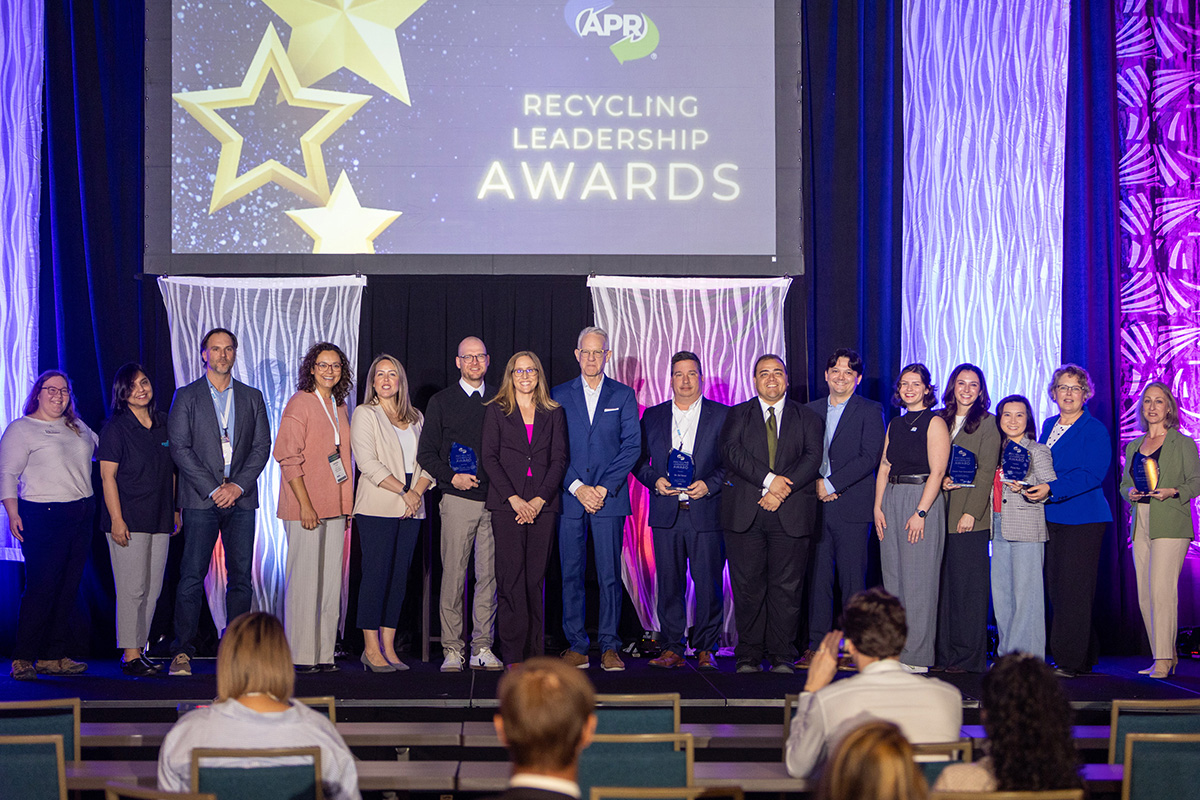
Researchers, policymakers and companies working in plastics recycling were recognized during the closing plenary of the Plastics Recycling Conference, where speakers highlighted innovation across the sector while acknowledging persistent market challenges.
The session honored winners from research competitions and the Association of Plastic Recyclers (APR) Recycling Leadership Awards while conference organizers used the moment to reflect on the industry’s progress and the work still ahead.
Marisa Adler, who coordinated the co-located Textile Recovery Summit, opened the session by presenting two awards connected to textile recovery projects.
Adler said interest in the topic reflected growing attention to the role of textiles within the broader recycling sector.
“While textiles are just a small part of this overall three-track conference, I would probably say maybe a little bit under 10% of you are here for textiles,” Adler said. “So there was a lot of crossover interest, and the energy levels that we saw at the sessions indicate to me that there is a growing importance and interest in honest dialogue in the textile recovery sector.”
Andrea Ferris, CEO of Intrinsic Advanced Materials and co-inventor of CiCLO technology to help reduce microplastic pollution caused by shedding of synthetic textiles, received the summit’s innovation stage award, which was selected through audience voting among technology and business model presentations.
Adler also announced the winner of a student design competition organized with Goodwill of San Diego and the San Diego College of Continuing Education. Students were tasked with creating practical products from donated post-consumer textiles. The winning project was a bag called the Carry All developed by the Rescue Textiles Project team.
Later in the session, Scott Trenor, technical director at APR, announced the winner of the conference poster competition.
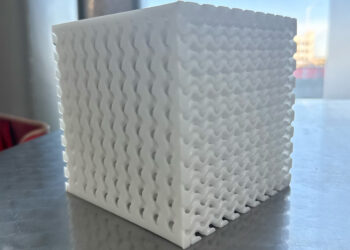
Kira Baugh, a doctoral student at Virginia Tech, received both the judges’ award and the audience choice award for research on converting waste PET into aerogel insulation materials.
In presenting her research, Baugh explained that the process dissolves PET flakes and converts them into a lightweight insulating material with strong mechanical performance and low thermal conductivity. “We figured out that there’s a really, really simple way to take waste PET and turn it into these high-performance materials,” she said.
APR Chief Operating Officer Curt Cozart then presented the organization’s second annual Recycling Leadership Awards. The outstanding leadership category included recognition for CalRecycle Director Zoe Heller and her agency’s work implementing California’s extended producer responsibility program for packaging, known as SB 54.
“We have 900 mission-driven, dedicated staff that work on recycling policy every single day,” Heller said. “We strive to build policy that’s data driven, collaborative and transparent.”
Another leadership award went to Ed Socci, director of R&D at PepsiCo, for work advancing recyclable packaging design principles. Socci credited colleagues and recyclers across the industry. “There are many colleagues in this room that are so deserving of this award,” Socci said. “Many forget more about plastics recycling than I will ever know.”
In the processor of the year category, Blue Mountain Plastics Recycling was recognized for processing large volumes of PET thermoforms and producing recycled PET used in beverage bottles.
Crystal Howe, vice president of sustainability and government relations at PET bottling company Ice River Sustainable Solutions, a sister company to Blue Mountain, accepted the award, saying the recycling sector’s ability to innovate depends heavily on end market demand. “In the last year we’ve seen so many closures, and we need to draw attention to the fact that the reason we’re able to innovate is because we have secure end markets for our material,” Howe said.
The awards also recognized packaging design improvements by Yum Brands’ Pizza Hut for a redesigned polypropylene bowl for chicken wings and a recycled content packaging project by Charter Next Generation and Scotts Miracle-Gro.
Closing the session, APR President and CEO Steve Alexander told attendees that technical progress in recycling continues despite economic pressures affecting the market. “This is why recycling works,” Alexander said. “Recycling works because of people like this and the commitment that they made.”
Alexander said the conference’s turnout reinforced his view that the industry remains committed to solving sustainability challenges surrounding plastics. “I was very worried about this conference and whether or not there’d be interest in these tough market conditions,” he said. “You have shown up, and you have reinforced my belief that we will solve this problem.”