





Advertisement Header Ad
Resource Recycling
  • The Latest
  • Analysis
    • All
    • Certification Scorecard
    • Industry Announcements
    • Opinion

    Certification scorecard for December 10, 2025

    Industry Announcements for Week of December 8

    Certification Scorecard for December 3, 2025

    Industry Announcements for Week of December 1

    News from Dynamic Lifecycle Innovations, Precision E-Cycle

    News from Northeast Recycling Council, Plastipak and more

    News from Northeast Recycling Council, Sortera Technologies and more

    News from MKV Polymers, Metallium Ltd. and more

    Certification Scorecard for November 19, 2025

  • Conferences
  • Publications

    Other Topics

    Textiles
    Organics
    Packaging
    Glass
    Brand Owners

    Metals
    Technology
    Research
    Markets
    Grant Watch

    All Topics

Subscribe
No Result
View All Result
Resource Recycling
  • The Latest
  • Analysis
    • All
    • Certification Scorecard
    • Industry Announcements
    • Opinion

    Certification scorecard for December 10, 2025

    Industry Announcements for Week of December 8

    Certification Scorecard for December 3, 2025

    Industry Announcements for Week of December 1

    News from Dynamic Lifecycle Innovations, Precision E-Cycle

    News from Northeast Recycling Council, Plastipak and more

    News from Northeast Recycling Council, Sortera Technologies and more

    News from MKV Polymers, Metallium Ltd. and more

    Certification Scorecard for November 19, 2025

  • Conferences
  • Publications

    Other Topics

    Textiles
    Organics
    Packaging
    Glass
    Brand Owners

    Metals
    Technology
    Research
    Markets
    Grant Watch

    All Topics

Subscribe
No Result
View All Result
Resource Recycling
No Result
View All Result
Home E-Scrap

Report: Flame retardants tough to remove from skin

byJared Paben
December 20, 2018
in E-Scrap
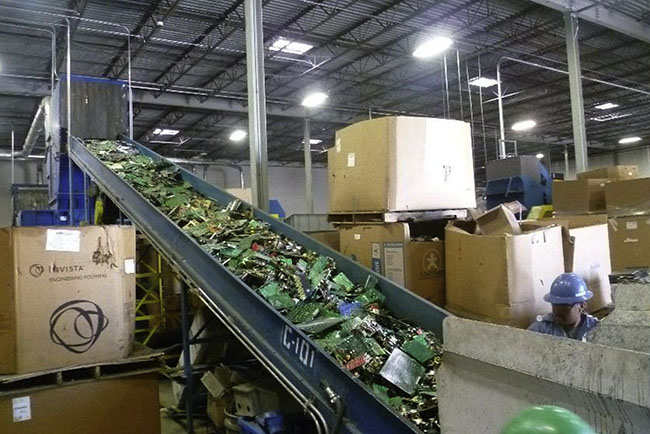
Materials and workers at an e-scrap facility.
Share on XLinkedin

Results of a new study suggest e-scrap workers must wipe their hands multiple times at the end of their shifts to remove toxic flame retardants.

The study was conducted by scientists at the National Institute for Occupational Safety and Health (NIOSH), Harvard T.H. Chan School of Public Health and the College of William & Mary. The resulting paper, titled “Field evaluation of sequential hand wipes for flame retardant exposure in an electronics recycling facility,” is slated to be published in the journal Chemosphere in March.

The study was conducted at an unnamed U.S. e-scrap facility that has both a manual disassembly department and a shredding and separation operation. Researchers tested isopropyl alcohol-soaked gauze and twill hand wipes used by 12 workers. The staff members wiped their hands three times sequentially before washing their hands at the end of the work day.

Broadly speaking, the study showed that while the first wiping generally removed the highest percentage of flame retardants on their hands, a large percentage – half or more – remained to be removed in subsequent wipings.

Even after the third wipe, some of the chemicals may remain on the skin. In particular, types of flame retardants that tend to combine with or dissolve in oils and fats required more passes to remove. That indicates several wipes may be needed to break down natural skin oils to remove the flame retardants. The researchers couldn’t definitively identify gauze or twill as the more effective material.

Some of the workers had worn gloves during their work shift, but researchers measured a lot of dust on their hands anyway.
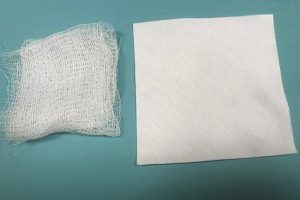
Wipes used in research study.“This work is most interesting because all the dust we found on these workers’ hands was on a fairly small e-recycling facility with a small shredder,” said Diana Ceballos of the Harvard Chan School of Public Health. Ceballos was a co-author of the study. “[It provides] good motivation for firms to reduce shredding as much as possible and focus on the great refurbishing efforts happening nationwide, and to minimize shredding of plastics and other materials that are known to contain flame retardants.”

Harvard on Dec. 18 posted a news item about the research.

While much remains unknown about the human health impacts of flame retardants, studies point to a link between them and reproductive problems, low birth weight and length, delayed motor skills and decreased IQ. Different types of flame retardants have been, and continue to be, used throughout electronics components.

E-Scrap News has written about other recent studies exploring e-scrap workers’ flame retardant exposure. In one, Indiana University researchers examined a previously undetected flame retardant chemical in dust at an Ontario, Canada e-scrap facility. In another, NIOSH researchers studied exposure at an Ohio e-scrap facility and found flame retardants in workers’ urine and blood.

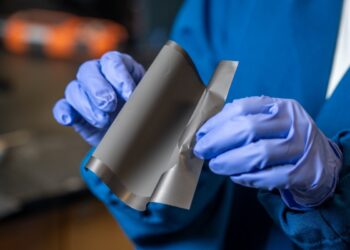
Photos from study.
 

Tags: Research
Jared Paben

Jared Paben

Related Posts

Chemical bonds

Alberta catalyst discovery targets hydrogen and plastics

byScott Snowden
December 10, 2025

A chance discovery inside a University of Alberta laboratory has developed into a Canadian cleantech project that aims to reshape...

Global recycling patent trends may reflect legislative push

Global recycling patent trends may reflect legislative push

byAntoinette Smith
November 25, 2025

Patent applications for chemical recycling technologies have reached a record high globally with government initiatives among the factors driving innovation,...

Study maps barriers to firms’ supply chain climate goals

byAntoinette Smith
October 14, 2025

Publicly articulating clear sustainability goals helps ensure company follow-through, according to an annual supply chain study from the Massachusetts Institute...

US recycles 13.3% of packaging, Plastic Pact estimates

New report explores the future of CPG packaging goals

byAntoinette Smith
July 23, 2025

A new report from RaboResearch explores the factors behind brand owners' retreat from 2025 packaging recycled content goals – and...

Project brings rare earth recovery into e-scrap facility

Project brings rare earth recovery into e-scrap facility

byColin Staub
July 10, 2025

A pilot project is demonstrating a bolt-on modular system that could make it logistically and economically feasible for e-scrap processors...

RIT researchers develop AI-based textile recycling system

RIT researchers develop AI-based textile recycling system

byAndrew Hawthorne
July 2, 2025

Researchers at the Rochester Institute of Technology are developing a high-speed automated system to disassemble and recycle clothing.

Load More
Next Post
Aerial view of Schupan's electronics recycling facility.

Michigan processor invests in HQ improvements

More Posts

Analysis: EU softens ESG rules as compliance pressure builds for US

Analysis: EU softens ESG rules as compliance pressure builds for US

November 19, 2025
Sector holds wide gaps in environmental standards

Sector holds wide gaps in environmental standards

November 19, 2025
From crawl to run: a clear roadmap for ITAD ESG

From crawl to run: a clear roadmap for ITAD ESG

November 19, 2025
New entrepreneurs bring renewed energy to e-cycling

New entrepreneurs bring renewed energy to e-cycling

November 19, 2025
The Re:Source Podcast Episode 1: E-Scrap look-back and 2026 outlook

The Re:Source Podcast Episode 1: E-Scrap look-back and 2026 outlook

November 21, 2025
ERI and ReElement partner on rare earth magnet recovery

ERI and ReElement partner on rare earth magnet recovery

November 26, 2025
Cyber risks confront ITAD work, contracts, coverage

Cyber risks confront ITAD work, contracts, coverage

November 26, 2025
Canadian PROs join forces to align design guidance

Canadian PROs join forces to align design guidance

November 17, 2025
Weak bale pricing compounds hauler headwinds

Weak bale pricing compounds hauler headwinds

November 18, 2025
Paper grades, plastic film bales soften 

Paper grades, plastic film bales soften 

November 18, 2025
Load More

About & Publications

About Us

Staff

Archive

Magazine

Work With Us

Advertise
Jobs
Contact
Terms and Privacy

Newsletter

Get the latest recycling news and analysis delivered to your inbox every week. Stay ahead on industry trends, policy updates, and insights from programs, processors, and innovators.

Subscribe

Welcome Back!

Login to your account below

Forgotten Password?

Retrieve your password

Please enter your username or email address to reset your password.

Log In

Add New Playlist

No Result
View All Result
  • The Latest
  • Analysis
  • Recycling
  • E-Scrap
  • Plastics
  • Conferences
    • E-Scrap Conference
    • Plastics Recycling Conference
    • Resource Recycling Conference
    • Textiles Recovery Summit
  • Magazine
  • About Us
  • Advertise
  • Archive
  • Jobs
  • Staff
Subscribe
This website uses cookies. By continuing to use this website you are giving consent to cookies being used. Visit our Privacy and Cookie Policy.