




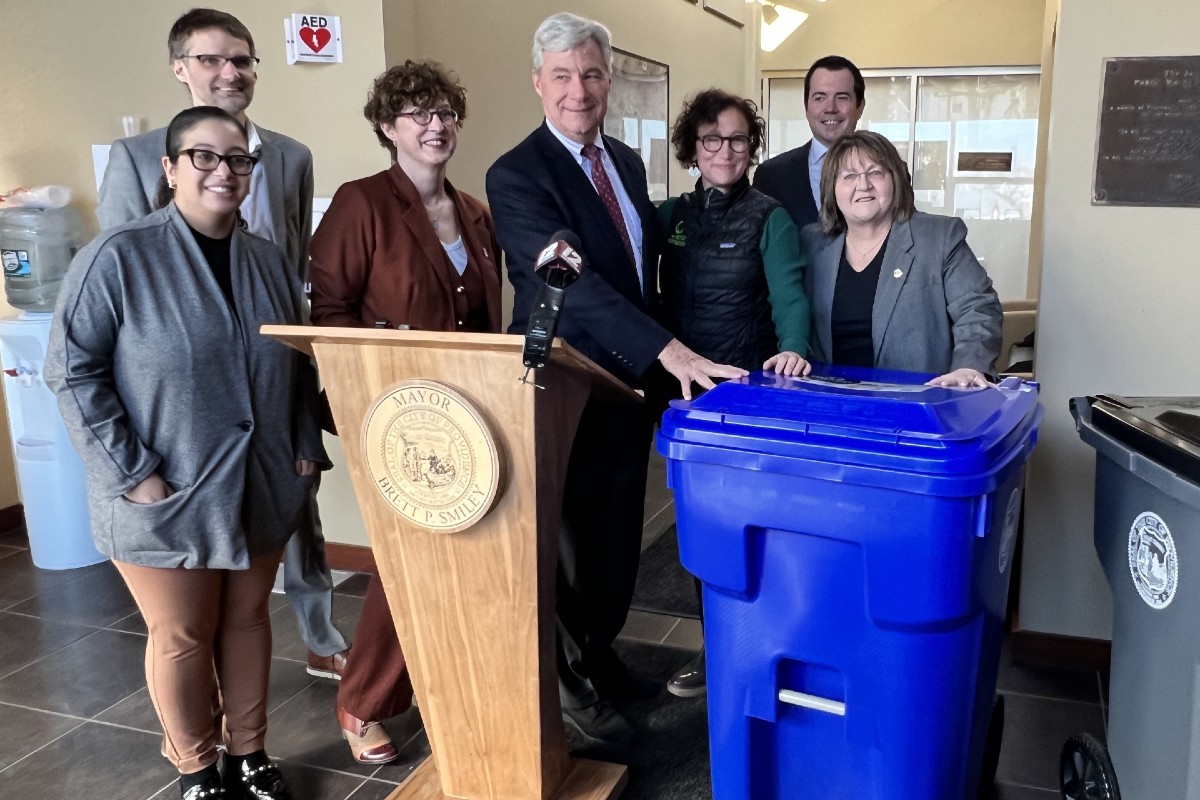
Providence, Rhode Island is getting a $7.4 million overhaul in its waste and recycling systems, with the goal of boosting its low recycling rate.
Specifically, the city is providing approximately 55,000 new, standardized trash and recycling collection carts to residents, starting this month. Delivery is expected to be completed by early summer. The project is a partnership between the city and several organizations, including The Recycling Partnership, American Beverage Association, and Closed Loop Partners, combined with funding from the US Environmental Protection Agency’s SWIFR grant program.
The cart rollout presents a key opportunity for behavior change, said Zoë Killian, grant development manager with The Recycling Partnership. “When residents receive new carts, they are more likely to pay attention to new information and reset old habits,” Killian said. “The city is building on that moment through its New Carts, New Start education campaign, using outreach to reinforce what belongs in recycling and why clean recycling matters.”
“Since the start of my Administration, we have focused on making Providence cleaner, greener and more efficient,” said Mayor Brett Smiley in a statement. “That’s why we are investing in new trash and recycling carts, along with education and enforcement strategies to change behavior and get the city’s recycling program back on track.”
Providence’s recycling rate is currently just 2.4%, according to the Rhode Island Resource Recovery Corporation (RIRRC), making it the lowest in the state and well below the national average. In 2024, RIRRC reported an average recycling rate of 27.6% for materials processed at Rhode Island’s MRF.
Providence’s new carts will replace aging, damaged, and mismatched carts, said Killian. “Because trash carts have not been replaced citywide since 2013, many households currently use carts in different sizes, colors, and labeling formats.”
Not only does the lack of standardization cause confusion, but lack of cart capacity often leads to trash being dumped in the recycling bins. Providence’s current contamination rate is over 47%, resulting in over 8,000 tons of materials intended for recycling being rejected and sent to landfills annually. That equates to approximately 288 pounds of valuable materials lost per household.
Each household will receive two standardized carts: a 95-gallon gray trash cart with a black lid, and a 95-gallon blue recycling cart with a blue lid. “Each cart will include an educational in-mold label on the lid that clearly shows what belongs inside, giving residents the information they need to sort materials correctly,” said Killian.
Changing behavior
The new carts are just the beginning in a program relaunch. “Transforming a system that has been underperforming for years takes more than new carts – it requires deep coordination, shared commitment, and the right partners working toward the same goal,” Killian said.
All new recycling carts come with an information packet that includes an info card, welcome letter, and answers to frequently asked questions. Providence also aims to work with its waste hauler (WM) on education and enforcement down to the building level. The city has planned in-person public education with a community-based nonprofit (Zero Waste Providence), including the use of targeted cart tags to give direct feedback along contaminated routes. Local media and radio ads are planned, as well as a citywide print and mail educational campaign.
The city hopes the new carts will begin reducing the nearly $2 million a year Providence loses because of contaminated recyclables. “When a recycling cart is contaminated with bags of trash, food, loose plastic bags, clothing, scrap metal, small appliances, or other nonrecyclable items, the entire recycling truck’s load may be rejected by the state’s recycling facility and dumped in the landfill instead,” the city writes on its website. “This costs taxpayers money since recycling is processed for free, while the city is charged for landfill-bound waste.”
Providence estimates the new carts will cost up to $7,363,750. The investment is covered by grants and low-interest financing through the project’s partners and should help Providence save money over time, the city notes.
New carts matter, Killian added. “Our data from working with thousands of communities across the US shows that when communities invest in cart-based recycling service, it can significantly expand residential recycling capacity and improve recovery of recyclable material.”