Resource Recycling
  • The Latest
  • Analysis
    • All
    • Certification Scorecard
    • Industry Announcements
    • Opinion
    Apple Watch on product box.

    Wearables are coming and ITAD isn’t ready

    Certification Scorecard — Week of April 13, 2026

    EV Battery Pack - Sergii Chernov-Shutterstock

    Redwood, Rivian deal fuels US infrastructure plans

    Bloom ESG and e-Stewards roll out critical metals metric

    Colorado regulators suggest mid-range EPR scenario

    Why collaboration on plastic waste still matters

    Battery recycler Ascend Elements files for bankruptcy

    Battery recycler Ascend Elements files for bankruptcy

    EPR fees are a market signal. Here’s what they’re telling you.

    EPR fees are a market signal. Here’s what they’re telling you.

    Wolframite ore, the primary ore of tungsten from Altai, Russia

    Tungsten scrap export controls draw industry attention

    Certification Scorecard — Week of April 6, 2026

  • Conferences
  • Publications

    Other Topics

    Textiles
    Organics
    Packaging
    Glass
    Brand Owners

    Metals
    Technology
    Research
    Markets
    Grant Watch

    All Topics

Subscribe
No Result
View All Result
Resource Recycling
  • The Latest
  • Analysis
    • All
    • Certification Scorecard
    • Industry Announcements
    • Opinion
    Apple Watch on product box.

    Wearables are coming and ITAD isn’t ready

    Certification Scorecard — Week of April 13, 2026

    EV Battery Pack - Sergii Chernov-Shutterstock

    Redwood, Rivian deal fuels US infrastructure plans

    Bloom ESG and e-Stewards roll out critical metals metric

    Colorado regulators suggest mid-range EPR scenario

    Why collaboration on plastic waste still matters

    Battery recycler Ascend Elements files for bankruptcy

    Battery recycler Ascend Elements files for bankruptcy

    EPR fees are a market signal. Here’s what they’re telling you.

    EPR fees are a market signal. Here’s what they’re telling you.

    Wolframite ore, the primary ore of tungsten from Altai, Russia

    Tungsten scrap export controls draw industry attention

    Certification Scorecard — Week of April 6, 2026

  • Conferences
  • Publications

    Other Topics

    Textiles
    Organics
    Packaging
    Glass
    Brand Owners

    Metals
    Technology
    Research
    Markets
    Grant Watch

    All Topics

Subscribe
No Result
View All Result
Resource Recycling
No Result
View All Result
Home Recycling

Panelists: Textile recycling requires more automation

Brian Clark HowardbyBrian Clark Howard
March 3, 2026
in Recycling
Panelists: Textile recycling requires more automation

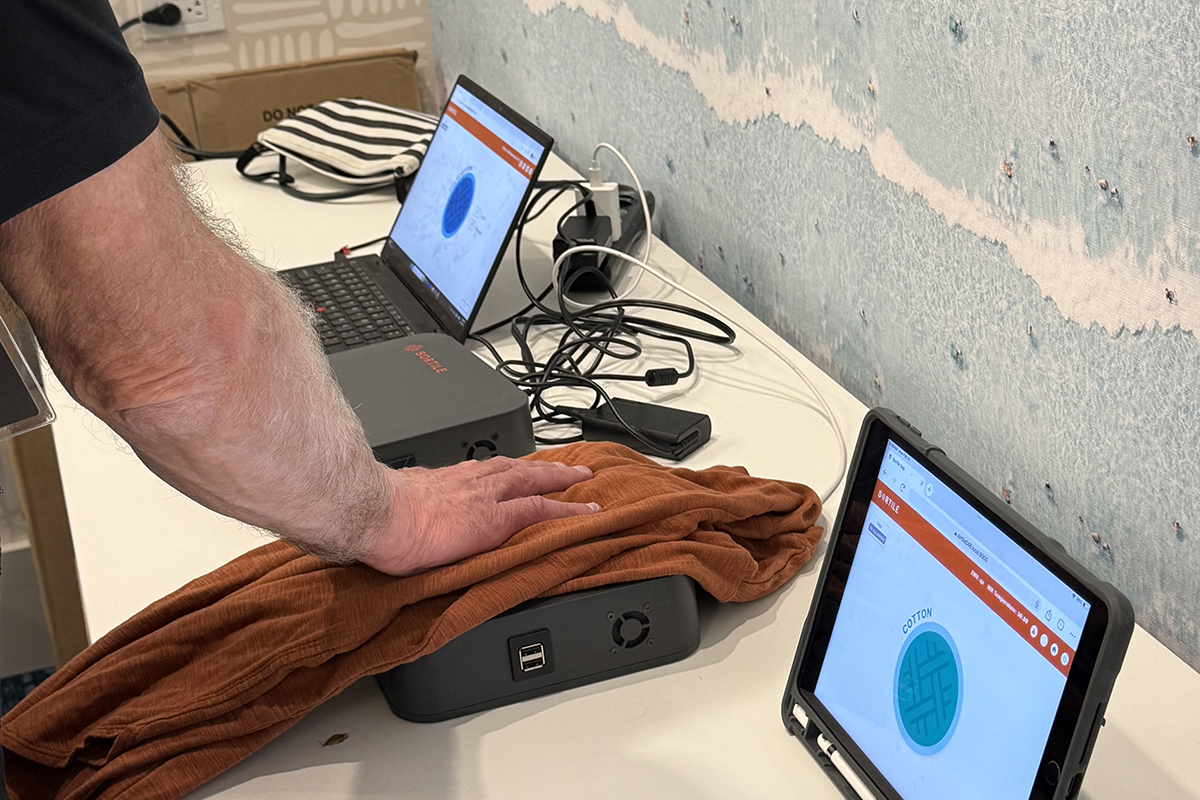
A participant at the 2026 Textile Recovery Summit scans clothing using the Sortile system. | Brian Clark Howard / Resource Recycling, Inc.

Recycling and reusing clothing presents unique challenges, as well as opportunities, according to industry experts during a textile sorting workshop at the 2026 Textile Recovery Summit in San Diego. Chief among the challenges is how much to automate the processes of sorting and grading the used clothes.

“Automation is definitely going to be needed going forward,” said Constanza Gómez, CEO and co-founder of Sortile, a technology company helping the textile industry better understand what blends of fibers are in fabrics. 

In order for clothing reuse and recycling to scale up, she said, “you need to figure out where automation makes sense and where it doesn’t.”

Gómez gave the example of a pile of uniforms, in which processors don’t need to test every one if they are all the same.

Gómez and the other panelists underscored the scope of the challenge. They pointed to the most recent data from the US EPA that found about 17 million tons of textiles were made in 2018 nationally, with a textile recycling rate of 14.7% (2.5 million tons). 

The 11.3 million tons of textiles sent to landfills in 2018 represented 7.7% of all material landfilled. But, according to estimates from the New York Department of Environmental Conservation, about 95% of textiles can be recycled or reused. So there is room for the reuse and recycling industry to grow, the panelists said.

A shifting industry

Beth Forsberg, senior vice president and chief sustainability officer for Goodwill of Central and Northern Arizona, said the process of clothing recycling begins with the key step of sorting, which is “a lot more complicated than what meets the eye.”

The clothing reuse and recycling industry has seen big shifts over the past half century or so, said Brian London, SMART president, the international trade association representing the for-profit textile reuse and recycling industry. 

For example, in the years after World War II, used clothing was sorted in the US, and much of it found its way into roofing and insulation applications. But as volumes increased over time, the domestic industry was overwhelmed. Much of the sorting shifted to lower-wage countries, particularly in South Asia and Central America. Markets also became increasingly international.

“People think if you give clothing to Goodwill it is going to be given to people who need clothing down the street,” London said. “But it got more complicated than that.” He added that “used clothing is unique. It can’t easily be automated.”

Some of the challenges include sorting by condition as well as for styles and for the right climate, the latter of which are factors that vary widely by region and culture. “Machines can’t capture that well,” London said.

Daniya Haji, president of Paragon Textiles, a Los Angeles-based textile recycling and secondhand apparel company operating Samiyatex and LA Vintage, said her firm’s job is to receive mixed textiles and sort them. “We want to make sure that every piece finds a home,” she said.

The first priority, said Haji, is to divert the garments to reuse, first locally, then internationally. An estimated 70% of the world wears used clothing, London noted. Next, items are selected for upcycling into something else, such as wiping rags for the automotive, mining, and hospitality industries. Finally, they are sent for recycling. “We send broken cashmere to Italy, where it gets reused to make new cashmere,” Haji said. Other items can be sent to chemical recyclers, which break down the fibers into their chemical building blocks for reuse.

Automated sorting

Two panelists represented emerging technologies that can help automate sorting – Gómez of Sortile and Rebecca Geppert, partnerships director for Refiberd, a California-based startup working on software solutions to enable circularity within the textiles industry.

Refiberd uses a hyperspectral, or infrared, camera and a proprietary algorithm to determine the fiber composition of a piece of clothing within 2% accuracy, said Geppert. Recyclers can use the device to speed up sorting operations versus relying on human eyes.

Sortile uses near-infrared (NIR) technology in a tabletop device to also determine the composition of clothing. Many customers use it for quality control at their facilities, said Gómez.

Geppert noted that her company is also working on a video-based technology to further aid sorting. 

“Material composition for recycling is king,” said Geppert. “Many are blended textiles, so it’s really important to have technology that can identify the elements in that fabric. It helps streamline and standardize the process.”

The two companies’ technologies help plant operators identify impurities in the materials they are working with, which can gum up equipment and cause it to fail. “In an industry that is fighting tooth and nail with the cost of virgin materials that is really important,” said Gómez.

She noted that her company has seen that content labels on garments are inaccurate more than 40% of the time, often confounding recyclers. Plus, many garments are made of multiple materials.

Automated sorting isn’t perfect when it comes to these challenges, but it can play a role in improving facility efficiency, said the panelists. And rapid advances in artificial intelligence hold further promise for the near future.

“As the recycling industry becomes more robust, having a better sense of the data is going to become important,” said Geppert.


Tags: Industry GroupsTextiles
TweetShare
Brian Clark Howard

Brian Clark Howard

Brian Clark Howard is an award-winning journalist with 25 years of experience. He is the co-author of several books and previously served as an editor and writer at The Hill, National Geographic, The Daily Green, E/The Environmental Magazine and The Daily Mail. He has covered a wide range of topics, from the environment to politics.

Related Posts

Recycling Partnership CEO stepping down

byStefanie Valentic
April 15, 2026

Outgoing CEO Keefe Harrison will remain until August with the organization she built from the ground up.

NERC launches hub to promote PCR demand 

byAntoinette Smith
April 15, 2026

The Northeast Recycling Council's PCR Material Demand Hub offers resources for government procurement, material- and product-specific resources, and certification and...

Reverse Logistics Network launches to support industry

byPaul Lane
April 14, 2026

The reverse logistics community has a new organization to give companies in that sector a place to connect.

Colorado regulators suggest mid-range EPR scenario

Why collaboration on plastic waste still matters

byCrystal Bayliss
April 13, 2026

Six years ago, the U.S. Plastics Pact launched at a moment of rising concern about plastic waste and growing momentum...

Industrial sources drive rise in PVC recycling

byAntoinette Smith
April 13, 2026

Volumes of post-industrial PVC recycled in 2024 rose by 10% from 2019 levels, while post-consumer sources fell and missed a...

End markets, policy key to RPET viability

End markets, policy key to RPET viability

byAntoinette Smith
April 8, 2026

Longer-term actions support domestic RPET markets and can help prevent the loss of public trust in recycling systems, industry experts...

Load More
Next Post

Mint, HP close loop on recycled copper

Leading the Charge in Safe Battery Recycling
Sponsored

Leading the Charge in Safe Battery Recycling

byThe Battery Network
April 13, 2026

We’re connecting people, brands, and communities through one nationwide network built to make battery recycling safer, simpler, and more accessible...

Read moreDetails

More Posts

Recycling Partnership CEO stepping down

April 15, 2026
Battery recycler Ascend Elements files for bankruptcy

Battery recycler Ascend Elements files for bankruptcy

April 13, 2026
EPR fees are a market signal. Here’s what they’re telling you.

EPR fees are a market signal. Here’s what they’re telling you.

April 10, 2026
Industry group: Help us find the plastic bale volumes we need

PET bales sink further as other grades firm 

April 15, 2026

WM opens new $60m MRF in Indy

April 10, 2026

GFL acquires SECURE Waste for $6.4bn

April 13, 2026

Bloom ESG and e-Stewards roll out critical metals metric

April 15, 2026
Colorado regulators suggest mid-range EPR scenario

Why collaboration on plastic waste still matters

April 13, 2026
Solarcycle starts up Georgia recycling plant

S3399 signals a shift in how states are tackling solar panel waste

April 6, 2026

Matium raises $8m, adds buyer financing

April 14, 2026
Load More

About & Publications

About Us

Staff

Archive

Magazine

Work With Us

Advertise
Jobs
Contact
Terms and Privacy

Newsletter

Get the latest recycling news and analysis delivered to your inbox every week. Stay ahead on industry trends, policy updates, and insights from programs, processors, and innovators.

Subscribe

Welcome Back!

Login to your account below

Forgotten Password?

Retrieve your password

Please enter your username or email address to reset your password.

Log In

Add New Playlist

No Result
View All Result
  • The Latest
  • Analysis
  • Recycling
  • E-Scrap
  • Plastics
  • Policy Now
  • Conferences
    • E-Scrap Conference
    • Plastics Recycling Conference
    • Resource Recycling Conference
    • Textiles Recovery Summit
  • Magazine
  • About Us
  • Advertise
  • Archive
  • Jobs
  • Staff
Subscribe
This website uses cookies. By continuing to use this website you are giving consent to cookies being used. Visit our Privacy and Cookie Policy.